Arm numbness, cold hands, stiff shoulders?
Thoracic Outlet Syndrome — Nerves and blood vessels compressed between neck and shoulder.
Easy to mistake for cervical disc, but if MRI shows no disc problem, suspect thoracic outlet syndrome. Particularly common in those with prolonged computer work or frequent overhead arm use.
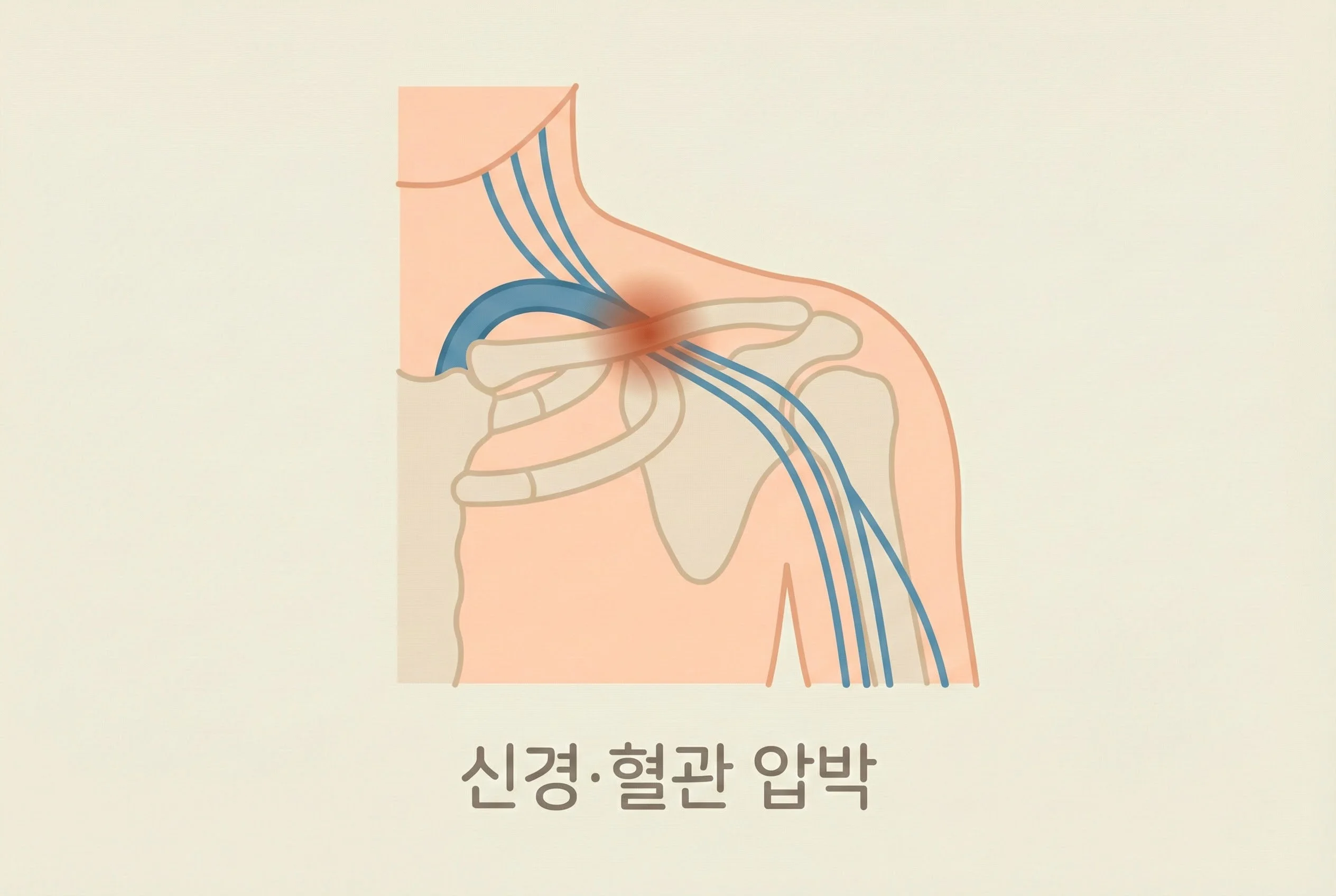
Quick Answer: Thoracic outlet syndrome occurs when nerves (brachial plexus) and blood vessels are compressed in the narrow space between neck and shoulder, causing arm numbness, cold hands, and shoulder stiffness. Symptoms similar to cervical disc, so important to evaluate posture, muscle tension, and triggering movements together.
Seek medical attention quickly if:
- Hand weakness or decreased sensation progressing
- Hand becomes cold, pale, or bluish repeatedly
- Chest pain, shortness of breath, or fainting accompanies
- Symptoms rapidly worsen after trauma
3 Key Points on This Page
- What thoracic outlet syndrome is and why it occurs
- How it differs from cervical disc
- Why muscle relaxation and posture correction help
These symptoms suggest thoracic outlet syndrome
- Arm or hand numbness or cold — Especially numbness extending toward pinky finger or inner arm.
- Stiffness between shoulder and neck — Above collarbone, trapezius area feels heavy and stiff.
- Symptoms worsen lifting arm overhead — Numbness intensifies when raising arm overhead or holding it up.
- Feeling of weakness in hand — Frequently dropping objects or fine work difficult.
- Hand becomes pale or cold — In vascular type, hand color changes or feels cold.
- Worsens during computer work — Symptoms intensify with prolonged sitting and working.
What is Thoracic Outlet Syndrome?
Nerves and blood vessels from neck to arm pass through 3 narrow passages:
- Scalene triangle — Between scalene muscles (anterior, middle) on side of neck
- Costoclavicular space — Between collarbone and first rib
- Under pectoralis minor — Below pectoralis minor at front of chest
When even one of these passages narrows, nerves or blood vessels get compressed causing arm numbness, pain, and cold feeling.
Why Does It Narrow?
- Scalene tension — Stress, breathing pattern issues, forward head posture
- Pectoralis minor shortening — Shoulders roll forward from rounded shoulders
- Scapula descent — Habit of carrying heavy bag on one side
- Repetitive arm use — Occupations using arms overhead (hairdressers, painters, etc.)
How does it differ from cervical disc?
Arm numbness symptoms are similar, but causes and symptom patterns differ:
Cervical Disc
- Worsens when tilting neck backward
- Radiating pain starting from neck
- Follows specific nerve distribution
- MRI confirms disc protrusion
- Changes with neck movement
Thoracic Outlet Syndrome
- Worsens when lifting arm overhead
- Symptoms throughout shoulder-arm-hand
- Especially numbness toward pinky finger
- Often normal MRI
- Changes with posture or compression
Important: Cervical disc and thoracic outlet syndrome can coexist. Accurate differential diagnosis requires appropriate treatment for each.
Our Approach at Yonsei Shinmyung
Thoracic outlet syndrome rarely requires surgery. Most improve by relaxing muscles and securing space.
- Phase 1: Downshift (Circulation HD)
Release trigger points in muscles causing compression like scalenes and pectoralis minor. Hydrodissection resolves adhesions around nerves. - Phase 2: Activate (Circulation PT)
Strengthen weakened lower trapezius and serratus anterior to stabilize scapula. Restore diaphragmatic breathing to reduce scalene burden. - Phase 3: Integrate
Correct posture like rounded shoulders and forward head, learn habits to reduce compression in daily life.
Simple Self-Test
If symptoms appear in these movements, thoracic outlet syndrome can be suspected:
EAST Test (Elevated Arm Stress)
① Raise both arms in ‘hooray’ position (90 degree bend)
② Open and close hands repeatedly for 3 minutes
③ Arm numbness or fatigue within 3 minutes → Positive
Adson Test
① With arm extended sideways
② Turn head toward painful side and look up
③ Take deep breath in
④ Wrist pulse weakens or numbness → Positive
Note: These tests are for screening purposes. Accurate diagnosis requires comprehensive physical examination by specialist and vascular ultrasound or nerve conduction study when needed.
Frequently Asked Questions
How to distinguish from cervical disc?
Thoracic outlet syndrome may be more triggered by specific postures (shoulder rolling, arm lifting). We look at triggering movements and muscle tension patterns together, not just imaging findings. Arm Numbness Q&A →
Does numbness location in fingers matter?
Numbness location helps estimate cause but can’t determine with one factor alone. Check numbness area with posture and work environment together. Finger Numbness Q&A →
Does cause differ by numbness location?
Suspected area may differ by numbness distribution like palm/back of hand, thumb side/pinky side. Examination and evaluation needed for accurate judgment. Numbness Location Q&A →
More numb during computer work. Why?
Prolonged posture with shoulders rolling forward and neck protruding can further narrow nerve/blood vessel passages. Adjusting work environment and moving intermittently helps. Keyboard/Mouse Prevention Q&A →
Can numbness occur even with normal MRI?
Even without major abnormalities on imaging, functional issues like fascial tension and nerve sensitivity can create symptoms. Symptom and triggering movement evaluation may be more important in these cases. Normal MRI Pain Q&A →
What order does treatment proceed?
First calm overtense neck/shoulder muscles (Downshift), restore scapula, breathing, and posture function (Activate), and prevent recurrence in daily movements (Integrate). Circulation Therapy Introduction →
Better then numb again, why?
If same postures repeat in daily life, nerve passages can narrow again. Important to change patterns causing recurrence along with pain control. Recurrence Q&A →
How does it differ from carpal tunnel?
Carpal tunnel often involves median nerve compression at wrist, while thoracic outlet syndrome involves compression between neck and shoulder. Numbness distribution and triggering movements are clues. Carpal Tunnel Syndrome Page →
Related Articles
MRI normal but arm keeps going numb?
We accurately evaluate if thoracic outlet syndrome and release compressed nerves and blood vessels.
Book Online