Pain that starts in the buttock and shoots all the way down to the toes
Sciatica. Pain that spreads into the leg when the sciatic nerve is compressed or irritated.
Every cough or sneeze feels like electricity running down your leg. The longer you sit, the worse it gets, and one entire leg feels numb or tight. This pain follows a nerve pathway, not the lower back itself.
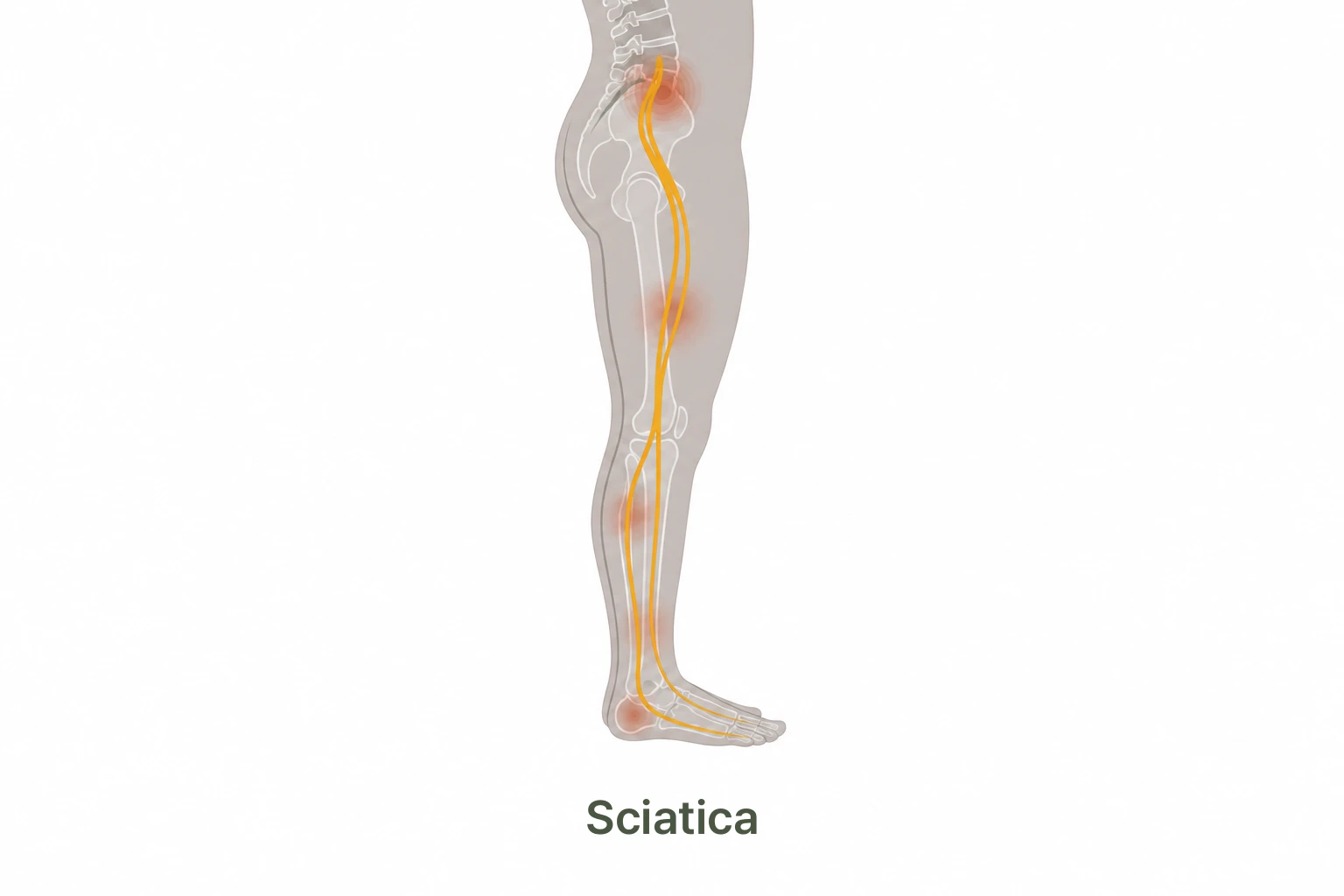
Quick answer: The sciatic nerve is the longest nerve in the body, beginning in the lower back and running through the buttock, thigh, and calf all the way to the toes. When this nerve is compressed or irritated anywhere along its course, pain, numbness, and pulling appear along the entire pathway. The main causes are disc herniation, stenosis, and piriformis tightness. When the nervous system is highly sensitive, even mild compression can trigger strong symptoms.
See a doctor promptly if you notice these signs
- Bladder or bowel dysfunction (unable to urinate, or incontinence)
- Symptoms appearing in both legs at the same time
- Sudden weakness in the foot or toes
The 3 key things this page explains
- What sciatica is and why numbness reaches all the way down the leg
- How to tell where the nerve is being pinched, such as disc, stenosis, or piriformis
- The Circulation Therapy approach to managing sciatica
These symptoms may point to sciatica
- The buttock and the back of the leg hurt and tingle more than the lower back itself, with the pain running down into the leg.
- Coughing, sneezing, or straining raises abdominal pressure, and a sudden sharp pain shoots down the leg.
- Symptoms usually follow just one leg.
- The longer you sit, the more pressure builds on the nerve and the worse the numbness gets.
- The numb feeling reaches past the calf all the way to the foot and toes.
What causes sciatica
Sciatica is not the name of a specific disease. It is a symptom pattern that appears along the path of the sciatic nerve. The cause varies depending on where the nerve is compressed or irritated.
- Lumbar disc herniation. The most common cause. A protruding disc compresses the sciatic nerve in the lower back.
- Spinal stenosis. The narrowed spinal canal pinches the nerve.
- Piriformis tightness. The piriformis muscle, deep in the pelvis, directly compresses the sciatic nerve.
Why sensitivity matters as much as compression
Even when a nerve is compressed, symptoms can be minimal if the nervous system’s sensitivity is low. Conversely, when the nervous system becomes oversensitive from stress, poor sleep, or past pain, even slight compression can produce strong pain.
So along with relieving the compression, we also need to bring down the nervous system’s sensitivity.
What’s causing the sciatica? How do you tell?
Sciatica is a symptom, not a diagnosis. The cause determines the treatment, so understanding where the sciatic nerve is being compressed is essential.
Sciatica from Lumbar Disc Herniation
- Low back pain plus pain or tingling radiating down the leg
- Coughing, sneezing, or straining intensifies leg symptoms
- Bending forward worsens leg symptoms
- Disc protrusion confirmed on MRI
Sciatica from Piriformis Syndrome
- Deep buttock pain is more prominent than back pain
- Sitting worsens symptoms, especially on hard surfaces
- Lumbar MRI is unremarkable
- Pressure on the piriformis reproduces the pain
Spinal stenosis can also mimic sciatica. If your legs grow heavy and numb the longer you walk, and the discomfort eases when you sit or lean forward, stenosis is more likely. Whatever the root cause, identifying it precisely leads to more effective and targeted treatment.
The causes listed here all come down to a compressed nerve.
Only the site of compression differs, so the symptoms overlap.
What changes when the area is pressed and moved is the firmer clue, and the final call is made in the consultation.
How we approach it at Yonsei SM
With sciatica, the key is to pinpoint exactly where the nerve is compressed and improve the environment around it.
- Phase 1: Calm
We settle the tension and inflammation around the nerve. Circulation HD (an injection procedure) opens up the space around the compressed nerve and restores nerve glide. We lower the nervous system’s sensitivity to stabilize the over-reactive state. - Phase 2: Wake (Circulation PT)
Sciatic nerve gliding exercises restore the nerve’s flexibility. Strengthening the gluteal muscles and core spreads out the repetitive load placed on the nerve. - Phase 3: Make it stick
We correct your sitting posture and walking pattern. Gait analysis finds the movement patterns that strain the nerve as you walk, so you can correct them in daily life.
Frequently Asked Questions
Are sciatica and a lumbar disc the same thing?
Sciatica is the way we describe a symptom, “pain and numbness running down the leg,” while disc herniation is one of its causes. Piriformis tightness or stenosis can produce the same symptoms. Lumbar Disc →
Does leg numbness always mean sciatica?
Leg numbness can have many causes beyond the sciatic nerve, including peripheral nerve or vascular problems. We identify the cause by assessing where the numbness appears and how it changes with movement. Leg Numbness Q&A →
Why does it hurt more when I sit for a long time?
Sitting stretches the piriformis and raises the pressure on the lumbar disc, irritating the sciatic nerve more strongly. Standing up and moving once every 30 minutes helps. Sitting Pain Q&A →
Can sciatica heal on its own?
Mild cases sometimes improve over time. But if symptoms last more than three months or keep getting worse, active assessment and treatment are needed. Treatment Duration Q&A →
Can I exercise during treatment?
Walking and stretching within a range that doesn’t worsen the pain are helpful. Avoid high-impact exercise and movements that bend the lower back sharply, and we’ll work on movement correction suited to each treatment phase. Back Exercise Q&A →
Related Articles
Pain running down your leg? We’ll find the cause.
With a nerve pathway assessment and gait analysis, we’ll build a treatment plan tailored to you.
Book OnlineReferences
- Koes BW, et al. Diagnosis and treatment of sciatica. BMJ. 2007;334(7607):1313-1317. PMID 17585160
- Stafford MA, et al. Sciatica: a review of history, epidemiology, pathogenesis, and the role of epidural steroid injection in management. Pain. 2007;124(1-2):5-25.
- Lewis RA, et al. Comparative clinical effectiveness of management strategies for sciatica. Spine J. 2011;11(2):150-158.
- Haugen AJ, et al. Prognostic factors for recovery in patients with sciatica: a systematic review. PM&R. 2012;4(2):118-128.