If the Achilles tendon above your heel hurts and feels stiff in the morning
Achilles tendinitis. The tendon has accumulated repeated micro-damage.
The Achilles tendon feels stiff on your first steps in the morning and eases a little as you walk. Running or jumping brings on pain above the heel, and pressing on the tendon is tender. Left untreated, tendon degeneration progresses and recovery can take longer.
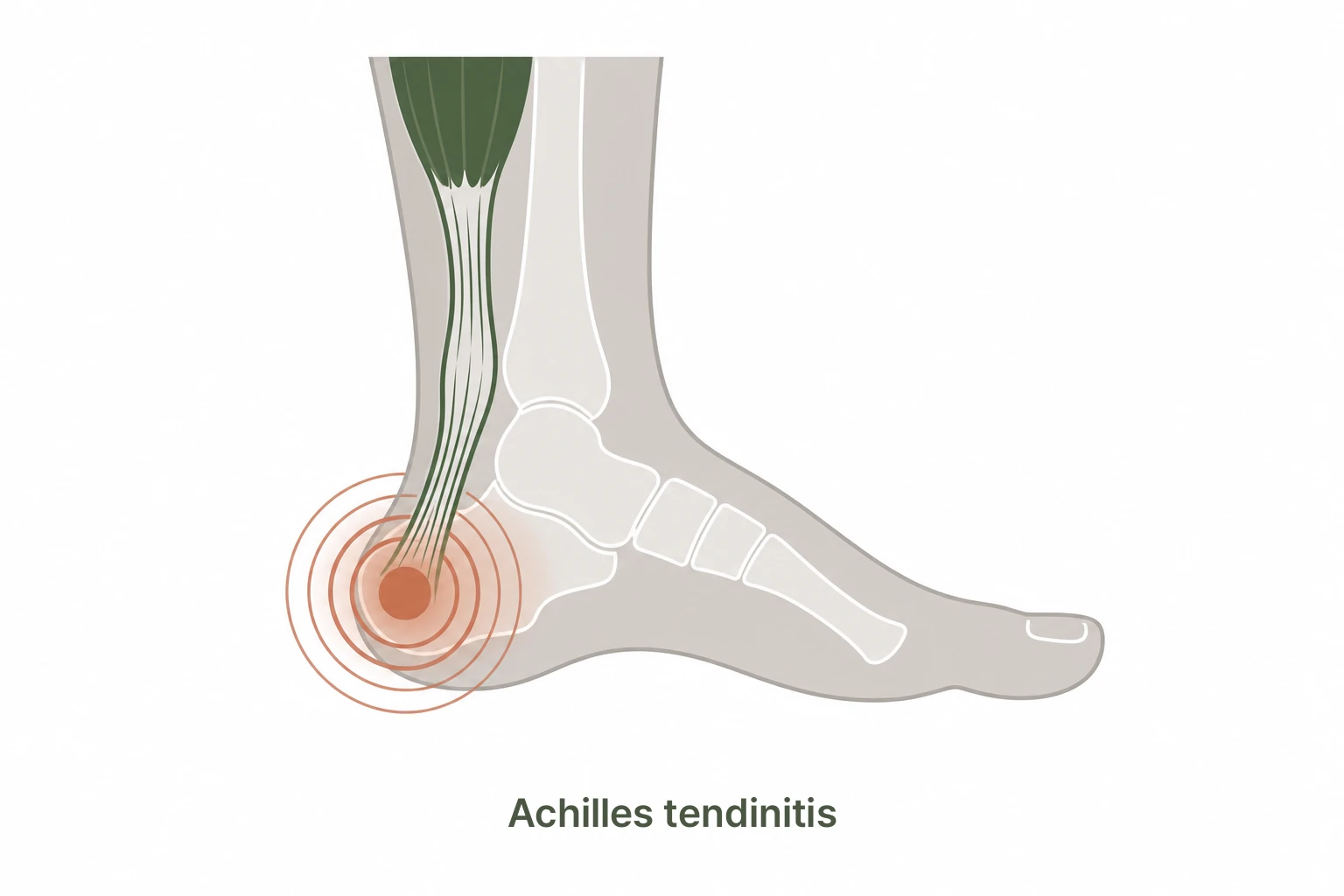
Quick answer: The Achilles tendon is the thickest, strongest tendon in the body, connecting the calf muscles to the heel bone. When repetitive running and jumping accumulate micro-damage, the tendon develops degeneration and pain. When the calf muscles shorten or weaken, excessive load is placed on the tendon.
See a doctor right away in these cases
- A sudden “pop” at the back of the ankle with severe pain can mean the Achilles tendon has ruptured and needs emergency evaluation.
- Severe swelling at the back of the ankle with an inability to walk should be checked to rule out a rupture or serious injury.
- Numbness in the ankle or foot alongside the pain should be checked to rule out nerve injury.
The 3 key points this page covers
- Why Achilles tendinitis develops and why it often does not heal easily
- How to prevent progression to a tendon rupture
- A circulation-based approach that promotes tendon remodelling
These symptoms may point to Achilles tendinitis
- The Achilles tendon is stiff and sore on your first steps in the morning, then eases as you walk. Reduced blood flow during sleep leaves the tendon contracted, so pain appears with the first steps of the day.
- Tenderness when you press the Achilles tendon just above the heel. Pressing on the degenerated area or the tendon’s attachment produces clear tenderness.
- Achilles pain when running or jumping. The pain worsens during running and jumping, when repetitive tendon loading is applied.
- Pain going uphill or rising onto your toes. Ankle dorsiflexion, lifting the top of the foot, stretches the Achilles tendon and brings on pain.
- A swollen or thickened feeling around the Achilles tendon. Inflammation around the tendon, or enlargement of the tendon itself, gives a thickened sensation.
Causes of Achilles tendinitis
The Achilles tendon repeatedly withstands forces several times your body weight. When you ramp up exercise intensity suddenly or load it repeatedly without enough recovery, micro-damage accumulates and tendon degeneration develops.
- Excessive running and jumping load. A rapid increase in training volume or repeated training without rest outpaces the tendon’s recovery rate.
- Calf muscle shortening. When the gastrocnemius and soleus shorten, sustained high tension is placed on the Achilles tendon.
- Lack of ankle stability. When the muscles around the ankle are weak, impact concentrates on the tendon during walking and landing.
Tendinitis and tendon rupture must be distinguished
- Tendinitis. Gradual onset, with morning stiffness and pain during exercise. Walking is possible.
- Tendon rupture. A sudden “pop” sound with immediate severe pain, and you cannot rise onto the toes. Seek care immediately.
Left untreated, tendinitis progresses to tendon degeneration, which can raise the risk of rupture.
Is it Achilles tendinitis, or another heel problem?
Not all heel pain is Achilles tendinitis. Plantar fasciitis occurs in a nearby location and is frequently confused with it.
Achilles Tendinitis
- Pain along the back of the heel (over the Achilles tendon)
- Stiffness with the first steps in the morning, which eases after warming up
- Pain and tightness when pulling the foot up toward the shin
- Worsens after running, jumping, or sport
Plantar Fasciitis
- Pain on the underside of the heel (plantar surface)
- Severe pain with the very first step in the morning, which reduces after a few minutes of walking
- Pain when bending the toes upward (stretching the plantar fascia)
- Worsens after prolonged standing or walking and again in the evening
Partial Achilles tendon rupture can look like severe tendinitis. A sudden increase in pain, visible thickening of the tendon, or noticeably reduced push-off strength warrants ultrasound evaluation to rule out a tear. The management differs significantly from tendinitis.
Our approach at Yonsei SM
Achilles tendinitis needs to progress in stages, reducing tendon inflammation, promoting tendon remodelling, and restoring ankle function.
- Phase 1: Calm
Circulation HD reduces inflammation around the Achilles tendon. By improving blood flow around the tendon, it creates an environment for tissue recovery and reduces pain. - Phase 2: Activate (Circulation PT)
Eccentric calf exercises promote tendon remodelling. This exercise, in which the muscle contracts while lengthening, is an effective method for tendon recovery. Ankle stability training is carried out alongside it. - Phase 3: Integrate
We analyse your walking and running landing patterns to reduce the impact placed on the Achilles tendon. We provide a guide for gradually increasing load as you return to exercise.
Frequently asked questions
How long does it take for Achilles tendinitis to improve?
It depends on the degree of tendon degeneration and the treatment approach. Generally a recovery period of several weeks to several months is needed, and chronic cases can take longer. Doing eccentric exercises consistently can speed up recovery. Treatment duration Q&A →
Do I have to rest from exercise completely?
Complete rest can lead to tendon weakening. Cut back for now on running or jumping that worsen the pain, but you can keep up low-impact exercise such as swimming or cycling. Eccentric calf exercises are the core of treatment and must always be carried out alongside.
Do steroid injections help?
Injecting steroid directly into the Achilles tendon carries a risk of tendon weakening and rupture, so it is generally not recommended. Whether to access the tissue around the tendon depends on the situation, and accurate evaluation is needed before treatment.
My Achilles tendon has thickened. Will it return to normal?
When the tendon has thickened from degeneration, it can be difficult to return it completely to its original state. However, with eccentric exercises and appropriate treatment you can restore the tendon’s strength and function, and the goal is to return to everyday sports activity.
When can I start running again?
You start running again in stages once you can walk comfortably without pain and can rise onto your toes (tiptoe) without pain. Returning suddenly to your previous distance and pace can cause a relapse. It is safer to check your landing pattern with gait analysis and increase distance by no more than 10% per week. Running leg pain Q&A →
Related reading
Is Achilles pain keeping you from walking or running comfortably?
We assess tendon changes and build an individualized plan aimed at recovery and reducing recurrence risk.
Book OnlineReferences
- Alfredson H et al. Heavy-load eccentric calf muscle training for the treatment of chronic Achilles tendinosis. Am J Sports Med. 1998;26(3):360-366.
- Beyer R et al. Eccentric training and heavy slow resistance training as treatment for Achilles tendinopathy: a randomised controlled trial. Am J Sports Med. 2015;43(7):1704-1711.
- Habets B et al. Effectiveness of exercise therapy in patients with non-insertional Achilles tendinopathy: a systematic review and meta-analysis. Br J Sports Med. 2017;52(22):1465-1472.
- de Vos RJ et al. Platelet-rich plasma injection for chronic Achilles tendinopathy: a randomized controlled trial. JAMA. 2010;303(2):144-149. PMID 20068208