Why Does Lymph Circulation Matter?
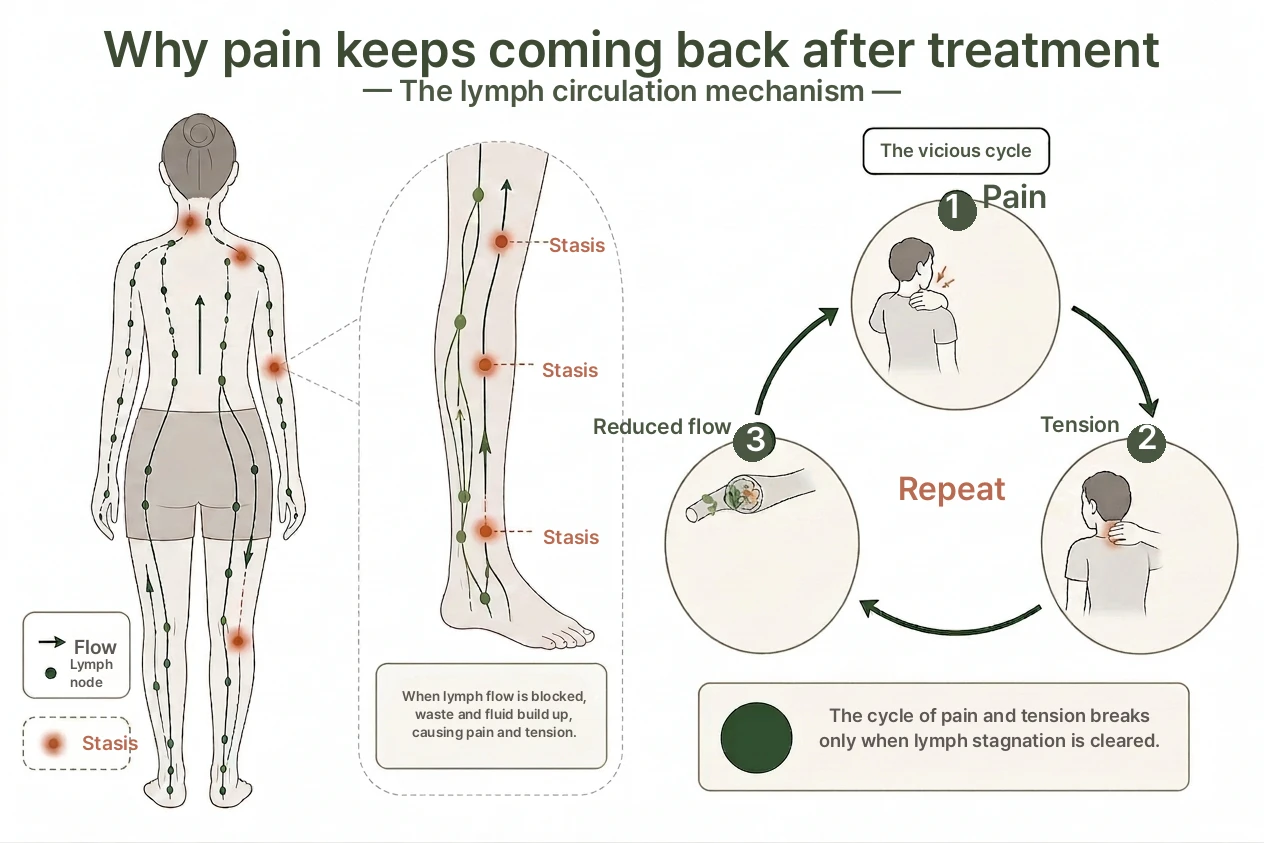
Inflammatory waste exits the body through the lymph system. When lymph is blocked, inflammatory substances accumulate and nerves are continuously stimulated, causing pain to become entrenched. Even when the cause is treated, if this environment remains, pain keeps returning.
When muscles or joints sustain injury, the body responds with an inflammatory reaction. This inflammatory waste is cleared not through blood, but through lymph. Unlike blood, lymph has no heart-like organ to drive it. It depends entirely on muscle movement and breathing to flow.
As pain intensifies, movement decreases. The fascia (the membrane surrounding muscles) stiffens and physically compresses lymph vessels. When inflammatory waste cannot drain and accumulates around nerves, nerves become hypersensitive to even minor stimuli.
This is the core reason behind the pattern of “feels better after treatment but hurts again quickly.” Treating only the injured area does not change this environment.
* This mechanism is a currently well-supported theory in pain research. The cause and pattern of pain varies between individuals.
How Pain Becomes Chronic
There is a reason a simple injury can harden into chronic pain. Understanding the flow below explains why “the cause is gone but pain remains.”
-
Muscle and Fascial Injury → Inflammatory Substances Released
Micro-trauma or repetitive loading causes immune cells in the tissue to release inflammatory substances like TNF-α and IL-1β. -
Reduced Lymph Pump Function → Inflammatory Stasis
High concentrations of inflammatory substances impair the lymph vessels’ ability to contract. Drainage stops and inflammatory waste pools in the interstitial space (between cells). -
Fascial Rigidity → Physical Compression of Lymph Vessels
Prolonged inflammation causes fibers within the fascia to harden and adhere. This adhesion strangles lymph vessels, blocking flow. -
Continuous Nerve Stimulation → Pain Sensitization
Stagnant inflammatory substances (bradykinin, substance P, ATP, etc.) continuously stimulate nerves. Nerves become progressively more sensitive, reacting strongly to stimuli that would normally cause no pain. -
Reflex Muscle Spasm → Further Lymph Blockage (Feed-Forward Loop)
When pain signals reach the spinal cord, surrounding muscles reflexively spasm. This spasm again compresses lymph vessels, completing the vicious cycle.
Key: Even when the source injury heals, if this cycle remains, pain continues.
Breaking this vicious cycle requires changing not just the injury site, but the lymph flow and fascial environment together.
These Symptoms May Indicate a Lymph Circulation Problem
Not all pain is a lymph problem. But if the patterns below apply, lymph environment may be contributing to persistent pain.
-
Temporary improvement from injections or medication, but quick recurrence
Injection effects fade within days, or pain seems to spread after treatment. -
MRI and X-ray are normal but there is deep heaviness or aching
No clear structural cause found on imaging, but persistent feelings of pressure, heaviness, or cold sensitivity. -
Rotating pain across multiple areas, accompanied by fatigue and sleep problems
One area improves and another starts, or multi-site pain with chronic fatigue, digestive discomfort, or sleep disorders.
The Integrated Approach at Yonsei SM Pain Clinic
Changing the lymph environment requires injection therapy and manual therapy working together. The two approaches work differently but toward the same goal.
Injection Therapy (Circulation HD)
Calm Down Phase
Ultrasound identifies the adhesion site and saline is precisely injected. Hydraulic pressure separates stuck fascia and flushes out concentrated inflammatory waste. The blocked lymph pathway is physically reopened.
Circulation HD Details →Manual Therapy (Circulation PT)
Activate & Integrate Phase
Muscle contraction and relaxation during movement acts as a lymph pump. Manual therapy releases stiff fascia and restores active movement to naturally revive lymph flow. The more you move, the better the lymph flows.
Circulation PT Details →Recommended Program
Circulation Combo
Injection therapy (Circulation HD) opens the blocked environment, then manual therapy (Circulation PT) drives the released inflammatory waste out. When both work in sequence, lymph recovery is more complete.
Book a Circulation Combo Consultation →Treatment Sequence Matters
Like cleaning from top to bottom, lymph drainage pathways must be opened from the center first.
Treating only the peripheral (painful) area first can displace freed inflammatory waste to surrounding areas if the upstream drainage route is still blocked, temporarily worsening symptoms.
-
Deep Breathing to Prime Full-Body Lymph Flow
5-10 diaphragmatic breaths lying down. Pressure changes in the chest and abdomen pump the thoracic duct (the body’s largest lymph vessel), priming systemic lymph circulation. -
Open Central Lymph Pathways First
The therapist gently stimulates key lymph nodes in the neck, axilla (armpit), and inguinal (groin) regions in order. This creates space to receive inflammatory waste rising from the treatment area. -
Injection to Directly Open the Blocked Area
Ultrasound identifies the adhesion site and saline is injected. Hydraulic pressure separates hardened fascia and flushes accumulated inflammatory waste. The compressed lymph pathway is reopened. -
Manual Therapy to Drive Freed Waste Out
Immediately after injection, the therapist applies gentle manual therapy from the treatment area toward the center. This helps the inflammatory waste freed by the injection drain through the pre-opened lymph pathways. -
Active Movement to Self-Power the Lymph Pump
After treatment, do 15 repetitions of gentle active movement, such as wrist flexion and extension or ankle pumping. Your own muscles directly pump lymph. This step is key to maintaining the treatment effect.
Learn More by Topic
References
- Tuckey, C., & Srbely, J. (2021). Interstitial Inflammatory Stasis: A proposed mechanism linking myofascial trigger points with chronic pain and systemic inflammation. Frontiers in Pain Research, 2, 734375.
- Systematic review & meta-analysis on Manual Lymphatic Drainage for Carpal Tunnel Syndrome: pain (VAS) and median nerve cross-sectional area reduction. Scientific Reports (2025). DOI: 10.1038/s41598-024-65123.
- Shi J et al. Lymphatic dysfunction in knee osteoarthritis. Osteoarthritis Cartilage. 2024. DOI: 10.1016/j.joca.2024.01.003
The above references are cited as academic support for the content of this page and do not guarantee treatment outcomes or promise specific results.
Want to Change the Root Pain Environment?
If pain keeps recurring despite any treatment, the lymph environment may be the cause. We’ll first assess your condition and find the right treatment sequence.
Book Online