Hand numbness but unsure where the problem is?
Hand Numbness — The cause varies depending on where the nerve is compressed.
Hand numbness can originate from the neck, shoulder, elbow, or wrist. Different fingers indicate different compressed nerves, requiring different treatment approaches.
Quick Answer: Hand numbness can have different causes depending on the compression location — wrist (carpal tunnel), elbow, shoulder (thoracic outlet), or neck. We first identify the numbness distribution and triggering movements, then approach it by calming the pain (Downshift), restoring function (Activate), and preventing recurrence (Integrate).
Seek medical attention quickly if:
- Progressive hand weakness or frequently dropping objects
- Worsening numbness with progressive sensory loss
- Chest pain, breathing difficulty, or fainting
- Rapid symptom worsening after trauma
3 Key Points on This Page
- Various causes of hand numbness (neck, shoulder, elbow, wrist)
- Estimating the cause from which fingers are numb
- Treatment approach for each cause
Which fingers are numb?
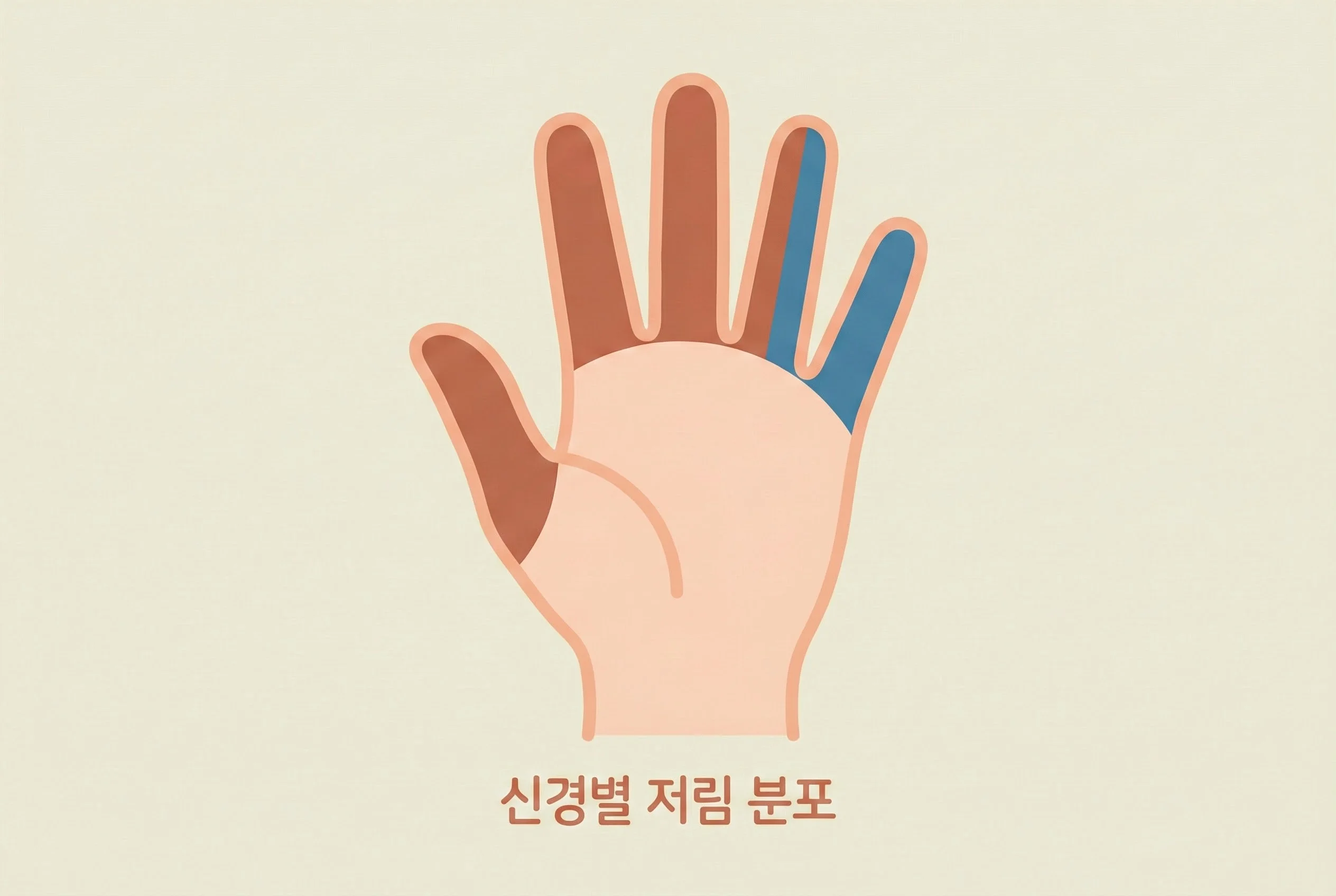
The numb fingers can help estimate where the nerve is being compressed.
1st-3rd fingers (thumb~middle)
Median nerve territory
- Wrist: Carpal tunnel syndrome
- Forearm: Pronator teres syndrome
- Neck: C6-7 cervical problems
4th-5th fingers (ring~pinky)
Ulnar nerve territory
- Elbow: Cubital tunnel syndrome
- Wrist: Guyon’s canal syndrome
- Neck: C8-T1 cervical problems
Back of thumb (dorsal hand)
Radial nerve territory
- Forearm: Radial tunnel syndrome
- Upper arm: Spiral groove syndrome
- Neck: C5-6 cervical problems
Entire hand or both hands
Multiple possible causes
- Neck: Cervical disc, stenosis
- Shoulder: Thoracic outlet syndrome
- Systemic: Diabetes, thyroid, vitamin deficiency
Where can nerves be compressed?
Nerves to the arm travel through neck → shoulder → elbow → wrist. Each point has ‘tunnels’ where compression can occur.
-
Neck (cervical spine)
Disc herniation or bone spurs compress nerve roots. Symptoms change with neck movement, and numbness radiates to shoulder or arm. -
Shoulder (thoracic outlet)
Nerves and blood vessels are compressed between the collarbone and first rib. Symptoms worsen when raising arms, and hands may become cold or pale. -
Elbow (cubital tunnel, radial tunnel)
Compression occurs on the inner (ulnar nerve) or outer (radial nerve) side of the elbow. Symptoms worsen when bending or leaning on the elbow. -
Wrist (carpal tunnel, Guyon’s canal)
Compression occurs on the palmar (median nerve) or outer (ulnar nerve) side of the wrist. Symptoms worsen with heavy wrist use.
Double Crush Syndrome: Nerves can be compressed at two or more locations simultaneously. For example, compression at both neck and wrist makes symptoms more severe and treatment more complex.
Check these points
- When turning or extending neck → Symptom changes suggest neck problem
- When raising arms overhead → Worsening symptoms suggest thoracic outlet syndrome
- When keeping elbow bent → 4th-5th finger numbness suggests cubital tunnel
- When keeping wrist bent → 1st-3rd finger numbness suggests carpal tunnel
- Worse at night → Common in carpal tunnel syndrome
- Both hands simultaneously numb → Consider systemic causes (diabetes, thyroid)
Our Approach at Yonsei Shinmyung
For hand numbness, accurately identifying where the nerve is compressed is the first step.
- Precise Assessment
We locate compression sites using physical examination, provocation tests, and ultrasound imaging. Nerve conduction studies and MRI are performed when necessary. - Phase 1: Downshift (Circulation HD)
We perform hydrodissection at the compression site to create space around the nerve. We release adhesions and improve blood flow. - Phase 2: Activate (Circulation PT)
Nerve gliding exercises, surrounding muscle strengthening, and posture correction. - Phase 3: Integrate
We correct postures or movements that cause compression. We help improve the work environment if occupational factors exist.
Seek prompt care in these cases
- Visible muscle wasting in fingers
- Frequently dropping objects
- Difficulty buttoning clothes or using chopsticks
- Cold hands with color changes
- Sudden severe worsening of numbness
- Both hands and feet simultaneously numb and weak
Muscle atrophy or functional decline may indicate progressing nerve damage. Early treatment increases recovery potential.
Frequently Asked Questions
Can numbness location estimate the cause?
Numbness distribution helps estimate the cause, but cannot definitively determine it. Assessment alongside triggering movements is needed. Numbness Location Q&A →
Does numbness in specific fingers have meaning?
Different numbness distributions (thumb side/pinky side) suggest different suspected areas. Accurate diagnosis requires examination and assessment. Finger Numbness Q&A →
Can heavy keyboard/mouse use increase numbness?
Prolonged repetition of wrist-bending postures can worsen nerve compression. Adjusting wrist angle, supports, and rest routines helps. Keyboard Posture Q&A →
My wrist hurts and is numb when using a mouse. Is it carpal tunnel?
Besides carpal tunnel, various causes like tendon problems and myofascial tension exist. We assess pain location and movement patterns together. Mouse Pain Q&A →
Can neck problems cause hand numbness?
Nerve irritation in the neck can cause numbness extending to arms and hands. We differentiate by examining numbness distribution and movement-related changes. Arm Numbness Q&A →
What is the relationship with thoracic outlet syndrome?
Nerve and blood vessel compression between neck and shoulder can cause arm numbness and cold hands. Posture and muscle tension patterns provide clues. Thoracic Outlet Syndrome Page →
Can numbness occur even with normal MRI?
Even without major imaging abnormalities, functional problems like myofascial tension and nerve sensitization can cause symptoms. In such cases, symptom and movement assessment may be more important. Normal MRI Pain Q&A →
What is the treatment sequence?
We find the compression location and reduce the burden (Downshift), restore nerve gliding, strength, and posture function (Activate), and prevent recurrence in daily life (Integrate). Circulation Therapy Introduction →
Related Articles
Hand numbness — we’ll find where the problem is
We locate the compression site through precise assessment and propose tailored treatment.
Book Online