Outer elbow pain and difficulty gripping objects?
Tennis Elbow. The tendons that extend your wrist are damaged.
You don’t need to play tennis to get it. Mouse use, frying pans, laundry, cleaning… Repetitive wrist extension causes micro-damage to accumulate in the outer elbow tendons.
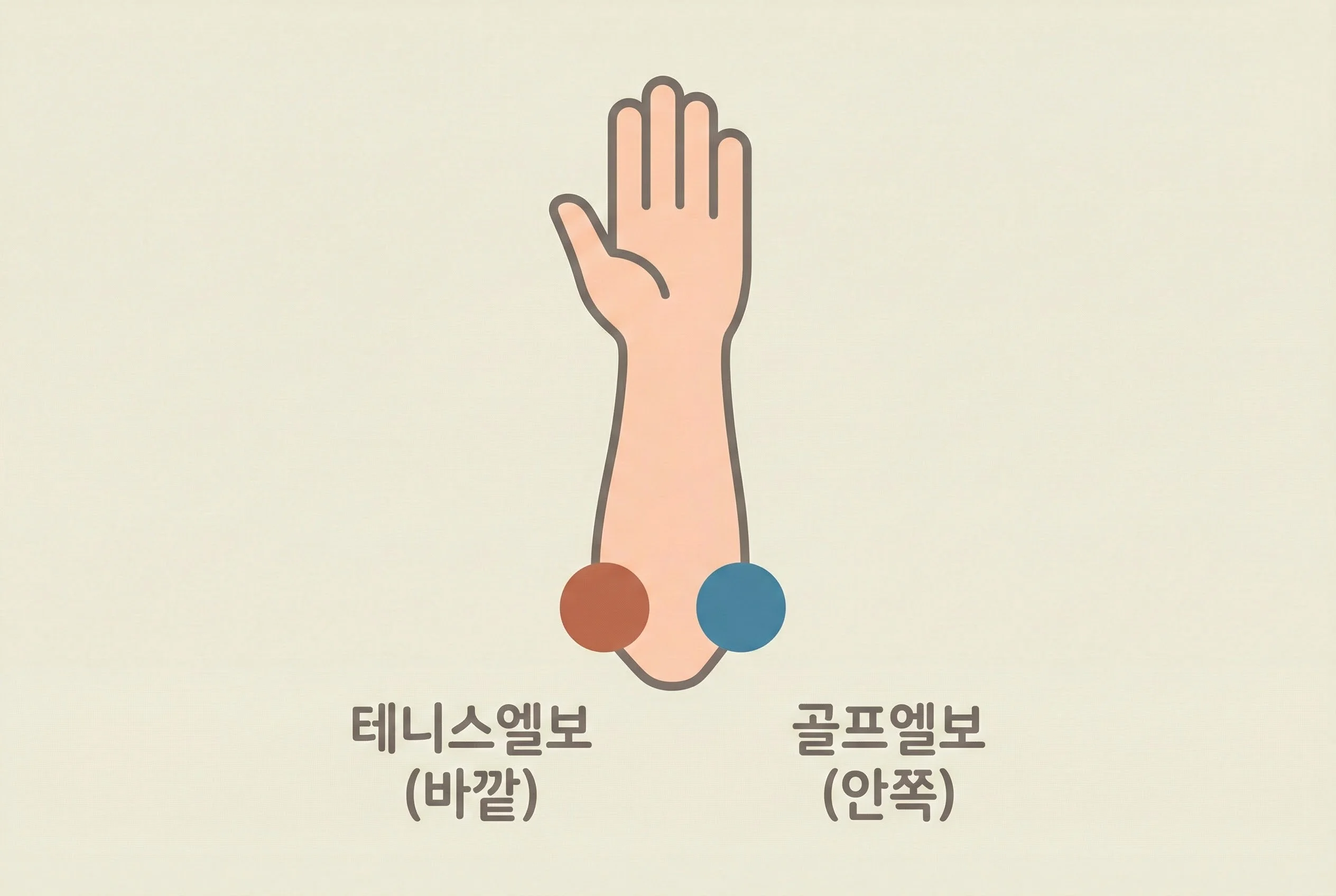
Quick Answer: Tennis elbow (lateral epicondylitis) often results from repetitive overload to the outer elbow tendons. The approach is to calm the pain first, then rebuild function with exercises like eccentric loading, and finally keep strain from building up again in daily activities.
Seek medical attention quickly if:
- Severe finger numbness or sudden loss of hand strength
- Rapid worsening after trauma
- Swelling, warmth, or fever
- Pain rapidly worsening despite rest
3 Key Points on This Page
- Why tennis elbow develops and why it doesn’t heal easily
- Limitations of steroid injections
- Treatment approaches
These symptoms suggest tennis elbow
- Tenderness on outer elbow (lateral epicondyle). Sharp pain when pressed.
- Pain when gripping or lifting objects. Cups, pans, hammers are difficult to hold.
- Pain during twisting motions. Opening bottles, turning doorknobs, wringing towels.
- Pain during handshakes. Gripping firmly causes elbow pain.
- Discomfort when using a mouse. Clicking or moving the mouse causes elbow aching.
Why does tennis elbow develop?
The formal name is lateral epicondylitis. The tendons of the wrist extensor muscles attach to the outer elbow bone (lateral epicondyle), and this attachment point develops problems.
While it was once thought to be inflammation (-itis), recent research shows degenerative changes (-osis) are the more accurate cause. The tendon tissue fails to heal properly and becomes degenerated.
This is why anti-inflammatory drugs or steroids alone do not address the tendon degeneration itself.
Activities that cause tennis elbow
- Prolonged computer use (mouse, keyboard)
- Racket sports (tennis, badminton)
- Cooking (frying pans, knives)
- Cleaning, laundry, ironing
- Using tools (screwdrivers, hammers)
- Carrying heavy bags
Why do steroid injections lead to recurrence?
Steroid injections are used to reduce initial pain. However…
- Inflammation suppression vs tissue damage. Steroids reduce inflammation but can weaken tendon tissue.
- Root cause unaddressed. Pain decreases but tendon degeneration remains. Recurrence occurs with renewed use.
- Poor long-term outcomes. Studies show steroid injection groups sometimes have worse outcomes after 1 year.
Steroid injections aren’t inherently bad, but tendon regeneration and strength training must follow once pain is reduced.
Is it tennis elbow, or another cause?
Not all lateral elbow pain is tennis elbow (lateral epicondylitis). Posterior interosseous nerve entrapment and cervical disc herniation can produce overlapping symptoms.
Tennis Elbow (Lateral Epicondylitis)
- Tenderness directly over the lateral epicondyle
- Pain worsens with wrist extension against resistance (Cozen’s test)
- Pain when gripping or turning a doorknob
- Pain is the dominant symptom. Numbness is uncommon
Posterior Interosseous Nerve Entrapment
- Pain located deeper in the forearm, below the lateral epicondyle
- More provoked by forearm rotation (turning a key) than wrist extension
- Positive on nerve compression testing rather than Cozen’s test
- Often fails to respond to standard tennis elbow treatment
Cervical disc herniation (C6) can also present as lateral elbow pain. If symptoms travel from the neck and shoulder, or shift with head position, a cervical cause should be evaluated alongside the elbow. Persistent lateral elbow pain that does not respond to treatment is a prompt to look beyond the joint itself.
Our Approach at Yonsei Shinmyung Pain Clinic
Tennis elbow requires tendon tissue regeneration and correcting arm use patterns.
- Stage 1. We bring the swelling down (Circulation HD)
Instead of steroids, we use hydrodissection to release adhesions around tendons and improve blood flow. Prolotherapy may be used to promote tissue regeneration. - Stage 2. We wake the muscles up (Circulation PT)
Progressively strengthen weakened wrist extensors. Eccentric exercise is used to help tendon regeneration. - Stage 3. We make the movement stick
Correct patterns that strain the elbow, such as mouse posture, lifting techniques, and sports movements.
Tennis Elbow Self-Care
What You Can Do Now
- Reduce painful movements (use less, not complete rest)
- Warm compress (2-3x daily, 15-20 min) – improves circulation
- Wear tennis elbow brace (strap)
- Lift objects with palms facing up
Eccentric Exercise (Recovery Phase)
- Hold dumbbell (1-2kg) and extend wrist back
- Use other hand to slowly lower wrist down
- Take 3 seconds for slow descent
- 3 sets × 15 reps daily
Stop and consult a specialist if exercise causes severe pain. In acute phases, rest takes priority over exercise.
Frequently Asked Questions
Does it hurt more when gripping? Is it tennis elbow?
If gripping or lifting objects causes outer elbow pain, tennis elbow is possible. We assess pain location and triggering movements together. Gripping Pain Q&A →
Is it related if mouse use makes it worse?
Repetitive wrist and forearm use can strain tendons. Adjusting work environment and wrist angle helps. Mouse Pain Q&A →
Can I continue exercise (weights or tennis)?
Reduce overload movements during painful periods and adjust routines to match your phase. Pushing through can delay recovery. Arm Exercise Q&A →
How is it different from golfer’s elbow?
Tennis elbow causes outer elbow pain. Golfer’s elbow causes inner elbow pain. They can coexist or overlap with other issues, requiring evaluation. Golfer’s Elbow Page →
Can I keep getting injections?
Injection frequency depends on type and purpose. Combining pain control with functional recovery routines is important. Injection Q&A →
Why does it improve then recur?
If daily use patterns repeat, tendons accumulate strain again. Changing recurrence-causing patterns alongside pain control is key. Recurrence Q&A →
How do I change keyboard and mouse habits?
Adjust wrist angle, use supports, position elbows properly, and take short breaks every hour. ‘Frequent short breaks’ beats ‘long continuous use’. Prevention Q&A →
What is the treatment sequence?
First calm the pain and tension, then restore function with eccentric exercises, and reduce recurrence risk in daily movements. Circulation Therapy Introduction →
References
- Bisset L et al. Mobilisation with movement and exercise, corticosteroid injection, or wait and see for tennis elbow: randomised trial. BMJ. 2006;333(7575):939.
- Coombes BK et al. Effect of corticosteroid injection, physiotherapy, or both on clinical outcomes in patients with unilateral lateral epicondylalgia. JAMA. 2013;309(5):461-469.
- Shiri R, Viikari-Juntura E. Lateral and medial epicondylitis: role of occupational factors. Best Pract Res Clin Rheumatol. 2011;25(1):43-57.
- Smidt N et al. Corticosteroid injections, physiotherapy, or a wait-and-see policy for lateral epicondylitis: a randomised controlled trial. Lancet. 2002;359(9307):657-662.
Related Articles
Is recurring elbow pain a concern?
We treat tendon regeneration and use pattern correction according to your condition.
Book Online