Does your finger click, lock, or get stuck when you try to straighten it?
Trigger Finger. The tendon is catching inside a narrowed tendon sheath.
Is your finger stiff in the morning or do you feel a hard nodule in your palm? In severe cases the finger can lock in a bent position and refuse to straighten.
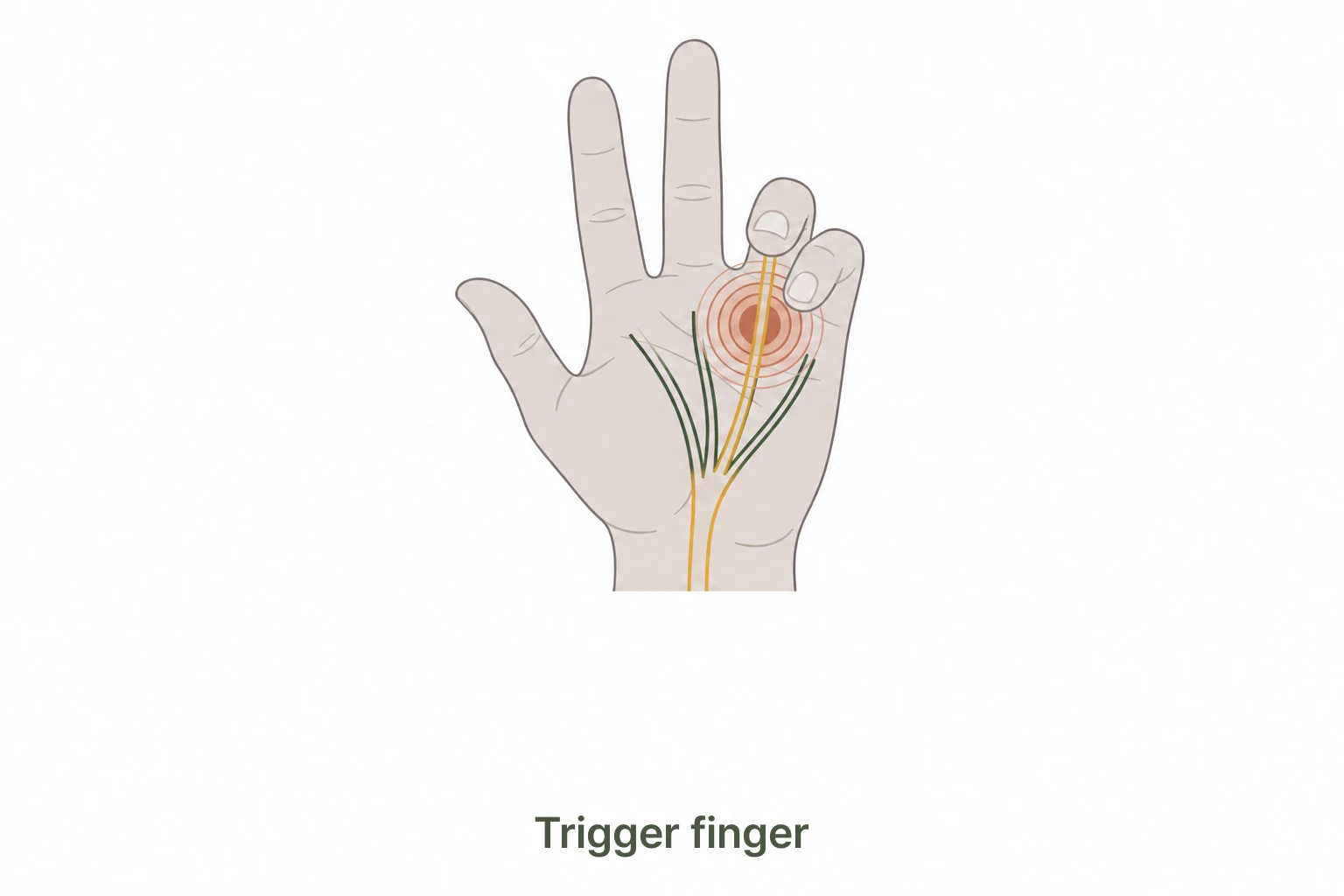
Quick Answer: Trigger finger (stenosing tenosynovitis) occurs when the flexor tendon catches or struggles to pass through the finger’s pulley (annular ligament). The tendon thickens or the pulley narrows, preventing smooth movement. The approach is to first calm the sheath inflammation, then restore balance between the finger flexors and the hand and forearm muscles, and finally improve how you use your hand.
Seek medical attention quickly if:
- Your finger is completely locked and won’t straighten even with force. Seek immediate care
- Significant fever or redness along with the symptoms, which can point to infectious tenosynovitis
- Sudden locking after an injury, which can mean a tendon injury
3 Key Points on This Page
- Typical symptoms of trigger finger and how it progresses
- Why it develops, including tendon overload and associated conditions
- How the 3-stage Circulation Therapy is structured
These symptoms suggest trigger finger
- Catching or clicking sensation when bending the finger. A distinct “snap” or catch, like pulling a trigger.
- Worse in the morning. Finger feels stiff on waking but loosens up with movement.
- Hard nodule and tenderness at the base of the finger in the palm. A firm, tender bump can be felt in the lower palm.
- Locking in severe cases. The finger stays bent and must be manually straightened with the other hand.
- Most commonly affects the thumb, middle, and ring fingers. One or multiple fingers may be involved at the same time.
Why does trigger finger develop?
The flexor tendons in the fingers pass through ring-like pulleys (annular ligaments) in the palm. These pulleys keep the tendons close to the bone so they can transmit force efficiently to the fingertips.
Key causes include:
- Repetitive gripping motions. Accumulated friction and load on the tendon lead to thickening.
- Tendon thickening. The tendon enlarges and can no longer glide smoothly through the pulley.
- Diabetes. Affects tissue metabolism and promotes changes in tendons and pulleys.
- Hypothyroidism. Can contribute to swelling of tissues around the tendon sheath.
- Elevated nervous system sensitivity. Increased pain sensitivity makes even minor catching feel much more intense.
Stages of Trigger Finger
- Stage 1. Pain and tenderness at the finger base. No catching yet
- Stage 2. Catching with active triggering (finger can spring back on its own)
- Stage 3. Locking. Must use the other hand to passively straighten the finger
- Stage 4. Complete lock. Cannot be straightened even with force
※ Early treatment before Stage 3-4 is strongly advised.
Is it trigger finger, or another finger problem?
A catching or locking finger is not always trigger finger. Early rheumatoid arthritis can present similarly and should be distinguished.
Trigger Finger (Stenosing Tenosynovitis)
- Finger catches, locks, or clicks when bending and straightening
- Tender nodule palpable at the base of the finger on the palm side
- Worse in the morning. Eases with movement
- Typically limited to one or two fingers
Rheumatoid Arthritis
- Multiple finger joints swollen and painful simultaneously
- Morning stiffness lasting more than one hour
- Warmth and visible swelling at the joints themselves
- Elevated inflammatory markers on blood tests
Rheumatoid arthritis can first appear as trigger finger symptoms. If multiple fingers are involved, or if joint swelling accompanies the catching sensation, blood tests to screen for autoimmune disease are advisable before assuming the diagnosis is purely mechanical.
Our Approach at Yonsei Shinmyung Pain Clinic
Trigger finger requires calming tendon sheath inflammation and restoring hand and forearm muscle balance.
- Stage 1: We bring the swelling down (Circulation HD)
Ultrasound-guided hydrodissection targets inflammation and adhesions around the A1 pulley. Creating space allows the tendon to glide more freely and reduces pain. - Stage 2: We wake the muscles up (Circulation PT)
We use exercises to improve finger flexor function and balance the muscles of the hand and forearm. Tendon gliding exercises help the tendon move smoothly through the pulley. - Stage 3: We make the movement stick
We help you modify how you use your hand, adjusting tool grip size, reducing repetitive gripping frequency, and building daily habits that reduce recurrence risk.
Trigger Finger Self-Care
What You Can Do Now
- Reduce the frequency and force of gripping activities
- Use a finger splint or taping for support
- Switch to tools with thicker, padded handles
- Warm compress (2-3 times daily, 15-20 min) to improve circulation
- Tendon gliding exercise. Slowly open and close the finger fully
What to Avoid
- Forcing a locked finger straight (risk of tendon injury)
- Continuing repetitive gripping through pain
- Using thin-handled tools for extended periods
- Letting symptoms progress to Stage 3-4 without treatment
If the finger locks completely or fever and redness develop, seek medical care promptly. The longer trigger finger progresses, the more difficult treatment becomes.
Frequently Asked Questions
How is trigger finger different from De Quervain’s tenosynovitis?
Trigger finger involves the tendon catching at the pulley on the palm side of the fingers. De Quervain’s is inflammation of the tendon sheath on the thumb side of the wrist. Both are tendon sheath problems but at different locations with different symptoms. De Quervain’s Tenosynovitis →
I have diabetes and my trigger finger keeps coming back. Why?
Diabetes accelerates changes in tendons and surrounding tissue, increasing the risk of trigger finger developing and recurring. Alongside blood sugar management, reducing tendon overload through lifestyle changes is essential. Recurrence Q&A →
Can trigger finger affect multiple fingers at the same time?
Yes, trigger finger can involve one finger or multiple fingers simultaneously. When systemic conditions such as diabetes or rheumatoid arthritis are present, multiple fingers are more commonly affected at once. Movement Assessment →
Can trigger finger resolve on its own without treatment?
In very early cases, rest and activity modification alone may bring improvement. However, once catching and snapping begin, structural changes have already occurred in the tendon sheath. At this point, active treatment is beneficial and waiting tends to allow progression. Circulation Therapy →
My wrist hurts too. Is it related?
Wrist pain can co-exist with trigger finger. Hand and forearm muscle imbalance, or concurrent De Quervain’s tenosynovitis, may contribute. A combined assessment helps clarify the picture. Carpal Tunnel Syndrome →
References
- Makkouk AH et al. Trigger finger: etiology, evaluation, and treatment. Curr Rev Musculoskelet Med. 2008;1(2):92-96. PMC2684207
- Peters-Veluthamaningal C et al. Corticosteroid injection for trigger finger in adults. Cochrane Database Syst Rev. 2009;(1):CD005617.
- Wojahn RD et al. Long-term outcomes following a single corticosteroid injection for trigger finger. J Bone Joint Surg Am. 2014;96(22):1849-1854.
- Wang J et al. Percutaneous release, open surgery, or corticosteroid injection, which is the best treatment method for trigger digits? Clin Orthop Relat Res. 2013;471(6):1879-1886.
Related Articles
Is a catching or locking finger making daily life difficult?
We treat tendon sheath inflammation and work with you on smoother finger movement.
Book Online