If the front of your knee hurts going up and down stairs or after sitting for a long time
Patellofemoral syndrome. Your kneecap (patella) is slipping out of its track.
The front of your knee aches when you go up and down stairs, and your knee feels stiff when you stand up after a movie or a long flight. You feel a grinding sensation at the front of the knee when you run or cycle. It is a common form of knee pain that affects younger people too, regardless of age.
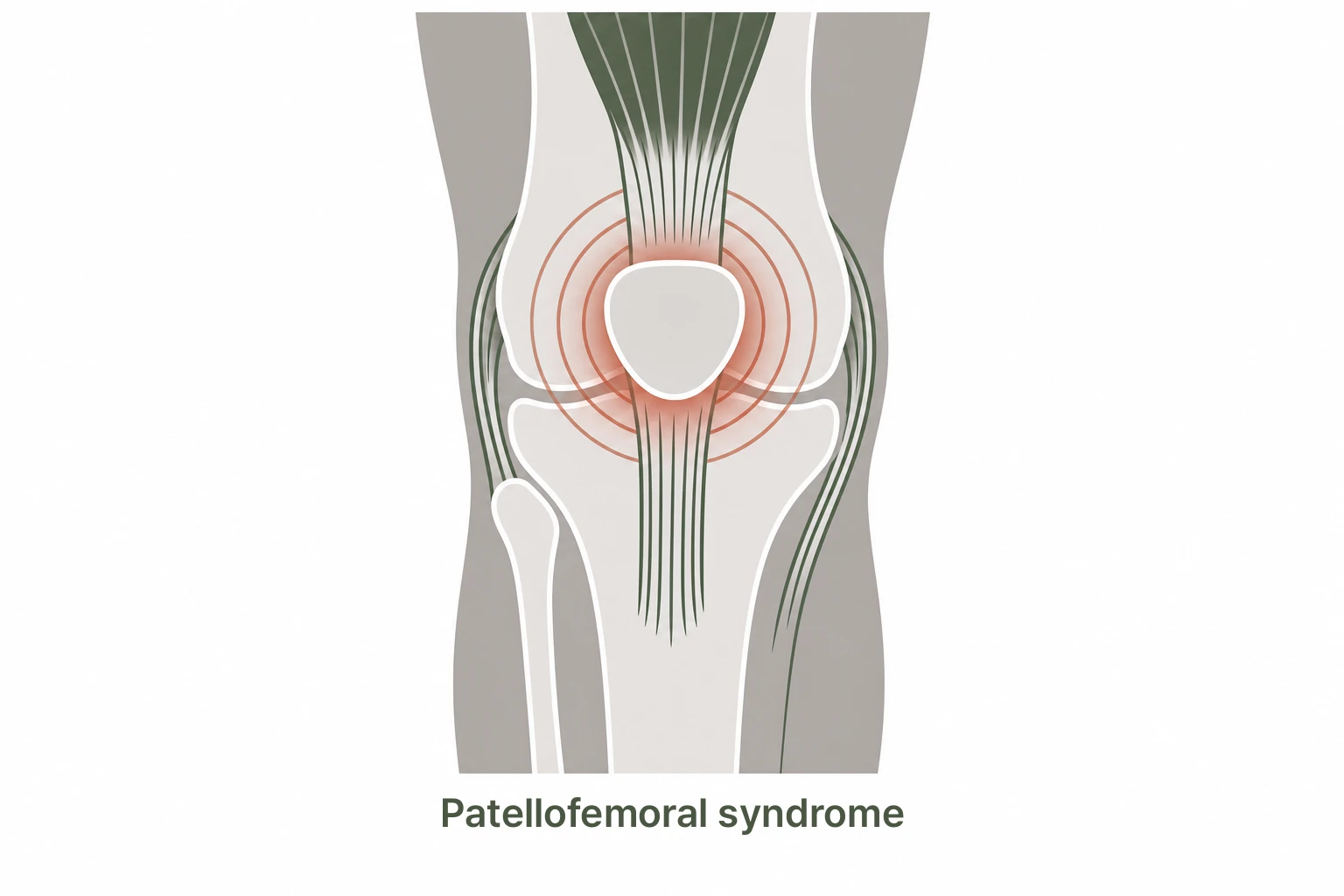
Quick answer: In patellofemoral syndrome, the kneecap (patella) drifts off its normal track as it moves over the femur, producing pain at the front of the knee. The main cause is an imbalance between an overly tight outer thigh and a weak inner thigh. It is common in active people and in those in their teens to thirties, and it can recover with the right muscle correction.
These signs call for a differential evaluation
- A sense that the knee gives way or dislocates calls for ruling out patellar instability or ligament injury.
- Severe swelling with fever calls for ruling out infection or other joint disease.
- Severe pain after trauma that makes walking difficult calls for ruling out a fracture or ligament tear.
3 key points this page covers
- Why the kneecap slips out of its track
- The muscle-imbalance cause of front-of-knee pain
- The circulation-therapy approach that restores kneecap alignment
These symptoms may point to patellofemoral syndrome
- The front of your knee hurts going up and down stairs. Pain stands out during stair movements, when pressure concentrates on the joint surface beneath the kneecap.
- Your knee is stiff and sore when you stand up after sitting for a long time, the so-called movie-theatre knee. Holding the knee bent for a long time builds up pressure on the patellofemoral joint surface, causing pain when you rise.
- Front-of-knee pain when running or cycling. Pain develops when the kneecap repeatedly slips off its track during repetitive bending and straightening of the knee.
- A grinding sensation or sound in the knee. The kneecap leaves its normal track and rubs abnormally against the joint surface of the femur.
- Front-of-knee pain when squatting on one leg. Bearing weight on a single leg makes the imbalance of the kneecap-stabilising muscles stand out.
Causes of patellofemoral syndrome
At the front of the knee, the kneecap moves along a groove on top of the femur. The thigh muscles must hold this kneecap in balance from both sides to keep it on its normal track. When this balance breaks down, the kneecap drifts outward.
- Vastus medialis (VMO) weakness. When the inner thigh muscle weakens, there is not enough force to pull the kneecap inward.
- IT band and vastus lateralis tightness. When the outer thigh tissues become overly tight, they pull the kneecap outward.
- Gluteal weakness. Weak hip muscles let the knee collapse inward (knee valgus), affecting kneecap alignment.
Patellofemoral syndrome vs. degenerative arthritis
- Patellofemoral syndrome. Pain at the front of the knee, affecting younger people too. It worsens after sitting for a long time and comes with a grinding sensation.
- Degenerative arthritis. Pain on the inner knee and throughout the joint, mostly in middle-aged and older people. It brings morning stiffness and swelling.
Both can be present together, so an accurate assessment is needed.
Is it patellofemoral pain syndrome, or another knee problem?
Pain around the kneecap is not always patellofemoral pain syndrome. Patellar tendinitis and knee osteoarthritis occur in nearby locations and need to be distinguished.
Patellofemoral Pain Syndrome
- Pain behind the kneecap
- Worst when rising after prolonged sitting, and when climbing stairs
- Worsens with sustained knee flexion (cinema sign)
- Provoked by running, cycling, and other repetitive flexion activities
Patellar Tendinitis (Jumper’s Knee)
- Tenderness directly at the patellar tendon attachment below the kneecap
- Distinctly worse after jumping or running
- Focal point tenderness on the tendon
- Common in athletes, and prone to recurrence after recovery
Knee osteoarthritis also needs to be considered. Arthritis typically causes medial or lateral knee pain with visible X-ray changes, whereas patellofemoral pain centres on the kneecap itself. The two conditions can coexist, particularly in older active individuals.
Here is how we approach it at Yonsei Shinmyung
For patellofemoral syndrome, the key is calming inflammation around the kneecap and correcting muscle imbalance.
- Stage 1: We bring the swelling down
Circulation HD is used to address inflammation around the kneecap. By releasing the overly tight IT band and lateral structures, it reduces the lateral pull placed on the kneecap. - Stage 2: We wake the muscles up (Circulation PT)
We selectively strengthen the vastus medialis (VMO) to build inner support for the kneecap. We wake the gluteal muscles to correct the knee’s tendency toward valgus. - Stage 3: We make the movement stick
We analyse your walking and running patterns to check knee alignment. By correcting stair-climbing mechanics, we distribute the load on the kneecap evenly.
Frequently Asked Questions
How long does patellofemoral syndrome take to get better?
It depends on the degree of muscle imbalance and your activity level. Most people experience symptom improvement within a few weeks to a few months. Consistent muscle strengthening and movement correction can lower the chance of recurrence. Treatment Duration Q&A →
Can I keep exercising?
It is best to ease off, for a while, on movements that aggravate the pain (deep squats, downhill running, and so on). You can keep doing exercises that put little pressure on the kneecap, such as swimming, cycling (with the saddle height adjusted), and walking on level ground. Muscle-strengthening exercise is central to treatment and is carried out alongside it.
Does a knee brace help?
A knee brace or taping to stabilise the kneecap can help relieve symptoms in the short term. However, relying only on supportive devices can let muscle weakening progress. It is recommended to use them as an aid alongside muscle strengthening.
Is there a reason it always hurts after sitting for a long time at the movies?
Keeping the knee bent for a long time maintains pressure on the joint surface between the kneecap and the femur. If the kneecap is off its normal track, this pressure concentrates on a particular spot and causes pain. That is why it has earned the nickname “movie-goer’s knee.”
I love running. Can I keep running?
It is best to reduce your running distance and speed while also correcting your landing pattern. A midfoot landing helps reduce the load on the knee more than a heel landing. After analysing your running pattern with gait analysis, we increase your distance step by step. Running knee pain Q&A →
Related Articles
Front-of-knee pain. Confirm the cause with a kneecap alignment assessment.
With a muscle-imbalance assessment and gait analysis, we find out why the kneecap is slipping off track and build a treatment plan tailored to you.
Book OnlineReferences
- Crossley KM et al. 2016 Patellofemoral pain consensus statement from the 4th International Patellofemoral Pain Research Retreat. Br J Sports Med. 2016;50(14):839-843.
- Lack S et al. Proximal muscle rehabilitation is effective for patellofemoral pain: a systematic review with meta-analysis. Br J Sports Med. 2015;49(21):1365-1376.
- Barton CJ et al. Foot orthoses and physiotherapy in the treatment of patellofemoral pain syndrome: a randomised clinical trial. BMJ. 2010;341:c6027.
- Collins NJ et al. Efficacy of nonsurgical interventions for anterior knee pain: systematic review and meta-analysis with emphasis on global assessment. Sports Med. 2012;42(1):31-49.