When your first step in the morning sends a stabbing pain through your heel
Plantar fasciitis. The fascia along the sole of your foot has become sensitive from repeated micro-injury.
The moment you get out of bed and put your foot down, your heel hurts sharply. It eases after a few steps, but it throbs again after standing or walking for a while. When the pain lingers, your walking pattern changes and the strain can travel up to the knee and hip.
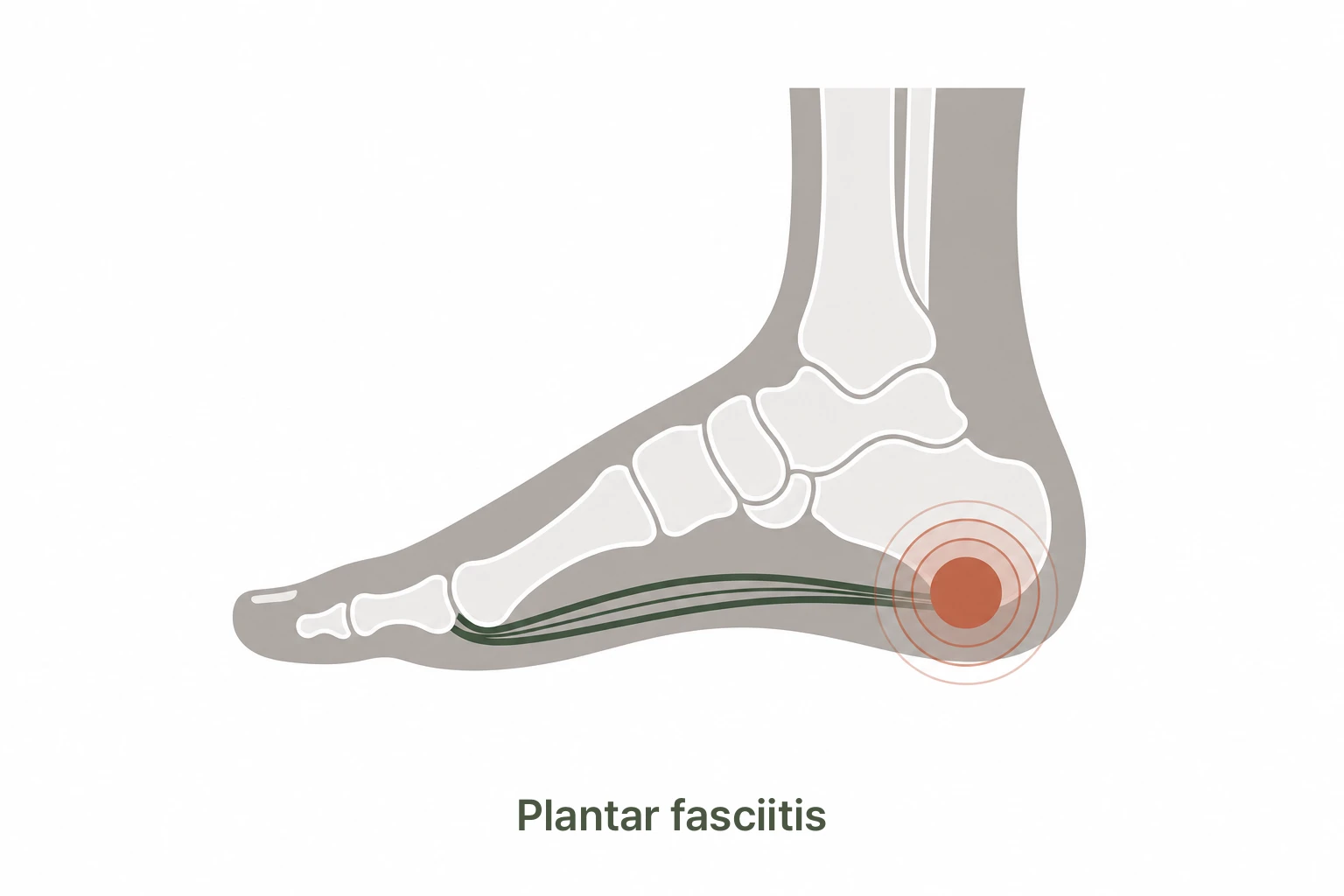
Quick answer: The plantar fascia is a thick band of tissue running from the heel to the toes. When repetitive stress from walking or running causes micro-injuries to build up, pain develops on the inner heel. It is especially severe in the morning because the fascia tightens during sleep and is suddenly stretched with your first step.
When you need an evaluation to rule out other causes
- Swelling and warmth in the foot means infection or another cause must be ruled out.
- An inability to bear weight after an injury means a fracture must be ruled out.
- Pain that persists at night even at rest means another cause must be ruled out.
- Numbness or altered sensation in the foot means nerve entrapment must be ruled out.
The 3 key points this page covers
- Why it is especially severe on your first step in the morning
- Why plantar fasciitis keeps coming back
- The circulation-based approach to restoring foot function
You may have plantar fasciitis if you experience these symptoms
- A stabbing heel pain on your first step in the morning that eases after a few minutes. The plantar fascia, shortened during sleep, is suddenly stretched on the first step, irritating the injured area.
- Heel pain when standing up after sitting for a long time. After resting while seated, the fascia tightens again, and the pain returns the moment you put weight on it.
- Your sole and heel throb after standing or walking for a long time. Repeated stress is applied to fascia already made sensitive by cumulative load.
- It hurts especially when walking barefoot. Without cushioning, barefoot walking delivers impact directly to the heel and worsens the pain.
- There is tenderness when you press the arch, the hollow of the foot. Pressing the plantar fascia attachment at the inner heel bone with your thumb produces sharp tenderness.
Causes of plantar fasciitis
The plantar fascia supports the arch of the foot and disperses impact during walking. When repetitive stress is applied to this fascia, micro-injuries accumulate and an inflammatory response develops. In some cases it is not simple inflammation but is accompanied by fascial degeneration, which makes it prone to becoming chronic.
- Excessive repetitive load. Prolonged standing, walking, and running pile repetitive stress onto the fascia.
- Calf muscle tightness. When the calf and Achilles tendon shorten, more tension is placed on the plantar fascia.
- Abnormal foot arch. Flat feet (low arch) or cavus feet (high arch) alter the loading pattern on the plantar fascia.
Why it recurs so often
When pain subsides, it is easy to assume recovery is complete. However, persistent fascial or calf problems may still contribute to symptoms returning, and foot strengthening and gait changes may help reduce recurrence risk.
A warm compress (2-3 times a day, 15-20 minutes) helps by promoting blood circulation.
Is it plantar fasciitis, or another heel problem?
Not all heel pain is plantar fasciitis. Heel fat pad syndrome and Achilles tendon problems can cause pain in a similar location.
Plantar Fasciitis
- Pain on the underside of the heel, toward the inner side (medial calcaneal tubercle)
- Severe pain with the very first step in the morning. Reduces after a few minutes
- Pain when bending toes upward (stretching the fascia)
- Worsens after prolonged standing or walking, and again in the evening
Heel Fat Pad Syndrome
- Pain centred directly on the bottom of the heel
- Worsens on hard floors or in thin-soled footwear
- More provoked by cumulative walking during the day than by the first morning steps
- Sensation that the heel cushion has thinned
Retrocalcaneal bursitis causes pain just above where the Achilles tendon inserts on the heel bone, and worsens when the heel counter of a shoe presses on it. Because plantar fasciitis, Achilles tendon pathology, and fat pad syndrome each have a distinct tender spot, locating the exact point of maximum tenderness is the key first step in telling them apart.
How we approach it at Yonsei SM
For plantar fasciitis, easing the fascial inflammation, restoring foot function, and correcting the walking pattern must be done together to reduce recurrence.
- Stage 1: We bring the swelling down
Circulation HD lowers the inflammation and nerve sensitivity at the plantar fascia attachment. It eases heel pain and makes everyday walking comfortable. - Stage 2: We wake the muscles up (Circulation PT)
We strengthen the intrinsic foot muscles to build up arch support. We restore flexibility in the calf muscles (gastrocnemius and soleus) and carry out arch support training. - Stage 3: We make the movement stick
Gait analysis examines your foot strike pattern (heel strike vs. midfoot strike). Footwear guidance and correction of your weight-distribution pattern help reduce recurrence risk.
* A warm compress (2-3 times a day, 15-20 minutes) is recommended. Cold compresses suppress blood circulation, so they are not recommended.
Frequently asked questions
Why is it especially severe in the morning and why does it ease as I keep walking?
While you sleep with your feet up, the plantar fascia stays in a shortened state. The moment you take your first step in the morning, the shortened fascia is suddenly stretched, irritating the already injured area. As you keep walking, the fascia gradually lengthens and blood flow increases, so the pain decreases.
If I have a heel bone spur, do I need surgery?
Even if a heel bone spur (calcium deposit) shows up on an X-ray, it is not necessarily the cause of the pain. Many people live without pain even though they have a spur. Treating plantar fasciitis focuses first on restoring fascia and muscle function rather than removing the spur.
Will shockwave therapy cure it?
Extracorporeal shockwave therapy (ESWT) can promote fascial remodeling in chronic plantar fasciitis. However, if calf muscle tightness and weakened foot function are not resolved, it can recur. To improve the treatment outcome, shockwave therapy should be combined with muscle strengthening and gait correction.
What kind of shoes should I wear?
Athletic shoes with plenty of heel cushioning and good arch support are best. Flat shoes without cushioning and high heels increase the load on the plantar fascia. Custom insoles can help in some cases. We will guide you based on your individual situation after assessing your walking pattern.
Will it get worse if I keep running?
Pushing through running while in pain causes micro-injuries to accumulate. During treatment, it is important to reduce your running distance and intensity and to correct your foot strike pattern. Once symptoms stabilize, we determine when you can return to running through gait analysis. Lower-leg pain when running Q&A →
Recommended reading
Heel pain calls for a foot function assessment to find the cause.
With gait analysis and a foot function assessment, we find why load keeps building up in your plantar fascia and build a tailored treatment plan.
Book OnlineReferences
- Goff JD, Crawford R. Diagnosis and treatment of plantar fasciitis. Am Fam Physician. 2011;84(6):676-682.
- Landorf KB et al. Effectiveness of different types of foot orthoses for the treatment of plantar fasciitis. J Am Podiatr Med Assoc. 2006;96(4):322-332.
- Riel H et al. Diagnosis and classification of plantar fasciopathy — a consensus update. BMJ Open Sport Exerc Med. 2017;3(1):e000203. PMC5638137
- Digiovanni BF et al. Tissue-specific plantar fascia-stretching exercise enhances outcomes in patients with chronic heel pain. J Bone Joint Surg Am. 2006;88(8):1775-1781. PMID 16882901