Dizziness That Gets Worse When You Move Your Neck? It May Be Cervicogenic
If dizziness increases when turning or bending your neck, cervicogenic dizziness may be the cause.
You’ve had your ears tested and everything came back normal. But dizziness still comes when you move your neck or sit at a computer for a long time. Cervicogenic dizziness occurs when dysfunction in neck muscles and joints distorts your body’s balance signals.
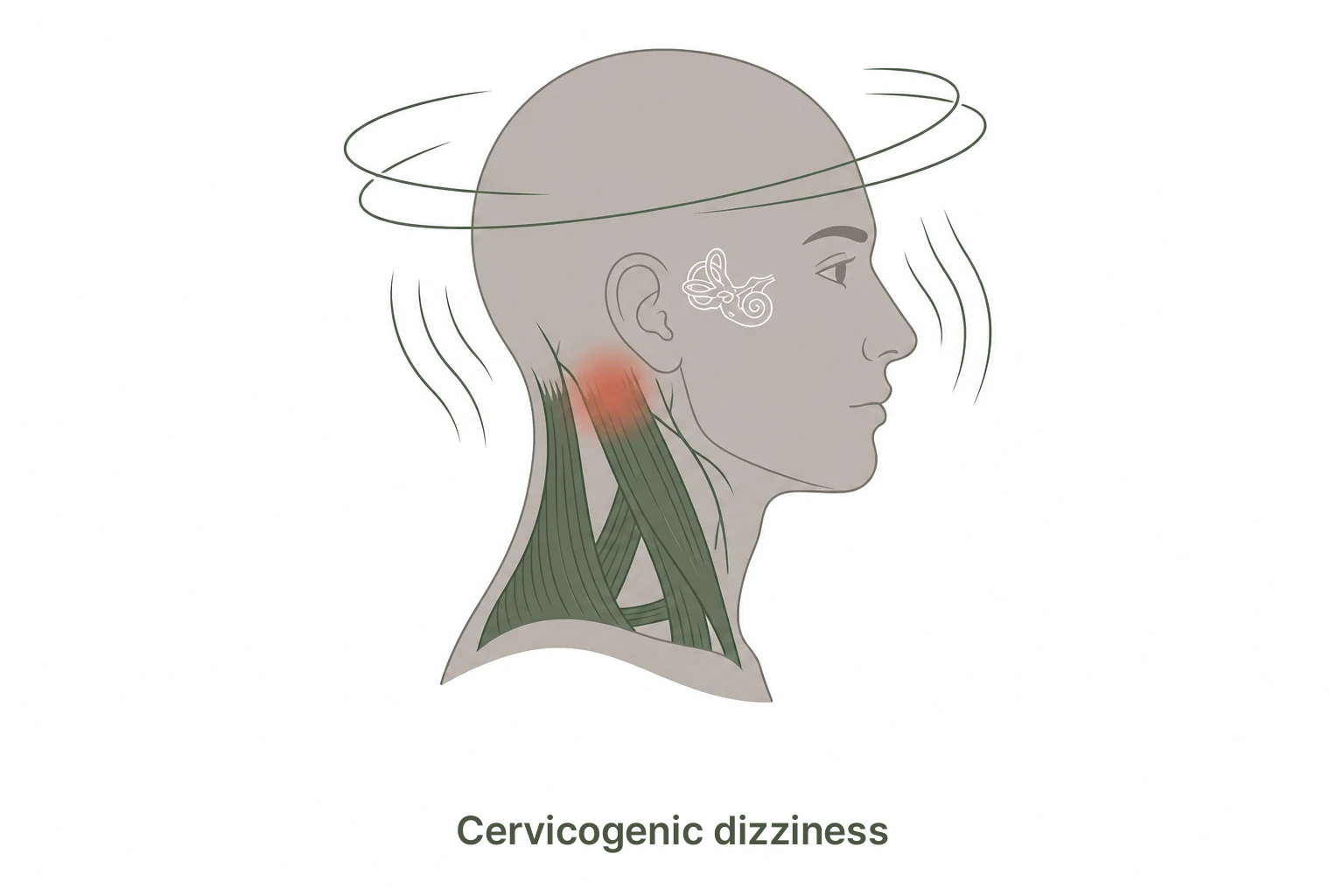
Quick Answer: Cervicogenic dizziness occurs when neck muscle and joint dysfunction distorts proprioceptive (balance sensing) signals sent to the brain. Distinguishing it from inner ear causes is important. It can improve with treatment focused on restoring cervical proprioception through our 3-stage Circulation Therapy.
Go to the emergency room immediately if:
- Sudden severe dizziness with vomiting, double vision, and slurred speech, which may signal a stroke
- Loud ringing in the ears with sudden hearing loss, which calls for ruling out BPPV or Menière’s disease
- Dizziness with arm or leg paralysis, or altered consciousness
- Severe dizziness that started suddenly after head or neck trauma
3 Key Points on This Page
- Why the neck can cause dizziness
- How cervicogenic dizziness differs from BPPV and Menière’s disease
- The 3-stage treatment approach to restore cervical proprioception
These symptoms may suggest cervicogenic dizziness
- Dizziness worsens when moving the neck. Turning or bending the head increases dizziness.
- Neck tension and headache accompany the dizziness. A stiff neck and headache come together with dizziness episodes.
- Eye fatigue and difficulty focusing. Screens and reading tire the eyes quickly.
- Dizziness worsens after prolonged sitting. Long computer sessions trigger or worsen dizziness.
- Possible tinnitus. Neck muscle tension can sometimes affect the muscles surrounding the ear.
Why can the neck cause dizziness?
Proprioceptive signal distortion. Tight neck fascia irritates cervical proprioceptors, the specialized sensors that tell the brain where your head and body are in space. When the signals from the neck don’t match those from the eyes, the brain interprets the mismatch as dizziness.
Postural overload. Forward head posture and rounded shoulders place excessive load on the upper cervical muscles. Sustained overload distorts proprioceptive signals and heightens nervous system sensitivity, leading to dizziness.
Difference from inner ear conditions. BPPV and Menière’s disease originate in the ear itself. The hallmark of cervicogenic dizziness is that symptoms change with neck movement and posture.
Cervicogenic vs BPPV: Key Differences
- Cervicogenic: worsens with neck movement or posture
- BPPV: brief intense spinning triggered by specific head positions
- Cervicogenic: often comes with neck tension and headache
- BPPV: may include ear fullness or ringing
- Accurate differentiation requires professional evaluation
Is it cervicogenic dizziness, or another cause?
Dizziness is not always related to the neck. Distinguishing it from BPPV (benign paroxysmal positional vertigo) and Ménière’s disease is important.
Cervicogenic Dizziness
- Dizziness correlates with neck position changes
- Accompanied by neck pain or shoulder tension
- Episodes often last several minutes or longer
- Provoked by turning the head in a specific direction
BPPV (Benign Paroxysmal Positional Vertigo)
- Intense spinning triggered by getting up from bed or rolling over. Lasts 30-60 seconds then stops
- Resolves on its own after a brief episode
- No neck pain. Dizziness occurs in isolation
- Confirmed with the Dix-Hallpike test
Ménière’s disease is characterised by tinnitus and hearing loss accompanying episodes of vertigo that last several hours and recur. The duration of dizziness (seconds vs. minutes vs. hours) combined with the presence or absence of tinnitus and hearing loss are the key distinguishing clues.
Our Approach at Yonsei SM Pain Clinic
Cervicogenic dizziness is addressed by releasing neck muscle tension and restoring cervical proprioception. We begin with a gait analysis to assess overall movement patterns.
- Phase 1: Calm (Circulation HD)
Release overactive neck muscles. Trigger point injections and fascial hydrodissection address the suboccipital muscles, trapezius, and sternocleidomastoid, the key muscles involved in cervicogenic dizziness. - Phase 2: Activate (Circulation PT)
Cervical proprioception training and gaze stabilization exercises are introduced. Movement correction addresses the postural patterns that overload the upper neck. - Phase 3: Integrate
Postural habits are connected to daily movements. Training continues so that balanced proprioceptive signals are maintained even during prolonged sitting or screen work.
Why don’t we look only at the neck?
Cervicogenic dizziness begins with distorted proprioceptive signals from the neck muscles. But the root cause of that neck tension often lies in gait patterns and pelvic stability. When the pelvis is unstable during walking, the proprioceptive burden on the cervical spine increases, and dizziness can recur. That is why at Yonsei SM Pain Clinic, we include gait analysis and pelvic stability assessment as part of every cervicogenic dizziness evaluation.
Daily Self-Care
Posture Habits
- Set monitor at eye level
- Take a 5-minute neck stretch break every hour
- Hold your phone up rather than looking down at it
- Use a pillow that supports the natural neck curve while sleeping
Warm Compress
- Apply a warm compress to the back of the neck 2-3 times daily, 15-20 minutes each
- A warm shower or bath helps relax neck muscles
- Cold packs and ice are not recommended as they can restrict blood flow
- Rest and seek care if dizziness becomes severe
Frequently Asked Questions
I was treated for BPPV but dizziness persists. Why?
If dizziness continues after BPPV treatment, a cervicogenic component may be co-existing. BPPV episodes can also leave behind residual neck tension that sustains dizziness. Evaluating both together is often helpful. Dizziness Q&A →
Will stretching my neck help with dizziness?
Gentle stretching can help reduce neck muscle tension that contributes to cervicogenic dizziness. Avoid sudden, forceful neck rotations or extreme positions. Slow, controlled movements are safer. If symptoms worsen with stretching, consult a specialist.
Dizziness is affecting my driving and daily life. What should I do?
When dizziness significantly interferes with daily activities, identifying the cause is the priority. Once the cause is treated, most people return to normal function. Avoid driving when dizziness is active and seek professional evaluation promptly.
Can correcting forward head posture improve dizziness?
Yes. For cervicogenic dizziness, correcting forward head posture reduces the excessive load on upper cervical muscles and decreases proprioceptive signal distortion, which can help reduce dizziness. Forward Head & Rounded Shoulders →
I get tension headaches and dizziness together. Are they related?
Yes. Overactive muscles in the back of the neck (especially suboccipital and trapezius) can produce both tension headaches and cervicogenic dizziness. These often stem from the same underlying muscle problem. What is Tension Headache? →
References
- Reid SA, Rivett DA. Manual therapy treatment of cervicogenic dizziness: a systematic review. Man Ther. 2005;10(1):4-13.
- Lystad RP, Bell G, Bonnevie-Svendsen M, Carter CV. Manual therapy with and without vestibular rehabilitation for cervicogenic dizziness: a systematic review. Chiropr Man Therap. 2011;19(1):21.
- Reiley AS, Vickory FM, Funderburg SE, Cesario RA, Clendaniel RA. Understanding dizziness as it relates to the cervical spine. J Orthop Sports Phys Ther. 2017;47(7):482-491.
- Biesinger E, Kipman U, Schätz S, Langguth B. Ginkgo special extract EGb 761 in the treatment of tinnitus with or without associated vertigo. HNO. 2020;68(11):844-853.
- Kang JH, Park RY, Lee SJ, Kim JY, Yoon SR, Jung KI. The effect of the forward head posture on postural balance in long time computer based worker. Ann Rehabil Med. 2012;36(1):98-104. PMID 22506241
- Sheikhhoseini R, Shahrbanian S, Sayyadi P, O’Sullivan K. Effectiveness of therapeutic exercise on forward head posture: a systematic review and meta-analysis. J Manipulative Physiol Ther. 2018;41(6):530-539. PMID 30107937
Related Articles
Dizzy but ear tests are normal?
We assess neck muscle function and proprioception to find the real cause and guide treatment.
3F Cheongdam Building, 413 Hakdong-ro, Gangnam-gu, Seoul (3 min walk from Gangnam-gu Office Station Exit 4)