Neck protruding forward, shoulders rolled inward?
Forward Head & Rounded Shoulders. Poor posture is where pain starts.
Extended computer and smartphone use causes neck to protrude forward and shoulders to roll inward. When this posture becomes fixed, it leads to various symptoms including neck, shoulder, headache, and arm numbness.
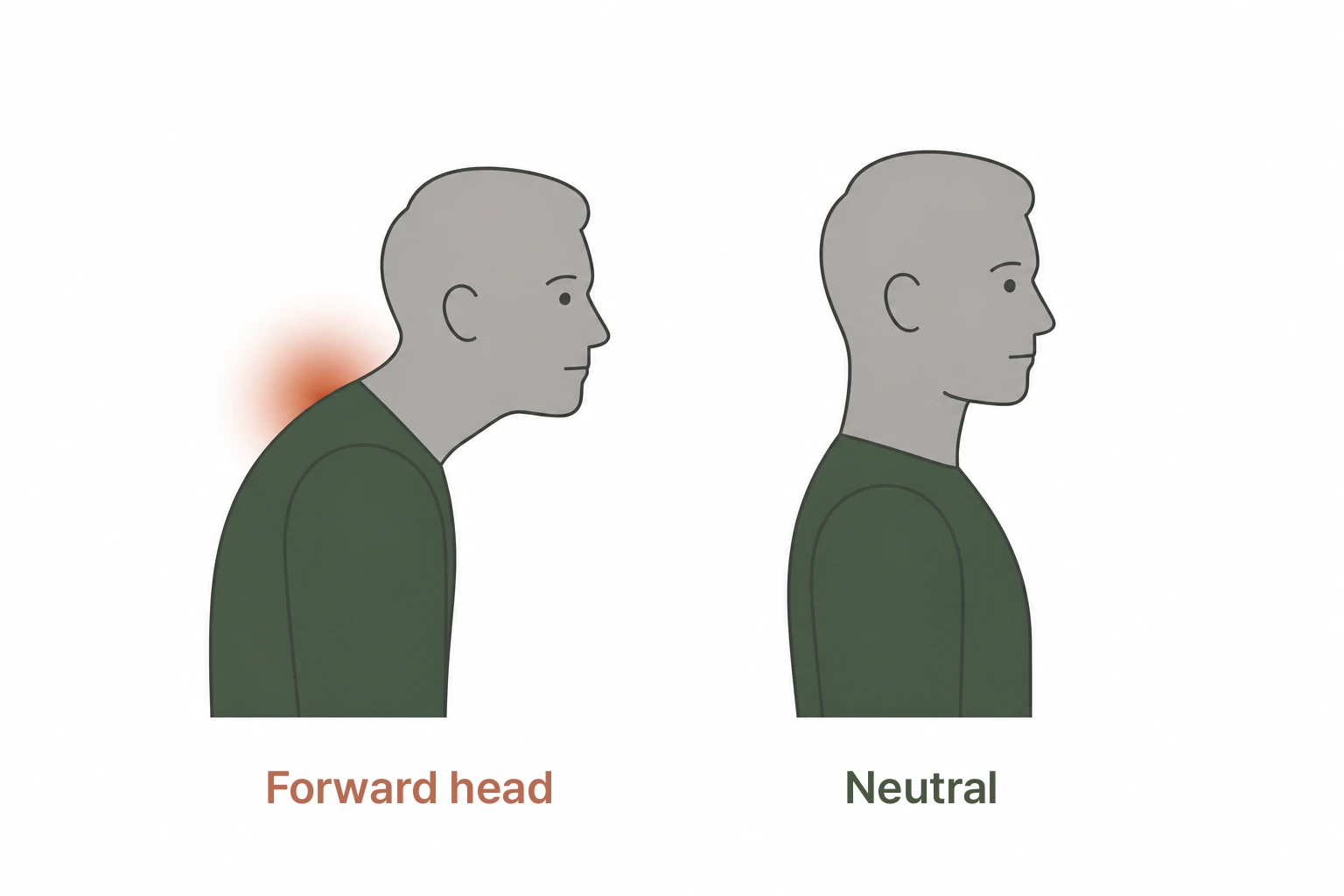
Quick Answer: Forward head and rounded shoulders are postural patterns involving neck and shoulder hypertension (front/upper) and weakness (back/lower) together. Stretching alone provides temporary improvement but easily returns to stiffness, so releasing the tight tissues first and then awakening weakened function in sequence is helpful.
Seek medical attention quickly if:
- Progressive arm and hand weakness or decreased sensation
- Severe night pain that wakes you or worsens despite rest
- Dizziness, vision changes, or nausea occurring repeatedly
- Neck pain persists or progressively worsens after trauma
3 Key Points on This Page
- Why forward head & rounded shoulders cause pain
- Whether posture correction alone is sufficient or treatment needed
- Effective posture correction methods
These symptoms suggest forward head & rounded shoulders
- The back of the neck and shoulders are always stiff. It gets especially worse in the afternoon.
- Frequent headaches. They start at the back of the head and spread to the sides and behind the eyes.
- The neck looks pushed forward in the mirror. From the side, the ears sit in front of the shoulders.
- A rounded upper back with rolled shoulders. The shoulders come forward on their own, without any effort.
- Arm numbness or cold hands. Nerve compression in the neck sends symptoms down the arms.
Why does forward head cause pain?
A normal neck maintains a C-curve to efficiently support head weight (about 5kg).
However, when the neck protrudes forward, load on the neck increases by 2-3kg for every 1cm the head moves forward. In forward head posture, the neck must support 15-20kg.
When this overload continues, neck muscles tighten, disc pressure increases, and nerves can become compressed.
Chain Reaction of Forward Head
- As the neck moves forward, the upper trapezius becomes overtensed.
- As the shoulders roll inward, the thoracic spine curves.
- As the shoulder blades spread apart, impingement risk rises.
- As breathing turns shallow, diaphragm function declines.
Forward Head Self-Check
Stand with your back against a wall.
- Place your heels, buttocks, and back against the wall.
- Does the back of your head naturally touch the wall?
- If it touches without tucking your chin, your posture is normal. If it doesn’t touch, or you have to tuck your chin, that points to forward head.
Long-standing forward head is difficult to correct with simple stretching alone. Tight fascia and weakened deep muscles must be addressed together.
Why don’t we look only at the neck?
Forward head is not just a neck problem. Research shows that the postural chain running from the pelvis through the lower back and thoracic spine up to the neck determines head position. A tilted pelvis changes lumbar curve, rounds the thoracic spine, and ultimately pushes the head forward.
Upper Back / Thoracic Spine
When the thoracic spine is stiff, the neck must compensate with excessive movement. Studies report that combining thoracic mobilization with exercise can help improve forward head posture.
Pelvis
Pelvic alignment determines lumbar curve, and lumbar curve determines thoracic rounding. Correcting from the ground up is what helps the neck find its proper position.
Breathing
In a forward head posture, the diaphragm cannot move fully, leading to shallow breathing. Shallow breathing creates a vicious cycle by further tensing the accessory neck and shoulder muscles.
Systematic review evidence suggests that therapeutic exercise addressing the full postural chain helps improve forward head posture. That is why at Yonsei Shinmyung Pain Clinic, gait analysis and pelvis/thoracic assessment are performed together during neck consultations.
Is it forward head posture, or something more serious?
Forward head posture and cervical disc herniation can look very similar at first, which is why it’s worth knowing the difference.
Forward Head Posture (Myofascial)
- General aching across both sides of the neck and shoulders
- Muscular pain. The area feels knotted when pressed
- Worsens with prolonged sitting. Temporarily eases with movement
- Any arm tingling does not extend clearly to the fingertips
Cervical Disc Herniation
- Numbness or tingling travels down one arm to the fingers
- Symptoms shift when you move your head to different positions
- Possible arm weakness or reduced sensation in the hand
- Tingling persists regardless of posture changes
Both conditions can coexist. Long-standing forward head posture can eventually contribute to cervical disc herniation or myofascial pain syndrome. If you notice arm tingling, hand weakness, or symptoms that change with head position, an evaluation to distinguish the two is the right first step.
These two are not separate problems. They are connected.
When swollen muscles keep pressing on the nerve, the nerve itself becomes damaged.
That is why we look at what changes when the area is pressed and moved.
Our Approach at Yonsei Shinmyung Pain Clinic
Forward head & rounded shoulders require more than ‘posture correction’ alone. We assess the full postural chain, release tight fascia, and awaken weakened muscles.
- Whole-body assessment, gait analysis and a pelvis and thoracic evaluation
We first assess gait pattern, pelvic tilt, and thoracic mobility. This is the step to identify where the source of neck pain originates. - Stage 1: We bring the swelling down
Release trigger points in hypertensive upper trapezius, sternocleidomastoid, and suboccipital muscles. When needed, fascia around the thoracic spine and breathing muscles are also released. - Stage 2: We wake the muscles up
Strengthen weakened deep neck flexors, lower trapezius, and serratus anterior. Pelvis stabilizing muscles and diaphragmatic breathing are restored together. - Stage 3: We make the movement stick
Learn to maintain postural balance throughout the whole body, from pelvis to neck, in daily life. Gait correction, monitor height, and breathing habits are all reviewed.
Posture Correction Tips for Daily Life
Monitor Position
- Monitor top at eye level
- Distance from screen: about arm’s length
- For laptop use: separate keyboard + stand
Smartphone Use
- Raise smartphone to eye level
- Minimize head-down time
- Neck stretching every 30 minutes
Frequently Asked Questions
Computer work makes my neck hurt more, is it from forward head?
The longer you sit looking at screen, the easier for head to come forward, making back of neck and upper shoulders stiffer. If pain repeats, checking posture, work environment, and movement patterns together is good. Computer Work Neck Pain Q&A →
What order for posture correction?
First release the tight muscles and fascia, then progressively strengthen the weakened muscles for a safe flow. Finally, creating sustainable daily habits is important. Posture Correction Q&A →
Why is neck stiff upon waking?
Sleep posture, pillow height, and accumulated daytime muscle tension can make mornings stiffer. If it repeats for several days, checking neck condition and lifestyle patterns together is good. Morning Neck Stiffness Q&A →
Office worker – how to prevent?
Adjusting monitor height, chair and armrests, and keyboard and mouse position, plus brief movement every hour helps. ‘Frequent and brief’ beats ‘long once’ is key. Office Worker Prevention Q&A →
Can forward head cause headaches too?
Neck muscle tension can lead to headaches. Especially if heavy back-of-head or eye fatigue headaches repeat, checking neck connection together is worthwhile. Back-of-Head Headache Q&A →
Can arm numbness be from neck?
If nerves are irritated in neck, numbness or sensory changes can extend to arms and hands. If symptoms repeat or weakness occurs, evaluation is needed. Arm Numbness Q&A →
Will stretching alone help?
It can help initially, but long-standing postural patterns can easily return. If pain repeats, designing release, strengthening, and daily habits together is good. Posture Correction Q&A →
Is there criteria for needing examination or treatment?
If pain persists despite rest or lifestyle adjustments, or if numbness or weakness accompanies it, cause evaluation is priority. Even with normal imaging, functional issues can cause pain. Normal MRI Pain Q&A →
Related Articles
Neglecting forward head makes it worse
Check your posture now and start fundamental correction.
Book OnlineReferences
- Cho J, Lee E, Lee S. Upper thoracic spine mobilization and mobility exercise versus upper cervical spine mobilization and stabilization exercise in individuals with forward head posture: a randomized clinical trial. BMC Musculoskelet Disord. 2017;18(1):525. PMID 29233164
- Quek J, Pua YH, Clark RA, Bryant AL. Effects of thoracic kyphosis and forward head posture on cervical range of motion in older adults. Man Ther. 2013;18(1):3-8. PMID 22959228
- Legaye J, Duval-Beaupere G, Hecquet J, Marty C. Pelvic incidence: a fundamental pelvic parameter for three-dimensional regulation of spinal sagittal curves. Eur Spine J. 1998;7(2):99-103. PMID 9629932
- Sheikhhoseini R, Shahrbanian S, Sayyadi P, O’Sullivan K. Effectiveness of therapeutic exercise on forward head posture: a systematic review and meta-analysis. J Manipulative Physiol Ther. 2018;41(6):530-539. PMID 30107937
- Koseki T, Kakizaki F, Hayashi S, Nishida N, Itoh M. Effect of forward head posture on thoracic shape and respiratory function. J Phys Ther Sci. 2019;31(1):63-68. PMID 30774207