Why Does My Pinky Finger Go Numb at My Office Job?
Pinky finger numbness occurs when the ulnar nerve is compressed at the elbow or wrist. Office workers are particularly susceptible because leaning elbows on desks or prolonged keyboard and mouse use causes sustained compression of this nerve.
Two Common Sites of Ulnar Nerve Compression
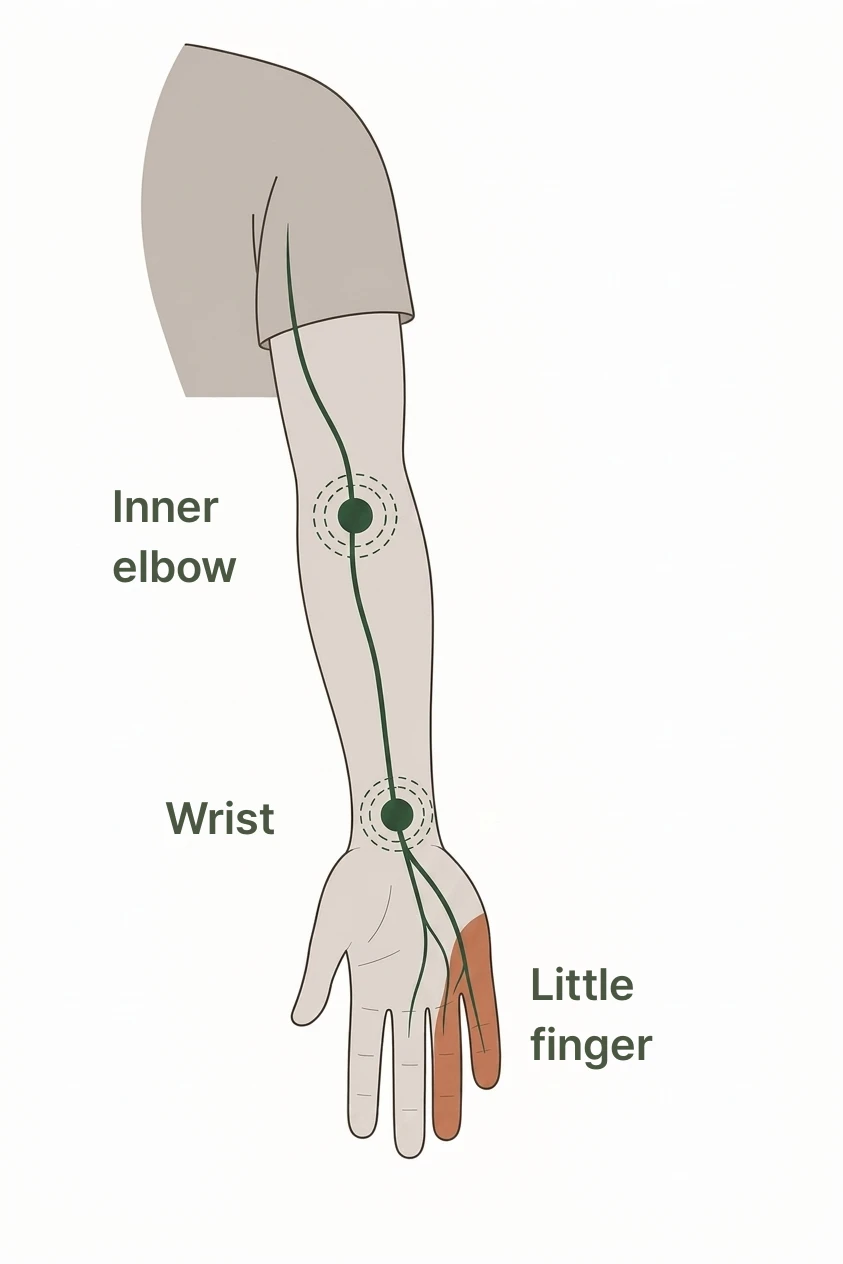
The ulnar nerve runs from the elbow to the fingertips. Compression typically occurs at two locations.
Inside the Elbow (Cubital Tunnel Syndrome)
The most common compression site. When you bend your elbow, the space through which the nerve passes narrows, and leaning your elbow on a desk directly compresses the nerve.
- Aching inside the elbow
- Worse in the morning after sleeping with bent elbow
- Worsens during phone calls with elbow bent
Wrist (Guyon’s Canal Syndrome)
When your wrist bends outward while using a mouse or when you press the desk edge with your palm, the nerve gets compressed at the wrist.
- Numbness on the palm side of the pinky finger
- Less numbness on the back of hand (different nerve)
- Weakened grip, dropping objects
Difference from Cervical Disc
Cervical disc issues cause numbness in multiple fingers along with neck pain. If primarily the pinky finger is numb, it’s likely an ulnar nerve problem.
Why Is This Common in Office Workers?
1. Leaning Elbows on Desk
When concentrating, we unconsciously lean our elbows on desks or armrests, directly compressing the nerve. If sustained for over 2 hours, it can cause swelling inside the nerve.
2. Keyboard Typing Posture
Standard keyboards are narrower than shoulder width, causing hands to converge inward and wrists to bend outward. This posture compresses the nerve pathway at the wrist.
3. Wrist Compression During Mouse Use
When moving the mouse, if the wrist lifts up or the palm presses against the desk edge, the nerve inside the wrist gets compressed.
4. Sleep Posture
Unconsciously bending the elbow while sleeping stretches and compresses the nerve all night, making symptoms worse in the morning.
Workstation Ergonomic Improvements
Keyboard Setup
- Split Keyboard. Separate hands to shoulder width to prevent wrist from bending outward.
- Keyboard Angle. Fold keyboard legs down to keep wrist flat, not bent upward.
- Wrist Rest. Keep wrists floating while typing, use rest only during breaks.
Mouse Setup
- Properly Sized Mouse. Must fit your hand to avoid excessive gripping force.
- Same Height as Keyboard. Position close to body to avoid reaching far.
- Consider Vertical Mouse. Can reduce excessive forearm pronation.
- Wrist Rest. Use soft pad to prevent palm from touching desk edge.
Elbow Protection
- Chair Armrests. Replace with soft material or avoid direct elbow contact.
- Desk Edge Padding. Attach soft padding where elbows contact desk.
Sleep Posture Management
- Elbow Splint. Keep loosely fixed at about 45 degrees to prevent excessive bending overnight.
- Towel Wrap. Can use towel instead of splint to gently secure elbow.
Why Treating Only the Wrist Isn’t Enough
Viewing pinky numbness as only a wrist problem and treating the wrist alone may result in symptom recurrence or minimal treatment effect.
Double Crush Syndrome
If a nerve is compressed at one point, it becomes more vulnerable to compression at another point. When there’s mild compression at the neck or shoulder, additional compression at the wrist or elbow makes symptoms much worse.
1. Neck and Shoulder Influence
Forward head posture and rounded shoulders common in office workers narrow the space between C8 and T1 vertebrae. This is where the ulnar nerve originates, and compression here makes finger numbness more likely and persistent.
2. Scalene Muscle Tension
When the scalene muscles in the front of the neck are tight, they compress the nerve at its origin. Research shows that office workers with neck pain experience decreased ulnar nerve conduction velocity after just 1 hour of computer use.
3. Treating the Entire Pathway Together
Fundamental treatment requires identifying and resolving all compression points along the entire pathway from neck to shoulder to elbow to wrist. Releasing only one site leads to easy recurrence.
Three Keys to Fundamental Treatment
Secure the Entire Nerve Pathway
Relieve compression at all points where the nerve passes from neck to fingers. Use Circulation HD to release muscle and tissue adhesions, creating space for the nerve to move freely.
Strengthen Nerve-Supporting Muscles
Wake and strengthen weakened shoulder and arm muscles to protect the nerve from compression. Use Circulation PT to achieve scapular stabilization and forearm muscle balance.
Correct Posture and Movement Patterns
Correct work posture and movement patterns to reduce recurrence risk. Learn postures through movement training that don’t burden the nerve in daily activities.
Simple Stretching (Neural Mobilization)
Nerves must glide smoothly between surrounding tissues. Prolonged static postures cause adhesions that produce pain.
Waiter Stretch
- Extend arm to the side with palm facing up.
- Bend elbow to bring hand near ear (like a waiter carrying a tray).
- Slowly tilt neck to opposite side and return.
- Repeat 5-10 times, 3-5 times daily.
Caution: Should not cause strong pain. Perform briefly and frequently within a range that produces only mild tingling or pulling.
Correcting Muscle Imbalances
- Intrinsic Hand Strengthening. Finger spreading with rubber bands, soft ball squeezing
- Scapular Stabilization. Strengthen rhomboids and lower trapezius to prevent shoulder rounding forward
- Forearm Muscle Release. Release forearm flexor tension to reduce cubital tunnel compression
Shake Hands Every 20 Minutes
Shaking your hands and stretching your fingers every 20 minutes during work improves circulation around the nerve.
Circulation Therapy Relieves Nerve Compression
If symptoms are already present, prevention alone is insufficient. You need to release adhesions and compression around the nerve and correct posture.
Stage 1: Calm
Circulation HD gently releases tense muscles and adhered tissue around the nerve.
Stage 2: Wake
Circulation PT awakens weakened shoulder and arm muscles to secure space for the nerve pathway.
Stage 3: Make it stick
Work-specific movement training may help reduce recurring symptoms during daily activities.
Seek Treatment Promptly If You Experience:
- Symptoms persisting over 6 weeks
- Weakened grip causing frequent dropping of objects
- Muscle wasting between fingers
- Pinky finger keeps spreading apart (Wartenberg’s sign)
- Must bend thumb tip joint to hold paper (Froment’s sign)
These symptoms signal progressing nerve damage. Without early treatment, recovery may become difficult.
Related Questions
References
- Palmer BA, Hughes TB. Cubital tunnel syndrome. J Hand Surg Am. 2010;35(1):153-163. PMID 21443055
- Svernlov B et al. Conservative treatment of the cubital tunnel syndrome. J Hand Surg Eur. 2009;34(2):201-207.
- Caliandro P et al. Treatment for ulnar neuropathy at the elbow. Cochrane Database Syst Rev. 2016;11:CD006839.
- Thomsen JF, Gerr F, Atroshi I. Carpal tunnel syndrome and the use of computer mouse and keyboard: a systematic review. BMC Musculoskelet Disord. 2008;9:134. PMC2427008