Waking up every night with numb hands?
Carpal Tunnel Syndrome. A nerve is being compressed in your wrist.
Your thumb, index, and middle fingers feel numb, worse at night, and improve when you shake your hands. Common in those who use their wrists frequently, but can also develop from diabetes or thyroid problems.
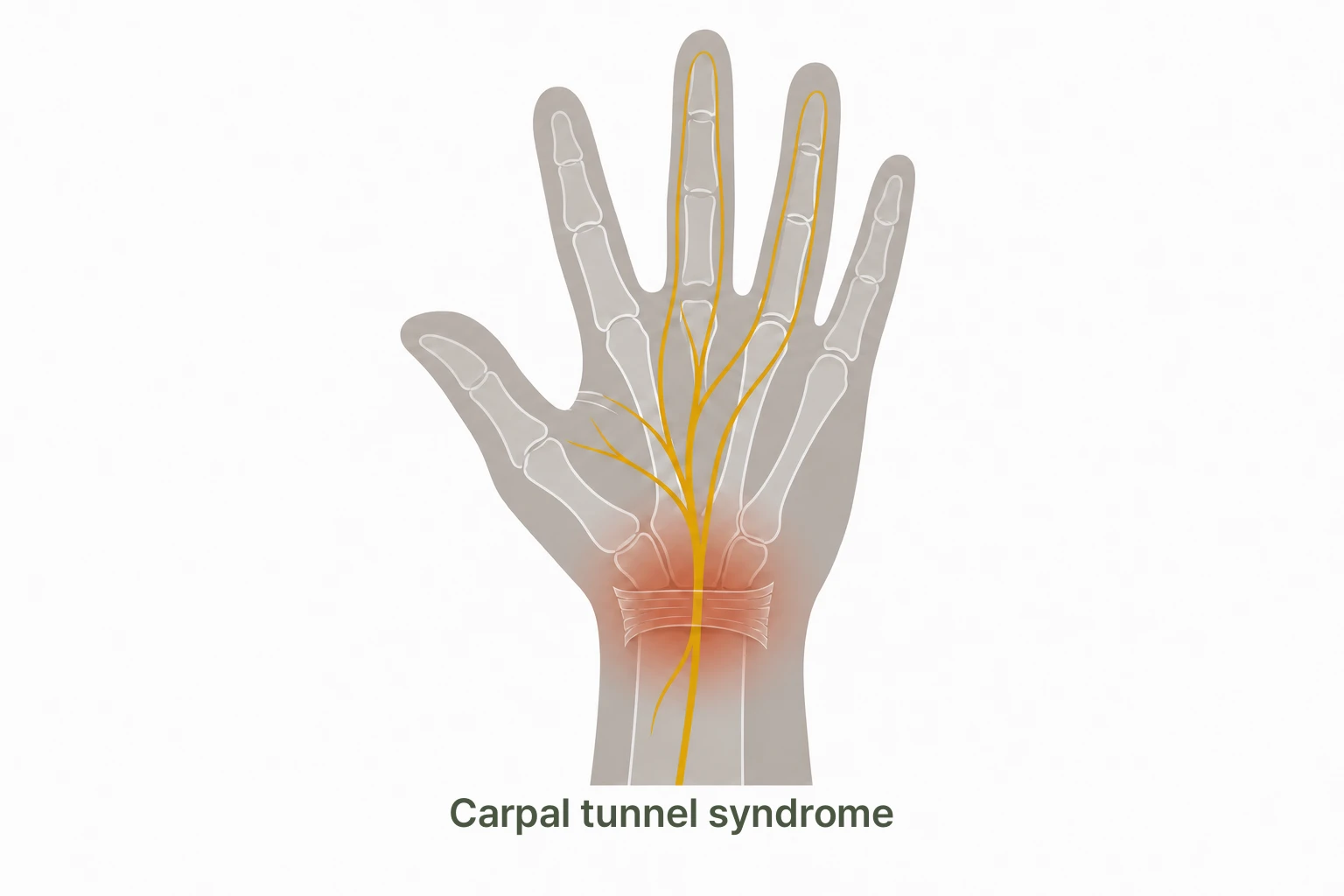
Quick Answer: Carpal tunnel syndrome occurs when the median nerve is compressed in the narrow passageway of the wrist, causing hand numbness and nighttime symptoms. The approach is to calm the pain first, then restore nerve gliding and healthier wrist habits, and finally keep it from coming back in daily life.
Seek medical attention quickly if:
- Visible muscle wasting in the thumb or frequently dropping objects
- Numbness progressively worsening with sensory decline
- Hand numbness expanding to arm and shoulder
- Rapid symptom worsening after trauma
3 Key Points on This Page
- Typical symptoms of carpal tunnel syndrome
- When surgery is needed and when it isn’t
- Non-surgical treatment methods
These symptoms suggest carpal tunnel syndrome
- Numbness in 1st-3rd fingers. Thumb, index, middle finger, and half of ring finger feel numb.
- Worse at night. Wake up from numbness, improve when shaking hands.
- Worsens when bending wrist. Smartphone use, driving, holding books.
- Frequently dropping objects. Weakened thumb muscles reduce grip strength.
- Swollen feeling in hands. Sensation of swelling even without actual swelling.
Why does carpal tunnel syndrome develop?
The front of the wrist has a narrow passageway (carpal tunnel) surrounded by bones and ligaments. The median nerve and 9 tendons pass through this tunnel.
When the nerve is compressed in this narrow space, numbness occurs. Causes include the following.
- Repetitive use. Frequent wrist use causes tendon swelling and nerve compression.
- Swelling. Pregnancy, hypothyroidism, rheumatoid arthritis, etc.
- Anatomical structure. Congenitally narrow tunnel.
- Diabetes. Nerves become more vulnerable to compression.
Self-Test: Phalen’s Test
- Place backs of both hands together
- Hold wrists bent at 90 degrees for 60 seconds
- Positive if 1st-3rd fingers become numb
※ Self-tests are for reference only. Nerve conduction studies may be needed for accurate diagnosis.
When is surgery needed?
Most carpal tunnel syndrome cases improve with non-surgical treatment. However, surgery is considered in these cases.
Surgery Candidates
- Visible thumb muscle atrophy
- No response to conservative treatment for 6+ months
- Severe nerve damage on nerve conduction study
- Significantly reduced sensation
Non-Surgical Treatment Possible
- Mild symptoms
- Short duration of symptoms
- No muscle atrophy
- Temporary cause (pregnancy, etc.)
Is it carpal tunnel syndrome, or something else?
Not all hand numbness is carpal tunnel syndrome. Cervical disc herniation (C6) can cause very similar symptoms and is often confused with it.
Carpal Tunnel Syndrome
- Numbness mainly in the thumb, index, and middle fingers
- Worse at night. Shaking the hand gives temporary relief.
- No symptoms above the elbow
- Phalen’s test: wrist flexion for 1 minute worsens numbness
Cervical Disc Herniation (C6 nerve root)
- Numbness travels from the neck and shoulder down through the arm to the hand
- Symptoms change with head position
- Pain in the shoulder and upper arm often accompanies the numbness
- Possible arm weakness or reduced reflexes
Double crush syndrome is also possible, meaning nerve compression occurs at both the neck and wrist simultaneously. In that case, treating the wrist alone may not fully resolve symptoms. If numbness extends from the hand all the way up to the neck and shoulder, both areas should be evaluated together.
The causes listed here all come down to a compressed nerve.
Only the site of compression differs, so the symptoms overlap.
What changes when the area is pressed and moved is the firmer clue, and the final call is made in the consultation.
Our Approach at Yonsei SM Pain Clinic
Carpal tunnel syndrome requires creating space around the nerve and correcting wrist use patterns.
- Phase 1. Calm the pain (Circulation HD)
Under ultrasound guidance, we perform hydrodissection around the median nerve. We release adhesions surrounding the nerve and create space. - Phase 2. Restore function (Circulation PT)
Nerve gliding exercises, wrist stretching, and forearm strengthening. - Phase 3. Reduce recurrence risk
Correct wrist brace usage, keyboard and mouse posture, and sleeping positions.
Carpal Tunnel Syndrome Self-Care
What You Can Do Now
- Wear wrist brace (especially during sleep)
- Avoid wrist-bending postures
- Adjust keyboard/mouse height
- Use cushion under wrist
- Reduce smartphone use
Nerve Gliding Exercise
- Extend wrist back and open fingers
- Straighten arm forward
- Gently pull fingers with other hand
- Hold 10 seconds, repeat 10 times
- 3 sets daily
If thumb muscles visibly shrink or you frequently drop objects, seek prompt medical care. Nerve damage becomes harder to reverse if it progresses.
Frequently Asked Questions
Where does numbness occur in carpal tunnel syndrome?
Carpal tunnel typically causes numbness in the thumb, index, and middle fingers, but patterns vary individually. We assess numbness location and triggering movements together. Numbness Location Q&A →
Does numbness in specific fingers have meaning?
Numbness distribution helps estimate the cause, but cannot be definitively determined by one factor alone. Assessment of symptoms along with posture and work environment is needed. Finger Numbness Q&A →
Does heavy keyboard and mouse use worsen it?
Prolonged repetition of wrist-bending postures can worsen symptoms. Adjusting wrist angle, supports, and rest routines helps. Keyboard Posture Q&A →
My wrist hurts when using a mouse. Is it carpal tunnel?
Wrist pain can have various causes besides carpal tunnel, including tendon problems and myofascial tension. We assess pain location and movement patterns together. Mouse Wrist Pain Q&A →
What should I check if the wrist itself hurts?
When numbness and pain coexist, we examine wrist structure, tendons, and nerve condition together. Assessment is needed to determine if it’s simple overuse or nerve compression. Wrist Pain Q&A →
Can neck problems cause hand numbness?
Nerve irritation in the neck can cause numbness extending to the arm and hand. We differentiate by examining numbness distribution and movement-related changes. Arm Numbness Q&A →
Why does it improve then recur?
If wrist use patterns and lifestyle habits remain unchanged, symptoms can repeat. Changing patterns that cause recurrence alongside pain control is important. Recurrence Q&A →
What is the treatment sequence?
We create space around the nerve, restore nerve gliding and forearm function, then build daily habits that reduce wrist strain. Circulation Therapy Introduction →
References
- Padua L et al. Carpal tunnel syndrome: clinical features, diagnosis, and management. Lancet Neurol. 2016;15(12):1273-1284.
- Ashworth NL. Carpal tunnel syndrome. BMJ Clin Evid. 2016;2016:1114.
- Shi Q, MacDermid JC. Is surgical intervention more effective than non-surgical treatment for carpal tunnel syndrome? A systematic review. J Orthop Surg Res. 2011;6:17.
- Huisstede BM et al. Carpal tunnel syndrome: hand surgeons, hand therapists, and physical medicine specialists reach consensus on treatment. Arch Phys Med Rehabil. 2010;91(7):1104-1110.
- Bland JD. The relationship of obesity, age, and carpal tunnel syndrome: more complex than assumed? Muscle Nerve. 2005;32(4):527-532.
Related Articles
Struggling with nightly hand numbness?
We create space around the nerve and correct wrist use patterns.
Book Online