Neck and shoulders are tight, and pressing them hurts elsewhere?
Myofascial Pain Syndrome — Trigger points in muscles are the cause.
When you press a specific area, you get that “that’s the spot!” feeling, and the pain spreads to your head or shoulders. Massage provides temporary relief but tightness returns quickly.
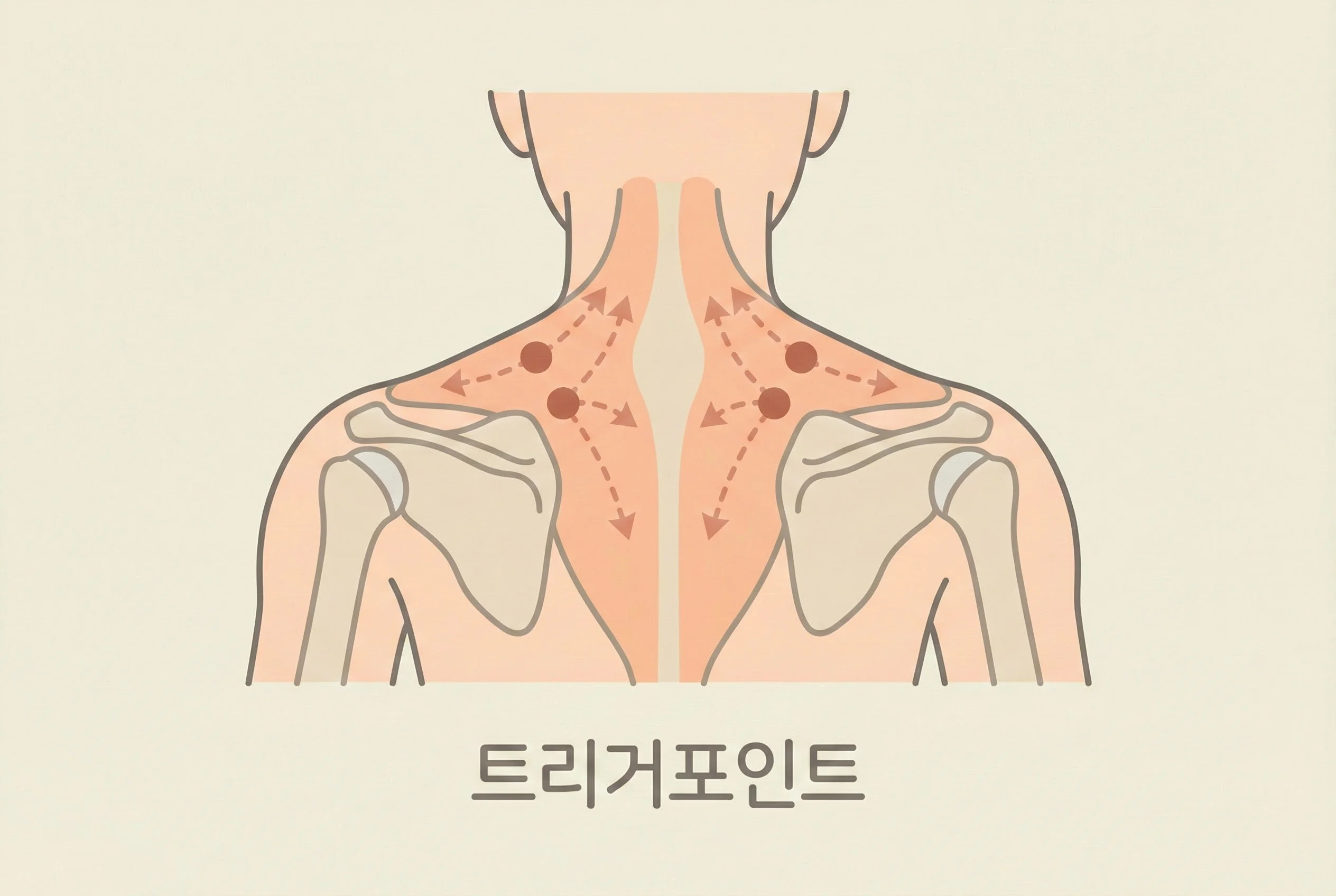
Quick Answer: Myofascial pain syndrome involves trigger points (hard tension points) in muscles that create pain and often cause referred pain to other areas. If you experience repeated cycles of ‘temporary relief from massage followed by tightness returning,’ an approach that accurately identifies tension points (Downshift) and restores function to prevent re-tightening (Activate·Integrate) is helpful.
Seek medical attention quickly if:
- Progressive arm/hand weakness or decreased sensation
- Systemic symptoms like fever, chills, or weight loss
- Severe night pain that wakes you and progressively worsens
- Pain persists or worsens after trauma
3 Key Points on This Page
- What trigger points are and why they form
- Referred pain patterns — why other areas hurt
- Why massage alone doesn’t work and effective treatment methods
These symptoms suggest myofascial pain syndrome
- Pressing a specific area gives “that’s the spot!” pain — Pressing a tight knot causes sharp or aching pain.
- Pain spreads to other areas when pressed (referred pain) — Pressing the neck triggers headaches, or pressing the shoulder causes arm numbness.
- Temporary improvement after massage, quick recurrence — No matter how much you massage, tightness returns without fundamental resolution.
- Worsens with prolonged postures — Computer work, driving, or sitting for long periods makes it worse.
- Stiff in the morning, improves with movement — Tight upon waking, gradually loosens with activity.
Why do trigger points form?
Trigger points are hyperactive areas within muscles. Muscle fibers that should normally relax remain contracted and hardened.
- Overuse — Repeatedly using the same muscles or sustained tension
- Postural problems — Forward head, rounded shoulders and other imbalances concentrate load on specific muscles
- Poor circulation — Reduced blood flow leads to waste accumulation and increased muscle tightness
- Stress — Psychological tension translates to muscle tension
- Post-injury sequelae — Areas that haven’t properly recovered after injury
Referred Pain Patterns
The characteristic of trigger points is that pain spreads to areas other than where pressed.
- Trapezius → Back and side of head headaches
- Suboccipital muscles → Behind-eye pain, eye fatigue
- Sternocleidomastoid → Forehead, behind-ear pain
- Levator scapulae → Side neck, shoulder blade area pain
Why massage alone isn’t enough?
Massage relieves superficial tension but has difficulty reaching deep trigger points.
- Only superficial layers released — Massage stimulates only skin and shallow muscle layers. Deep trigger points remain.
- Temporary relaxation — Blood flow improves briefly but the root cause (hyperactive motor endplates) isn’t resolved.
- Compensation patterns persist — If other muscles’ substitution patterns don’t change, tightness returns.
This doesn’t mean massage has no effect at all. However, trigger point treatment + movement correction together are needed for fundamental resolution.
Our Approach at Yonsei SM Pain Clinic
Myofascial pain syndrome requires addressing not just ‘releasing tight areas’ but the underlying cause of tightness.
- Phase 1: Downshift (Circulation HD)
Trigger point injections (TPI) directly stimulate and relax hyperactivated motor endplates. Fascial hydrodissection releases adhered fascial layers. - Phase 2: Activate (Circulation PT)
Awaken weakened deep muscles (prime movers) and reduce burden on overused superficial muscles. - Phase 3: Integrate
Correct postural problems like forward head and rounded shoulders, and establish habits for maintaining proper posture in daily life.
Why don’t we look only at the neck?
Myofascial trigger points are not just a local problem. Gait pattern abnormalities or pelvic imbalance can overload the upper trapezius, creating trigger points. In addition, shallow chest breathing keeps the accessory neck and shoulder muscles in constant tension. That is why Yonsei SM Pain Clinic evaluates gait and pelvis/thoracic spine together.
What is Trigger Point Injection (TPI)?
One of the core techniques in Circulation HD, Trigger Point Injection, directly stimulates hyperactivated motor endplates to release tension.
Procedure Method
- Accurate location identified via ultrasound or palpation
- Dry needling or small amount of saline injection
- Quick stimulation resets muscle spindles
- Procedure time: 10-20 minutes
Features
- Steroid-free
- Immediate tension relief
- Resume daily activities immediately after
- Repeatable with minimal side effects
Frequently Asked Questions
MRI is normal, so why does it keep hurting?
Functional issues like fascial tension or nerve sensitization may not clearly show on imaging. Sometimes symptom and movement pattern evaluation is needed together. Normal MRI Pain Q&A →
I exercise but why does it still hurt?
Rather than exercise itself being bad, repeating inappropriate intensity or movements for your current condition can maintain pain. It’s better to first calm ‘tension causing pain,’ then gradually adjust your routine. Exercise Still Hurts Q&A →
Why does it improve then tighten again?
If posture, work environment, and sleep patterns remain the same, tension can accumulate again in the same areas. Changing patterns that cause recurrence is important along with pain control. Recurrence Q&A →
How long does treatment take?
It varies depending on pain duration, tension extent, and lifestyle patterns. Generally both ‘pain calming phase’ and ‘function restoration phase’ are needed together. Treatment Duration Q&A →
Can I keep getting injections?
Repeat plans vary by injection type and purpose. An approach addressing adhesions, tension, and function together rather than just briefly reducing symptoms can be helpful. Injections Q&A →
Office worker with constantly stiff neck and shoulders. How to manage?
Adjusting monitor height, chair/armrests, and keyboard/mouse position, plus brief movement every hour helps. ‘Frequent and brief’ beats ‘long once’ is key. Office Worker Management Q&A →
Is headache with neck pain related to myofascial pain?
Trigger points around the neck can have referred pain patterns leading to headaches. If back-of-head or temple headaches repeat, checking together is worthwhile. Headache Types Q&A →
Is there a routine I can do at home right away?
Small changes like brief rest, stretching, breathing, and workspace adjustments can help. If pain persists, cause evaluation comes first. Posture Correction Q&A →
References
- Gerwin RD. Classification, epidemiology, and natural history of myofascial pain syndrome. Curr Pain Headache Rep. 2001;5(5):412-420.
- Tough EA, White AR, Cummings TM, Richards SH, Campbell JL. Acupuncture and dry needling in the management of myofascial trigger point pain: a systematic review and meta-analysis of randomised controlled trials. Eur J Pain. 2009;13(1):3-10. PMID 18395479
- Dommerholt J, Bron C, Franssen J. Myofascial trigger points: an evidence-informed review. J Man Manip Ther. 2006;14(4):203-221. PMC2565076
- Fernández-de-las-Peñas C, Dommerholt J. International consensus on diagnostic criteria and clinical considerations of myofascial trigger points. Pain Med. 2018;19(1):142-150.
- Simons DG. Review of enigmatic MTrPs as a common cause of enigmatic musculoskeletal pain and dysfunction. J Electromyogr Kinesiol. 2004;14(1):95-107. PMID 14759755
- Cho J, Lee E, Lee S. Upper thoracic spine mobilization and mobility exercise versus upper cervical spine mobilization and stabilization exercise in individuals with forward head posture: a randomized clinical trial. BMC Musculoskelet Disord. 2017;18(1):525. PMID 29233164
- Sheikhhoseini R, Shahrbanian S, Sayyadi P, O’Sullivan K. Effectiveness of therapeutic exercise on forward head posture: a systematic review and meta-analysis. J Manipulative Physiol Ther. 2018;41(6):530-539. PMID 30107937
Related Articles
Break the cycle of repeated tightness
We accurately identify trigger points for treatment and resolve root causes to prevent re-tightening.
Book Online