Thumb-side wrist pain that makes it hard to pick things up?
De Quervain’s tenosynovitis — the sheath wrapping your thumb tendons is inflamed.
If your thumb-side wrist hurts after carrying a baby or extended smartphone use, check for this. Severe pain on Finkelstein’s test strongly points to De Quervain’s tenosynovitis.
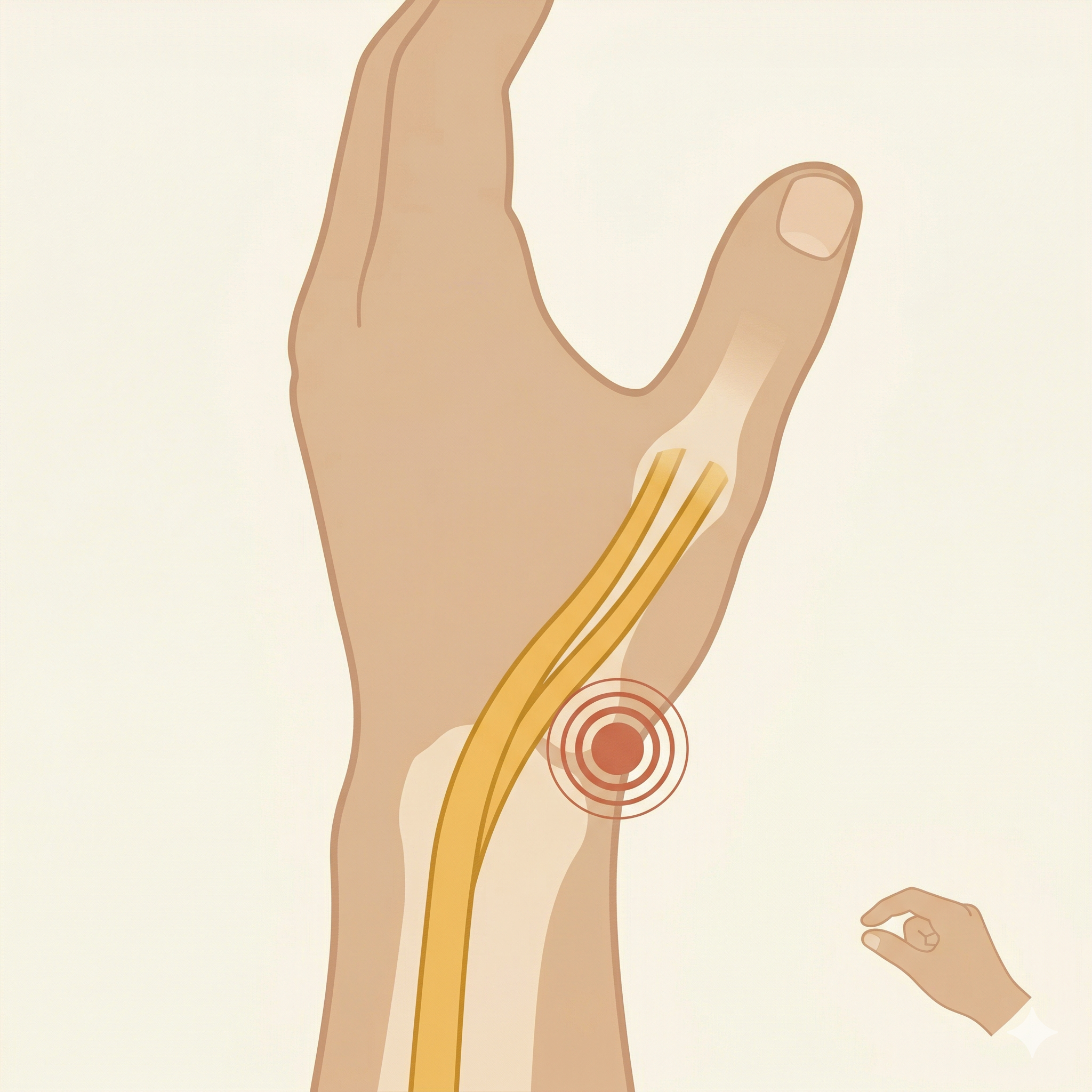
Quick answer: De Quervain’s tenosynovitis is inflammation of the sheath wrapping the two tendons that move your thumb. Suspect it strongly if you feel sharp pain when you tuck your thumb into your fist and bend your wrist toward the little finger. The order matters: calm the inflammation (Calm), restore thumb and wrist movement (Wake), and correct the repetitive movement patterns (Connect).
See a doctor promptly in these cases
- Severe fever, redness, or warmth → septic tenosynovitis needs to be ruled out
- Wrist looks deformed or is badly swollen after an injury → a fracture needs to be ruled out
- Thumb movement suddenly becomes very limited or numbness develops
The 3 key things this page covers
- Typical symptoms of De Quervain’s tenosynovitis and how to self-check
- Why it develops — thumb overload and nervous system sensitivity
- How to recover with 3-stage Circulation Therapy
You may suspect De Quervain’s tenosynovitis with these symptoms
- Pain at the base of the thumb and the thumb side of the wrist — It hurts when you press the thumb side of the wrist.
- Pain worsens when moving the thumb or picking things up — Opening bottle caps, using chopsticks, and scrolling on a phone become difficult.
- Worse after repetitive movements — Pain grows after carrying a baby or after extended smartphone or keyboard use.
- Warm, swollen feeling at the wrist — The area is actually swollen or feels warm.
- May be worse in the morning — Pain is strong on the first movement after lying still during sleep.
Why does De Quervain’s tenosynovitis develop?
The two tendons that move your thumb pass through a narrow tunnel over the wrist bone. When the sheath wrapping this tunnel thickens and becomes inflamed from repeated overload, pain develops.
Major triggers:
- Postpartum childcare — Repeatedly lifting and lowering a baby overloads the thumb and wrist.
- Extended smartphone use — Repeatedly scrolling and typing with the thumb puts cumulative load on the tendons.
- Keyboard and mouse — Holding the wrist still while repeatedly using the thumb is a risky posture.
- A nervous system more sensitive to pain — Sleep deprivation, stress, and postpartum hormonal changes amplify pain.
Self-test: Finkelstein’s test
- Wrap your other fingers around your thumb to make a fist
- Bend your wrist down (toward the little finger)
- Suspect De Quervain’s tenosynovitis if you feel sharp pain on the thumb side of the wrist
※ Self-tests are for reference only. An accurate diagnosis requires a specialist consultation.
Here is how we approach it at Yonsei SM
For De Quervain’s tenosynovitis, the key is relieving the sheath inflammation and correcting how you use your thumb and wrist.
- Stage 1: Calm (Circulation HD)
Under ultrasound guidance, we inject around the tendon to calm the inflammation and swelling. We create space around the narrowed tunnel to reduce pain. - Stage 2: Wake (Circulation PT)
We restore the balance of the wrist and thumb muscles — strengthening the thumb muscles, stretching the forearm, and training wrist stability. - Stage 3: Connect
We correct how you hold your baby, grip your phone, and use your keyboard. We work movement patterns that prevent recurrence into daily life.
De Quervain’s tenosynovitis self-care
What you can do right now
- Wear a thumb-wrist brace
- Change how you lift and lower your baby
- Use your smartphone with both hands
- Warm compress (2–3 times a day, 15–20 min) — to improve circulation
- Temporarily cut back on pain-provoking movements
What to avoid
- Overdoing thumb stretches (in the early, painful stage)
- Pushing through the pain and keeping using it
- Lifting your baby with one hand only
- Long keyboard sessions with the wrist bent
If pain suddenly worsens along with fever and redness, it may be septic tenosynovitis. Seek care immediately.
Frequently asked questions
How is De Quervain’s different from carpal tunnel syndrome?
De Quervain’s causes pain on the thumb side of the wrist, and it hurts when you tuck your thumb into your fist and bend the wrist. Carpal tunnel syndrome involves a pinched nerve on the palm side, causing numbness in the first to third fingers. The two can occur together, so an exam is needed. Carpal Tunnel Syndrome →
Why is De Quervain’s so common after childbirth?
The repetitive motion of lifting and lowering a baby, nursing postures, sleep deprivation, and hormonal changes all combine to increase tendon strain and make the nervous system more sensitive. It is especially common in women right after giving birth. Wrist Pain Q&A →
Can a brace alone fix it?
In mild early stages, a brace and movement correction alone can sometimes lead to improvement. But if pain persists or recurs, a process that treats the sheath inflammation itself is needed. Circulation HD →
How long does treatment take?
It depends on how long symptoms have lasted and how severe they are. We follow a flow of calming the inflammation (Calm), restoring movement (Wake), and changing daily habits (Connect). To prevent recurrence, correcting your patterns remains important even after the pain is gone. Treatment Duration Q&A →
Are there cases that need surgery?
Most cases of De Quervain’s tenosynovitis recover with non-surgical treatment. Surgery is considered only when non-surgical treatment over a long period brings no improvement, or when the sheath wrapping the tendon has thickened severely. Do I Need Surgery? Q&A →
Does the whole arm need to be assessed?
Thumb-side wrist pain sometimes needs to be distinguished from pain spreading down from the neck or shoulder. Gait analysis and movement assessment help identify where the pain starts. What is gait analysis? →
Related articles
Is thumb-side wrist pain making daily life uncomfortable?
We calm the sheath inflammation and restore your thumb and wrist movement.
Book OnlineReferences
- Rowland P et al. De Quervain’s tenosynovitis: a systematic review of anatomy, diagnosis, and treatment. Hand (NY). 2015;10(1):1–12.
- Abi-Rafeh J et al. Conservative nonsurgical management of de Quervain stenosing tenosynovitis. Plast Reconstr Surg. 2020;146(2):105e–116e.
- Ali M et al. Corticosteroid injection versus physiotherapy for de Quervain’s tenosynovitis in postpartum women. J Pak Med Assoc. 2015;65(11):1177–1179.
- Mak JC et al. Evidence-based review for the management of de Quervain syndrome. Postgrad Med. 2013;125(2):191–202.