Is the pain just below your lower back, on one side, worse when you stand up from sitting?
SI Joint Dysfunction. The sacroiliac joint connecting your spine to your pelvis is out of balance.
It sits too low to be a typical back problem, yet too high to feel like a standard hip issue. It hurts most when standing up from a chair or climbing stairs. If your lower back seems fine on imaging but one side keeps nagging you, the SI joint deserves a look.
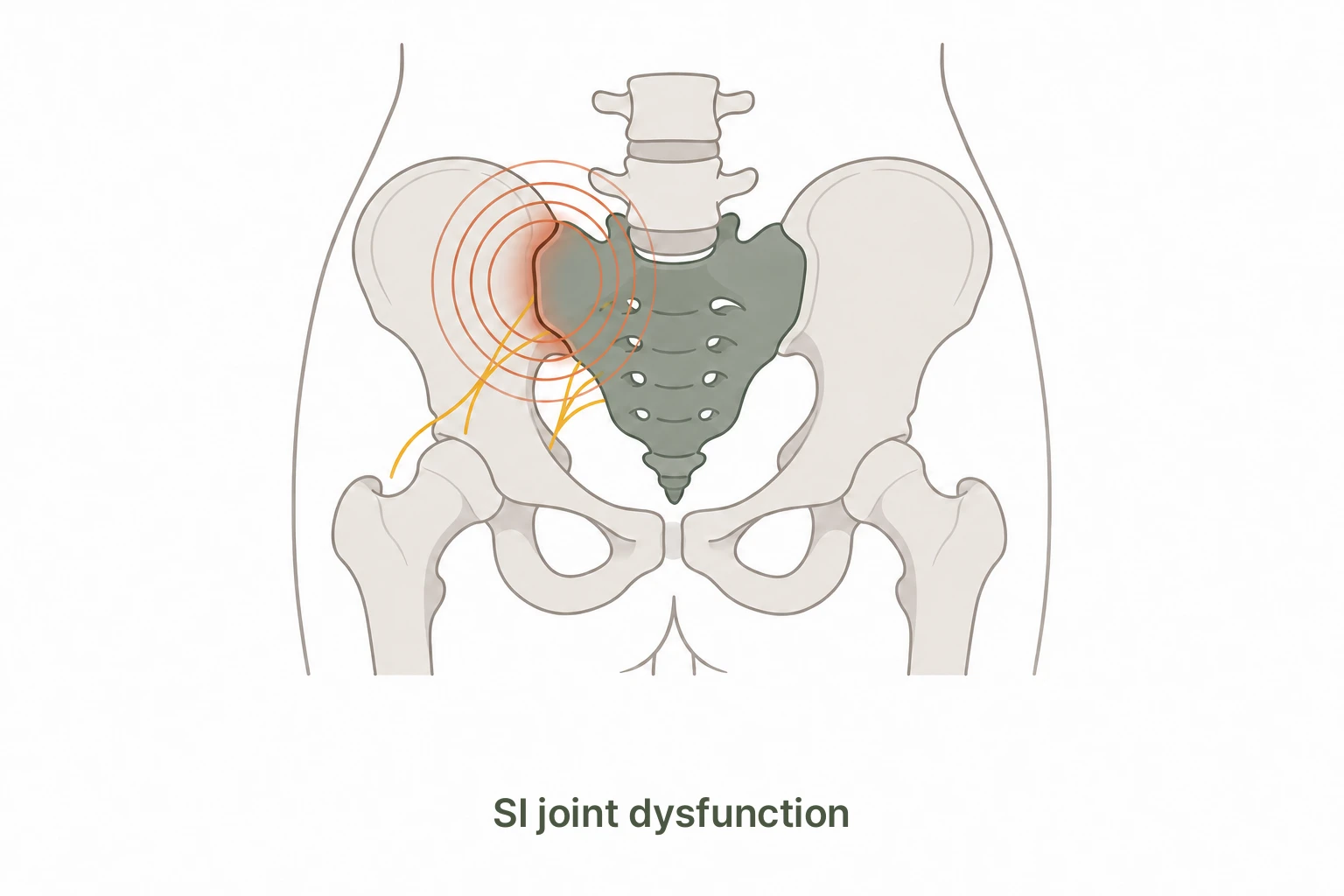
Quick Answer: The sacroiliac (SI) joint connects the sacrum (tailbone) to the ilium (pelvic bone), absorbing shock between the spine and pelvis. Dysfunction in this joint produces one-sided pain at the lower back-pelvis boundary. Pelvic asymmetry and muscular imbalances around the joint are the primary culprits, often compounded by habitually loading one leg more than the other.
These findings need further workup:
- Unexplained night pain with fever, which may indicate ankylosing spondylitis or infection
- Severe pelvic pain after trauma (fall, accident), which requires ruling out a fracture
3 Key Points on This Page
- What the SI joint is and why it causes pain
- How to distinguish SI joint pain from lumbar disc pain
- Restoring pelvic balance through Circulation Therapy
Signs that suggest SI joint dysfunction
- One-sided pain at the lower back-buttock boundary. A dull, aching throb just beside the tailbone, right at belt-line level, on one side.
- Sharpest when rising from a seat. The transition from sitting to standing is particularly painful. You may briefly hobble until the joint settles.
- Worsens on stairs. Each step that concentrates weight on one leg amplifies the pain.
- Discomfort after prolonged sitting. The sacral area feels stiff and achy after long periods seated, prompting constant position changes.
- Common in postpartum women. Relaxin hormone loosens pelvic ligaments during pregnancy and childbirth, leaving the SI joint less stable.
What causes SI joint dysfunction?
The SI joint normally moves very little. It is held stable by dense ligaments and surrounding muscles. Muscular imbalance or repetitive asymmetric loading causes the joint to move abnormally or become fixed in an off-center position, producing pain.
- Pelvic asymmetry. Unequal pelvic height or tilt concentrates force on one side of the joint.
- Muscle imbalances. Imbalances in the glutes, piriformis, and quadratus lumborum pull the joint unevenly.
- Postural habits. Habitually shifting weight to one leg or crossing legs while sitting applies uneven force across the joint.
SI Joint vs. Lumbar Disc Pain
- SI joint. Pain beside the tailbone, one side. Sharpest when rising from sitting. Leg numbness uncommon.
- Lumbar disc. Back pain plus leg numbness. Worsens with forward bending. Worse with coughing.
Both can occur together, making accurate assessment important.
Is it the sacroiliac joint, or another source of buttock pain?
Pain in the sacrum and pelvis can come from several overlapping structures. Distinguishing lumbar disc herniation from piriformis syndrome determines the treatment direction.
Sacroiliac Joint Dysfunction
- One-sided pain right beside the sacrum (PSIS)
- Worse when rising from a chair or getting in and out of a car
- One-sided pain with lumbar extension
- Positive FABER and FADIR provocation tests
Piriformis Syndrome
- Tenderness deeper in the buttock at the piriformis muscle
- Sitting worsens symptoms, especially on hard surfaces
- Pain reproduced with hip internal rotation
- Lumbar MRI unremarkable
Lumbar disc herniation produces a sharp jolt down the leg with coughing or sneezing and worsens with trunk flexion. This is a key distinction from the other two. All three conditions present as buttock pain, making careful palpation and provocative testing essential for accurate differentiation.
Our Approach at Yonsei SM Pain Clinic
SI joint dysfunction requires restoring joint stability and correcting left-right imbalances.
- Phase 1: Calm Down
Release over-tight muscles and ligaments surrounding the SI joint. Circulation HD (hydrodissection) eases tension around the joint and improves local blood flow. - Phase 2: Wake Up (Circulation PT)
Strengthen pelvic stabilizers (transversus abdominis, multifidus, and gluteal muscles). We assess left-right imbalances and selectively wake the weaker side to restore pelvic symmetry through movement correction. - Phase 3: Connect
Gait analysis checks left-right pelvic symmetry during walking. Sitting posture and weight-bearing patterns are corrected so the joint no longer receives uneven loading.
Frequently Asked Questions
My MRI is normal. Why does it still hurt so much?
SI joint dysfunction often does not appear on MRI or X-ray. Diagnosis requires evaluating functional abnormalities (movement patterns and muscular imbalances) rather than relying on imaging alone. Why Pain with Normal MRI? →
I developed pelvic pain after childbirth. Could it be the SI joint?
During pregnancy, relaxin hormone loosens pelvic ligaments, potentially destabilizing the SI joint. Strengthening pelvic stabilizers and correcting gait patterns after delivery are important steps in recovery.
Is this buttock pain the SI joint or the piriformis muscle?
If the pain is directly beside the tailbone, the SI joint is more likely. If the pain is deep inside the buttock, is tender to direct pressure, and radiates down the leg, piriformis syndrome is more likely. Careful palpation and functional testing distinguish the two. Piriformis Syndrome →
Can I do pelvic exercises at home?
Random pelvic stretches without proper assessment can actually destabilize the joint further. The first priority is identifying which muscles are weak and strengthening them. Treatment-guided movement correction is the safest approach.
How long will treatment take?
Recovery depends on the degree of muscular imbalance and how long the dysfunctional pattern has been established. We first calm the joint and then build stability, in stages. Treatment Duration Q&A →
References
- Szadek KM, et al. Diagnostic validity of criteria for sacroiliac joint pain: a systematic review. J Pain. 2009;10(4):354-368.
- Laslett M. Evidence-based diagnosis and treatment of the painful sacroiliac joint. J Man Manip Ther. 2008;16(3):142-152. PMC2565072
- van der Wurff P, et al. Clinical tests of the sacroiliac joint. Man Ther. 2006;11(4):246-252.
- Ruhe A, et al. Pelvic stability and muscle imbalance in patients with non-specific chronic low back pain. Chiropr Man Therap. 2015;23:23.
Related Articles
One-sided low back pain? Get your pelvic balance assessed.
Gait analysis and pelvic function assessment help us find the cause and design your personalized plan.
Book Online