Why your legs go numb when you walk, then feel better the moment you rest
Spinal Stenosis. The spinal canal narrows and presses on the nerves.
You walk just a little and your legs grow numb and heavy, so you have to stop. Yet leaning slightly forward or sitting down brings quick relief. If you can ride a bike but struggle to walk, spinal stenosis is worth considering.
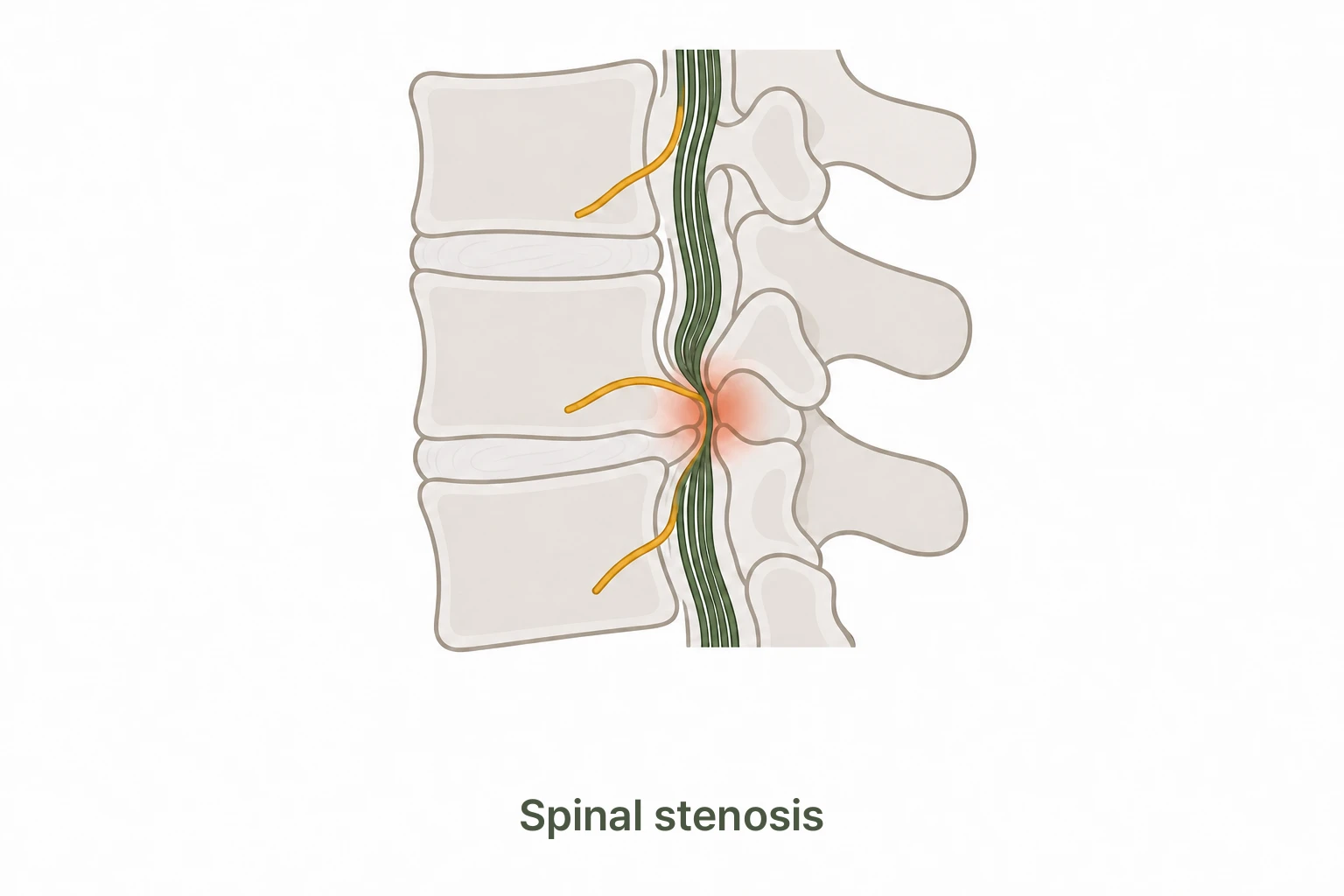
Quick answer: As the spinal canal narrows, the nerves inside it are compressed, producing neurogenic claudication. The more you walk, the less blood reaches the nerves, so numbness and pain set in. Sitting or bending forward widens the canal and relief comes fast. Unlike a herniated disc, bending forward is what makes stenosis feel better. In many cases the sensitivity of the nervous system, more than the degree of structural narrowing, determines how intense the symptoms actually are.
See a doctor right away if you have:
- Urinary incontinence or bladder or bowel dysfunction
- Sudden weakness or numbness in both legs at the same time
- A sudden inability to walk
The 3 key things this page covers
- Why walking brings on numbness and resting relieves it (neurogenic claudication)
- How to tell a herniated disc apart from stenosis
- The Circulation Therapy approach to managing stenosis without surgery
Signs that may point to spinal stenosis
- Legs go numb when walking, better when resting (neurogenic claudication). After a certain distance your legs feel heavy or numb and you must stop. A brief sit lets you walk again.
- Comfort when leaning forward. Symptoms ease when you bend slightly forward, as when pulling a shopping bag or pushing a cart.
- Worse when arching backward. Leg symptoms intensify when you straighten or arch your back.
- Cycling is still possible. Pedaling in the seated, forward-flexed posture is often manageable.
- Symptoms can occur in both legs. Numbness may affect not just one leg but both.
What is spinal stenosis?
The spinal canal is the passage through which the spinal cord and nerves travel. With age, bones, ligaments, and discs thicken or deform, and this passage narrows. When the nerves are compressed inside the narrowed canal, their blood supply drops, causing numbness and pain.
Walking makes the nerves demand more oxygen, but a narrowed space cannot deliver enough blood, so symptoms appear. Sitting or bending forward widens the canal relatively, blood flow recovers, and the symptoms quickly subside.
Neurogenic vs. vascular claudication
- Neurogenic claudication (stenosis). Quick relief when you sit or bend forward. Cycling is possible.
- Vascular claudication (peripheral artery disease). Relief is relatively slow even when seated. Cycling is also hard.
The two can overlap, so accurate differentiation is important.
Can severe stenosis on MRI still be painless?
Yes. The degree of narrowing seen on imaging does not always match the intensity of the symptoms. Pain research shows that the sensitivity of the nervous system influences symptoms just as much as the nerve compression itself.
The physical compression
The degree of spinal canal narrowing and nerve compression. Visible on MRI.
The nervous system’s sensitivity
Nervous system sensitivity, stress, sleep, and past pain experience. Not visible on imaging.
So even when MRI shows stenosis, pairing your care with an approach that calms the nervous system’s sensitivity lets you manage symptoms effectively.
Is it spinal stenosis, or another cause of leg pain with walking?
Leg heaviness and pain that builds with walking and eases with rest can come from two very different sources. Distinguishing spinal stenosis from peripheral vascular disease is critical.
Spinal Stenosis (Neurogenic Claudication)
- Legs become heavy, numb, and achy the longer you walk. Squatting or sitting relieves it
- Leaning forward (shopping-cart posture) provides relief
- Cycling is usually tolerable
- Narrowed spinal canal confirmed on MRI
Peripheral Vascular Disease (Vascular Claudication)
- Cramping pain forces you to stop walking. Rest (not forward bending) relieves it
- Feet feel cold. Skin color may change
- Reduced or absent pulses in the foot
- Confirmed by vascular ultrasound or ankle-brachial index
Lumbar disc herniation also needs to be distinguished. Stenosis tends to affect older adults and produces walking-dependent symptoms that ease with sitting, whereas disc herniation causes pain even at rest and worsens with coughing. The two conditions frequently coexist.
Our approach at Yonsei SM
For spinal stenosis, the key is to improve the environment around the nerves and restore your ability to walk.
- Stage 1: We bring the swelling down (Circulation HD)
We settle the swelling and tension around the nerves. Injection treatment opens up the space around the pinched nerve and releases adhesions. By lowering nervous system sensitivity, we calm a state that overreacts to even small stimuli. - Stage 2: We wake the muscles up (Circulation PT)
We reawaken weakened core and gluteal muscles. As the muscles that support the spine grow stronger, the uneven load on the nerves decreases. We work on movement correction while gradually increasing your walking distance. - Stage 3: We make the movement stick
We optimize your walking pattern. Through gait analysis we find the posture and stride that place the least burden on the nerves while walking, and guide you to apply them in daily life.
Frequently asked questions
How is stenosis different from a herniated disc?
A herniated disc tends to hurt more when you bend forward and feel better when you arch back. Stenosis is the opposite. Bending forward feels comfortable and arching back makes it worse. The two can occur together, so accurate assessment is needed. Lumbar disc herniation →
Does stenosis only get better with surgery?
Unless you have bladder or bowel dysfunction or progressive paralysis, conservative treatment can be tried first. In many cases, improving the environment around the nerves and strengthening the muscles restores the ability to walk. Do I need back surgery? Q&A →
Should I do walking exercise?
Walking steadily within a pain-free range is helpful. When your legs go numb, sit and rest briefly, then walk again, gradually building up the distance. Forcing yourself to push through and keep walking is not recommended. Pain when walking Q&A →
Is it okay to ride a bike?
For stenosis patients, the seated, forward-flexed posture of cycling often reduces pain. Aerobic exercise on a stationary bike can help, though it depends on your individual condition.
How long does treatment take?
It depends on the degree of narrowing, your nerve symptoms, and your muscle strength. The stage that brings the swelling down and the stage that wakes the muscles up proceed in sequence. Treatment duration Q&A →
Related articles
Struggling to walk? Get evaluated for neurogenic claudication.
With gait analysis and nerve function assessment, we’ll build a treatment plan tailored to you.
Book OnlineReferences
- Ammendolia C, et al. Nonoperative treatment for lumbar spinal stenosis with neurogenic claudication. Cochrane Database Syst Rev. 2013;(8):CD010712.
- Weinstein JN, et al. Surgical versus nonsurgical therapy for lumbar spinal stenosis. N Engl J Med. 2008;358(8):794-810. PMID 18287602
- Deyo RA, et al. Spinal-fusion surgery — the case for restraint. N Engl J Med. 2004;350(7):722-726.
- Fritz JM, et al. Lumbar spinal stenosis: a review of current concepts in evaluation, management, and outcome measurements. Arch Phys Med Rehabil. 1998;79(6):700-708.