Back pain with numbness running down your leg?
We check how your back pain and leg numbness are related.
A lumbar disc herniation can make your leg feel numb. We first check where the numbness spreads and whether your leg strength has changed. After an assessment, you may receive Circulation HD or Circulation PT here if either treatment is appropriate for you. Book a consultation to have your symptoms assessed.
Seek emergency care now for these symptoms
- New difficulty controlling your bladder
- New difficulty controlling your bowels
- Leg or foot weakness that is getting worse quickly
- New numbness in the perineum
Do not delay care
- If your back or leg symptoms rapidly worsen with a fever
- If your back or leg symptoms rapidly worsen after an injury
What should we check when a lumbar disc and leg numbness occur together?
- How a disc can irritate a nerve and cause leg numbness
- Why numbness, leg strength, and imaging findings need to be considered together
- Which treatments may be considered after an assessment
How can leg numbness related to a lumbar disc feel?
- Back and leg symptoms can occur together. Numbness or pain may travel through the buttock toward the calf or foot.
- Sensation in the leg may change. We check where it feels numb and whether one or both legs are affected.
- Changes in strength matter. Tell us if you have trouble moving your ankle or toes.
- Symptoms may change with movement. We ask what happens when you sit, walk, or move your back.
Why can a lumbar disc herniation make your leg numb?
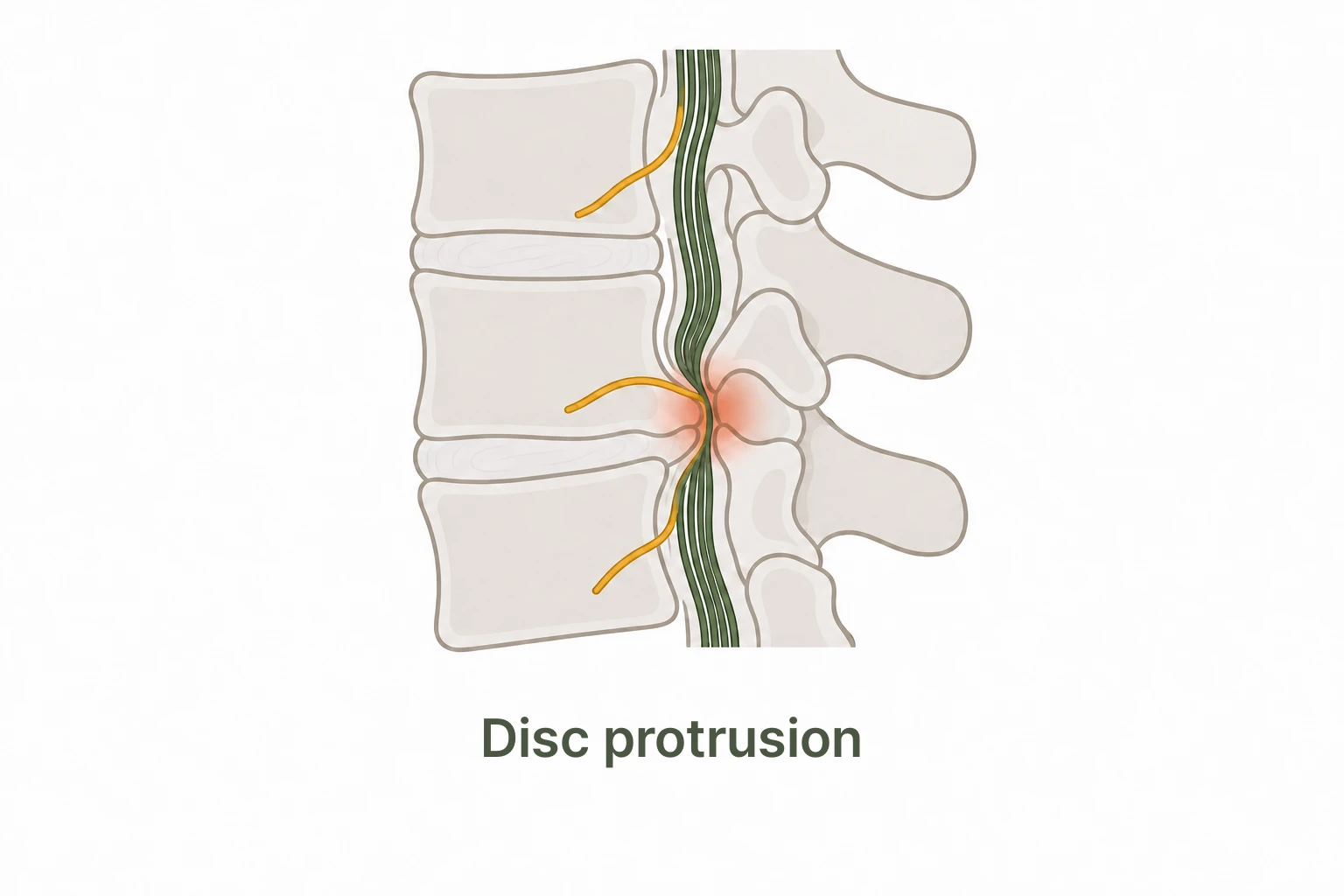
When an intervertebral disc moves out of place and irritates a nerve in the lower back, numbness or pain can travel into the leg. Similar numbness can also have other causes.
A disc change may appear on an MRI even when a person has no symptoms. We therefore consider where the numbness spreads, sensation, and leg strength alongside the images.
Terms used in imaging reports
- Bulging. The disc swells outward
- Protrusion. Part of the disc pushes out
- Extrusion. The nucleus breaks through the annulus
- Sequestration. The herniated fragment separates
Does a disc finding on MRI mean you need surgery?
An MRI finding alone does not determine whether surgery is needed. Nerve symptoms, leg strength, and daily function also matter. Some herniated discs shrink during conservative care, but an individual’s course cannot be predicted from this finding.
When prompt assessment matters
- New bladder or bowel problems or loss of sensation around the groin
- Leg strength that is worsening quickly
- Pain and numbness that severely limit daily activities
When conservative care may be considered
- There are no emergency neurological symptoms
- An assessment supports activity changes and rehabilitation
- Symptoms and function can be reviewed as care progresses
Is it a lumbar disc, or another cause of leg numbness?
Leg numbness may be related to a lumbar disc, spinal stenosis, or another nerve problem near the buttock. We consider where the numbness spreads, leg strength, and which movements change the symptoms.
When we assess a lumbar disc
- We ask where numbness travels down the leg.
- We check sensation and strength in the ankle and toes.
- We consider whether the symptoms match the imaging findings.
When we assess other causes
- We ask how symptoms change when you walk or sit.
- We check where pain occurs in the buttock and leg.
- We explain whether another evaluation may be needed.
A nerve problem near the buttock may also be related to leg symptoms. One movement or imaging finding alone does not establish the cause.
We assess the extent of numbness and changes in strength before discussing treatment.
How do we treat a lumbar disc and leg numbness?
We consider leg numbness, changes in strength, and discomfort during movement together. Depending on the assessment, we may discuss Circulation HD, Circulation PT, or Circulation Combo, which combines both treatments.
Our care follows three steps. We bring the swelling down. We wake the muscles up. We make the movement stick.
- Circulation HD
We assess pain and inflammation before deciding whether an injection is appropriate. - Circulation PT
You work with a therapist to assess how you move and practice rehabilitation suited to your condition. - You practice using the movements discussed during care in daily activities.
The treatment and its sequence depend on the assessment. These steps describe care goals, not guaranteed individual results.
How should you move when your leg feels numb?
Movements that worsen symptoms
- Do not stay in a position that makes numbness worse.
- Stop lifting if it makes your symptoms worse.
What to note before your visit
- Note where numbness starts and how far it spreads.
- Note how symptoms change when you walk or sit.
- Tell us if your leg feels weaker.
Frequently Asked Questions
Why can a lumbar disc herniation make my leg numb?
A herniated disc may irritate a nerve in the lower back, causing numbness or pain that travels into the leg. We assess where it spreads and check leg strength.
Are sciatica and a lumbar disc herniation the same thing?
Sciatica describes pain that travels into the leg. A lumbar disc herniation is one possible cause. Learn more about sciatica
If my leg is numb, does that always mean a disc?
No. Spinal stenosis or another nerve problem may also be related to leg numbness. We assess where it occurs, leg strength, and how it changes with movement. Learn more about leg numbness
Why does it hurt more when I sit?
Several problems can make symptoms worse when you sit. Note which positions change the numbness and discuss them during your assessment. Learn more about pain while sitting
When is back surgery necessary?
New bladder or bowel problems and rapidly worsening leg weakness need urgent evaluation. Decisions about surgery also consider nerve symptoms, function, and the course of treatment. Learn more about back surgery
Does disc surgery completely resolve the problem?
Recovery after surgery varies with the symptoms and nerve condition. Ask the treating clinician whether rehabilitation is needed afterward. Learn more about disc surgery
Can a disc show up on MRI but not hurt?
Yes. Some people have disc changes on imaging without symptoms. We consider your current symptoms and leg function as well. Learn more about MRI findings and pain
Does walking help?
It depends on your condition. Notice whether numbness or leg strength changes while walking. If symptoms worsen, discuss your activity level during a consultation. Learn more about pain while walking
How long does treatment take?
It depends on numbness, changes in strength, and your response to care. During a consultation, we discuss the treatment plan and when to reassess it. Learn more about treatment duration
Related Articles
Would you like to discuss your back pain and leg numbness?
We assess where numbness spreads and check leg strength before discussing treatment options.
Book OnlineReferences
- Pojskic M, et al. Lumbar disc herniation: Epidemiology, clinical and radiologic diagnosis WFNS spine committee recommendations. World Neurosurg X. 2024;22:100279. PMID 38440379. DOI 10.1016/j.wnsx.2024.100279
- Yaman O, et al. The role of conservative treatment in lumbar disc herniations: WFNS spine committee recommendations. World Neurosurg X. 2024;22:100277. PMID 38389961. DOI 10.1016/j.wnsx.2024.100277
- Brinjikji W, et al. Systematic literature review of imaging features of spinal degeneration in asymptomatic populations. AJNR Am J Neuroradiol. 2015;36(4):811-816. PMID 25430861. DOI 10.3174/ajnr.A4173
- Chiu CC, et al. The probability of spontaneous regression of lumbar herniated disc: a systematic review. Clin Rehabil. 2015;29(2):184-195. PMID 25009200. DOI 10.1177/0269215514540919
- Hennessy O, et al. Assessment and early investigation of cauda equina syndrome: a systematic review of existing international guidelines and summary of the current evidence. Eur Spine J. 2025;34(4):1545-1551. PMID 40000448. DOI 10.1007/s00586-025-08732-0
- Maselli F, et al. The diagnostic value of Red Flags in thoracolumbar pain: a systematic review. Disabil Rehabil. 2022;44(8):1190-1206. PMID 32813559. DOI 10.1080/09638288.2020.1804626