When your knee is stiff and stairs keep getting harder
Knee osteoarthritis. Worn cartilage compounded by muscle imbalance.
Your knee is stiff when you wake up, and the inside of it hurts every time you go up or down stairs. You put up with it as just age, but it keeps getting worse. It may not be only a cartilage problem. The balance of the muscles around the knee plays a part too.
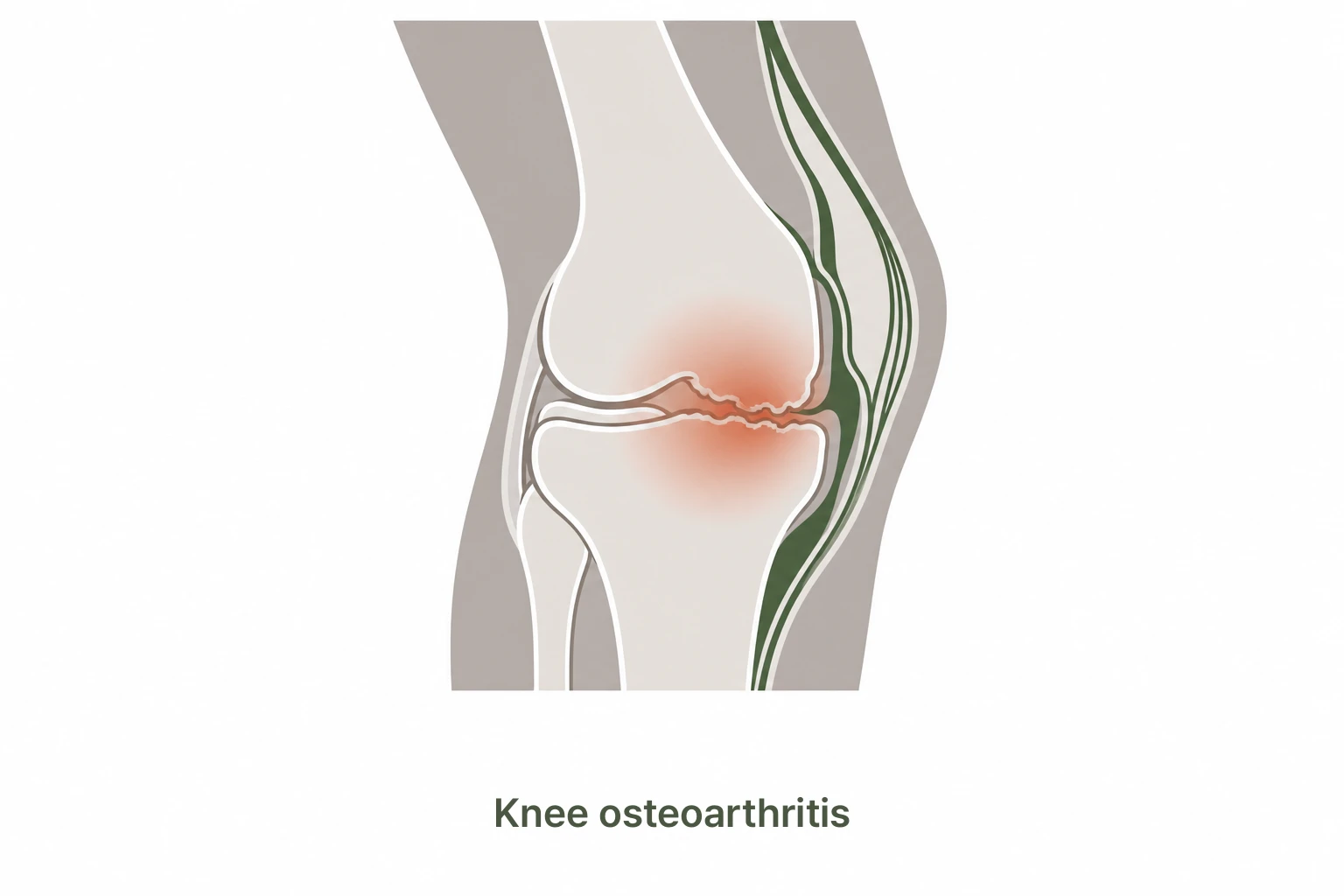
Quick answer: Knee osteoarthritis is not a problem of worn cartilage alone. Weak thigh muscles, knee alignment problems, and changes in your walking pattern all play a part. Even with worn cartilage you may feel no pain if the surrounding muscles support the joint well, and even with normal cartilage you may hurt if there is muscle imbalance.
You need a proper evaluation when:
- Severe swelling and warmth in the knee at the same time means a joint infection must be ruled out.
- The knee gives way or locks after an injury, which calls for ruling out ligament or meniscus damage.
- Severe pain at rest, even at night, means other causes must be ruled out.
The 3 key points on this page
- Why muscles matter so much in knee osteoarthritis
- Why the degree of cartilage wear and the level of pain don’t always match
- How Circulation Therapy restores function without surgery
These symptoms may point to knee osteoarthritis
- The front or inner side of the knee hurts on stairs. Stair movements concentrate your body weight on one knee, raising pressure inside the joint and causing pain.
- The knee is stiff when you wake up and eases after 10-30 minutes. Joint fluid decreases during sleep, so stiffness is worst in the morning and gradually improves as you move.
- The knee throbs after long walking or standing. Accumulated load activates inflammation around the joint, making pain worse.
- The knee clicks or pops, and swells often. Worn cartilage increases friction inside the joint, and inflammation increases joint fluid.
- Squatting or bending the knee hurts badly. The deeper the knee bends, the greater the pressure on the joint surfaces, and the more the pain.
What causes knee osteoarthritis
The knee joint is where the femur meets the tibia, with cartilage absorbing the impact. As we age, the cartilage wears down and inflammation develops around the joint. This is osteoarthritis. But how much pain you feel depends on more than cartilage wear alone.
- Weak thigh muscles. When the quadriceps and gluteal muscles are weak, load lands directly on the knee joint.
- Knee alignment problems. Bow legs or knock knees place uneven load on specific joint surfaces.
- Changes in walking pattern. A compensatory gait that avoids pain adds extra load to other joints.
How much cartilage is worn is not how much you hurt
The degree of cartilage wear does not always match the level of pain. Muscle condition and walking pattern can have a greater effect on pain. Some people live without pain despite severe arthritis on X-ray, while others feel severe pain from only minor changes.
That is why muscle balance and walking pattern need to be assessed together.
Is it knee osteoarthritis, or another knee problem?
Not all knee pain is osteoarthritis. Meniscal tears and patellofemoral pain syndrome can produce overlapping symptoms.
Knee Osteoarthritis
- Inner knee (medial compartment) pain is most common
- Worsens on stairs and inclines
- May be accompanied by joint swelling or visible deformity
- Reduced joint space visible on X-ray
Meniscal Tear
- Knee catches, locks, or gives way at a certain angle
- Pain with deep squatting or twisting movements
- Often begins after a traumatic incident
- Meniscal damage confirmed on MRI
Patellofemoral pain syndrome (kneecap pain) is characterised by pain behind the kneecap that is worst when rising after prolonged sitting or climbing stairs. It is common in younger people as well as those with arthritis. Because knee pain responds differently to treatment depending on its cause, an accurate diagnosis matters.
How we approach it at Yonsei SM
Knee osteoarthritis requires reducing joint inflammation, strengthening the surrounding muscles, and correcting the walking pattern all together.
- Stage 1: We bring the swelling down
Circulation HD eases inflammation and swelling around the knee joint. By lowering the heightened sensitivity of the nerves around the joint, it reduces pain. - Stage 2: We wake the muscles up (Circulation PT)
We strengthen the quadriceps and gluteal muscles to build up the support for the knee joint. We improve knee alignment and restore stability through balance training. - Stage 3: We make the movement stick
Gait analysis examines the load pattern on your knee. We correct movements like going up and down stairs and sitting and standing, to optimize the load placed on the knee.
Frequently asked questions
If my cartilage is worn, don’t I need surgery?
Cartilage wear by itself is not an absolute reason for surgery. We weigh several things together, such as the level of pain, how much daily function is limited, and how well non-surgical treatment works. Many people recover everyday function fully through muscle strengthening and gait correction. Surgery is considered when non-surgical treatment does not bring enough improvement.
My knee hurts, is it okay to exercise?
If you avoid movement entirely because of pain, the muscles weaken further and the knee loses support. It is recommended to do quadriceps and gluteal strengthening within a range that does not worsen the pain. Which exercises suit you is decided after a proper assessment.
How is this different from injection treatment?
Steroid or hyaluronic acid injections help reduce inflammation and pain inside the joint temporarily. Circulation Therapy focuses on easing inflammation while also reducing the load on the knee itself through muscle strengthening and gait correction. In some cases the two can be combined.
Should I avoid stairs altogether?
Avoiding stairs completely weakens the thigh muscles and limits daily function. When pain is severe, hold off for a while, but once muscle strengthening and movement correction are in place it is good to bring stair training back in. What matters most is correcting how you go up and down the stairs (your movement pattern).
How big an effect does being overweight have on the knee?
As body weight rises, the load placed on the knee joint increases sharply. Walking puts about 3-5 times your body weight on the knee, and stairs put 7-8 times. Losing weight can have a meaningful effect on reducing knee pain, but it works best when combined with muscle strengthening. Inner knee pain Q&A →
Related reading
Pinpoint the cause of your knee pain with a muscle balance assessment.
With gait analysis and muscle function testing, we analyze the load pattern on your knee and build a tailored treatment plan.
Book OnlineReferences
- Fransen M et al. Exercise for osteoarthritis of the knee. Cochrane Database Syst Rev. 2015;1:CD004376. PMID 25569281
- Bannuru RR et al. OARSI guidelines for the non-surgical management of knee, hip, and polyarticular osteoarthritis. Osteoarthritis Cartilage. 2019;27(11):1578-1589. PMID 31278997
- McAlindon TE et al. OARSI guidelines for the non-surgical management of knee osteoarthritis. Osteoarthritis Cartilage. 2014;22(3):363-388. PMID 24462672
- Hochberg MC et al. American College of Rheumatology 2012 recommendations for the use of nonpharmacologic and pharmacologic therapies in osteoarthritis. Arthritis Care Res. 2012;64(4):465-474. PMID 22563589