Medial Knee and Calf Pain – Is the Spine the Cause?
It’s most likely saphenous nerve entrapment. If only the medial knee and the inner calf hurt while ankle movement is normal, this may not be a lumbar disc but the saphenous nerve being compressed in the adductor canal of the thigh.
What Is the Saphenous Nerve?
The Longest Sensory Branch of the Femoral Nerve
The saphenous nerve arises from the L3 and L4 nerve roots and travels through the adductor canal on the inner thigh. When it is compressed here by the sartorius muscle or the adductor fascia, pain and numbness develop in the medial knee and the inner calf.
This is easily mistaken for an L4 disc or degenerative knee arthritis.
How Do You Tell It Apart From an L4 Disc?
| Feature | Saphenous Nerve Entrapment | L4 Disc |
|---|---|---|
| Pain location | Medial knee, inner calf (saphenous nerve path) | Front of thigh, front of knee, front of shin |
| Ankle movement | Completely normal (pure sensory nerve) | Weakness in lifting the ankle (dorsiflexion) |
| Knee reflex | Normal | Reduced |
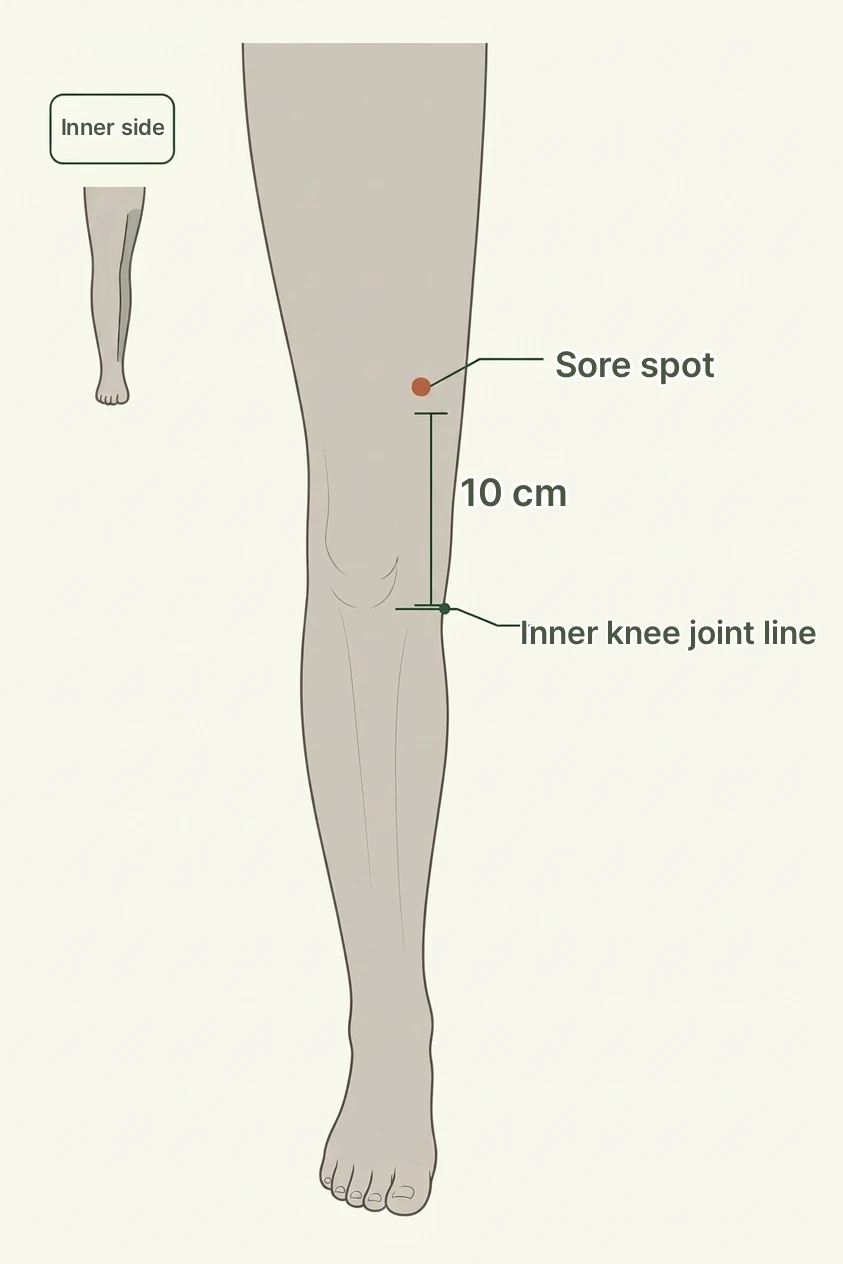
| Adductor canal tenderness | Tenderness about 10cm above the inner knee (+) | No tenderness |
| Aggravating factors | Climbing stairs, repetitive lower-leg movement | Back movement, coughing, sneezing |
Adductor Canal Tender-Point Test
Find the spot
Locate a point about 10cm above the inner knee bone (the medial femoral condyle).
Press test
Pressing this point (the entrance of the adductor canal) with a finger produces an electric, tingling sensation.
Reproduce the pain
If your usual medial knee and calf pain is reproduced exactly, this is saphenous nerve entrapment.
Ankle Strength Test, The Decisive Differentiator
Saphenous Nerve Entrapment
Strength to lift the ankle up (tibialis anterior) is normal.
Strength to straighten the knee (quadriceps) is normal.
Because it is a pure sensory nerve, strength is preserved.
L4 Disc
Strength to lift the ankle up may be weak.
Strength to straighten the knee may be weak.
Nerve root compression causes a decline in motor function.
When It Gets Mistaken for Knee Arthritis
If you were diagnosed with arthritis for medial knee pain but the X-ray or MRI shows no significant abnormality, saphenous nerve entrapment should be suspected.
Treating Saphenous Nerve Entrapment
We precisely release the adductor canal area.
- Circulation HD:
- Releasing adhesions in the adductor canal
- Relaxing sartorius and adductor tension
- Improving circulation around the nerve
- Circulation PT:
- Restoring adductor flexibility
- Correcting knee alignment
- Improving the walking pattern
Frequently Asked Together
Want to Find the Exact Cause of Your Knee and Calf Pain?
We evaluate the spine, the knee, and the peripheral nerves together to make an accurate diagnosis.
Book OnlineReferences
- Drosos GI, Pozo JL. The causes and mechanisms of meniscal injuries in the sporting and non-sporting environment in an unselected population. Knee. 2004;11(2):143-149.
- Alvarez-Nemegyei J et al. Prevalence of musculoskeletal pain and clinical features of pes anserinus tendinitis/bursitis in type 2 diabetes mellitus. J Rheumatol. 2011;38(9):1979-1983.
- Logerstedt DS et al. Knee pain and mobility impairments: meniscal and articular cartilage lesions. J Orthop Sports Phys Ther. 2010;40(6):A1-A35. PMID 20511698
- Fransen M et al. Exercise for osteoarthritis of the knee. Cochrane Database Syst Rev. 2015;1:CD004376. PMID 25569281