Jaw hurts, neck hurts too? Or vice versa?
Jaw-Neck Connection — They’re interconnected.
You went to the dentist for jaw pain but were told nothing’s wrong. When your neck is stiff, your jaw hurts more. When you clench your teeth, your neck aches. They’re closely linked.
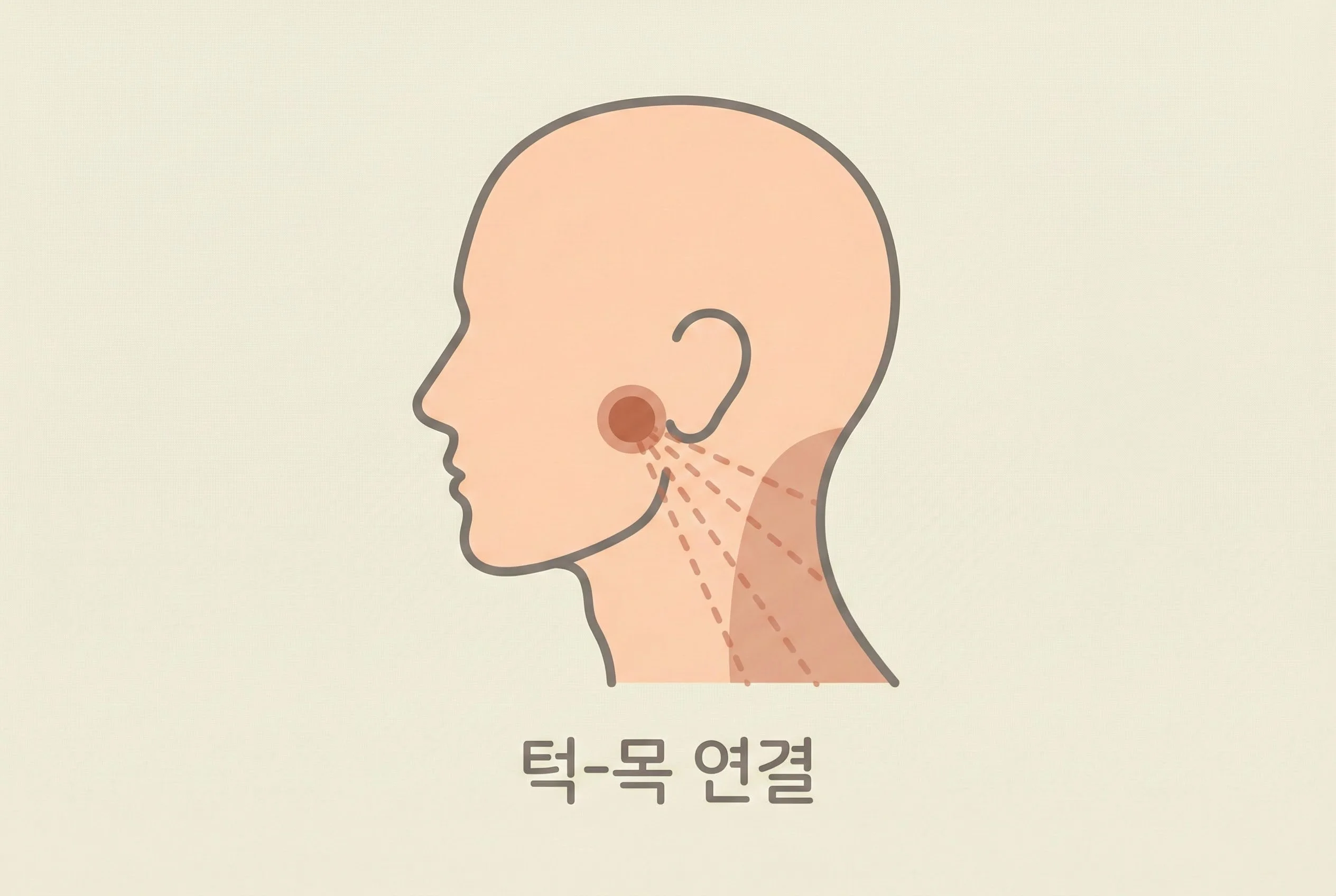
Quick Answer: The jaw joint and neck affect each other through anatomical, postural, and stress factors. Rather than looking at jaw or neck alone, evaluating chewing muscle tension + neck area overload + postural patterns together helps prevent recurrence.
Seek medical attention quickly if:
- Dizziness with fainting, vision changes, or paralysis
- Jaw suddenly won’t open or pain rapidly worsens
- Fever or severe inflammation (swelling, warmth)
- Jaw or neck pain persists or worsens after trauma
3 Key Points on This Page
- Why jaw and neck affect each other
- How teeth grinding and clenching relate to neck pain
- Why treating jaw and neck together is important
These symptoms suggest jaw-neck connection issues
- Jaw joint area painful and stiff — Difficulty opening mouth wide or clicking sounds occur.
- Jaw stiff in the morning — Muscles fatigued from nighttime clenching or grinding.
- Headache starts at temples — Temporalis (chewing muscle) tension-related headache.
- Jaw discomfort when neck is stiff — Jaw and neck symptoms appear together.
- Dentist finds nothing wrong — X-rays show jaw joint structure is normal.
- Worse with stress — Unconsciously clench teeth when tense.
Why are jaw and neck connected?
Anatomical connection: Muscles that move the jaw (masseter, temporalis, pterygoids) and neck muscles (sternocleidomastoid) are controlled by the same nerves (trigeminal, cervical nerves).
Functional connection: Forward head posture pulls the jaw backward, overloading the jaw joint and chewing muscles.
Stress connection: Stress causes shoulder shrugging and teeth clenching. Neck and jaw tense simultaneously.
Impact of Teeth Clenching
- Normal chewing force: 20-30kg
- During clenching: 70-100kg+
- 8 hours of nighttime grinding → muscle fatigue accumulation
- Daytime unconscious clenching → even more serious impact
Key muscles involved in jaw-neck connection
Jaw Muscles
- Masseter — Both sides of jaw, used for chewing
- Temporalis — Temples, causes headaches
- Medial Pterygoid — Inside jaw, limits opening
- Lateral Pterygoid — Front of jaw joint, clicking sounds
Neck Muscles
- Sternocleidomastoid — Under jaw to collarbone, headache-related
- Digastric — Under jaw, involved in swallowing
- Suboccipital — Back of neck, causes headaches
- Longus Colli — Front of neck, maintains posture
Our Approach at Yonsei Shinmyung
Jaw-neck connection issues recur if treated separately. We evaluate and treat jaw and neck together.
- Phase 1: Downshift (Circulation HD)
Release trigger points in masseter, temporalis, and sternocleidomastoid. Address fascial adhesions around jaw joint. - Phase 2: Activate (Circulation PT)
Strengthen weakened deep neck flexors and suprahyoid muscles. Train awareness and relaxation of clenching habits. - Phase 3: Integrate
Correct forward head posture and maintain relaxation during stress. Collaborate with dentists when needed.
Daily Self-Care
Awareness of Clenching
- Set phone alarms hourly to check
- “Lips together, teeth apart”
- Rest tongue lightly on roof of mouth
- Extra attention during stress
Jaw Muscle Relaxation
- Warm compress on jaw area
- Gentle massage of masseter (cheeks)
- Avoid wide mouth opening (careful with yawning)
- Limit hard foods and gum
Frequently Asked Questions
Morning jaw and neck stiffness. Why?
Nighttime teeth clenching or improper sleep posture/pillow can accumulate tension in both jaw and neck. If it repeats for several days, checking patterns and tension areas together helps. Morning Stiffness Q&A →
Jaw discomfort with dizziness. Related?
Neck area overload and posture issues can cause accompanying dizziness. If dizziness repeats or interferes with daily life, cause evaluation is needed. Dizziness Q&A →
Will changing pillows help jaw-neck pain?
Incorrect pillow height and support can accumulate neck tension during sleep, affecting both jaw and neck. However, rather than pillow alone, checking neck condition and habits together is safer. Pillow Selection Q&A →
Can correcting forward head help jaw too?
Forward head posture pulls the jaw backward, increasing load on jaw joint and chewing muscles. Correcting posture patterns can relieve both jaw and neck symptoms. Posture Correction Q&A →
Can temple headaches be from jaw?
Chewing muscle (temporalis) tension can cause temple headaches. Distinguishing headache patterns helps determine approach. Headache Types Q&A →
Office worker who frequently clenches. How to manage?
Stress situations can create unconscious clenching habits. Adjusting work environment and routines to release jaw and shoulder tension help. Office Worker Management Q&A →
When is evaluation or treatment needed?
If pain persists or symptoms like dizziness or numbness accompany it, cause evaluation is priority. Functional issues can cause pain even when imaging is normal. Normal MRI Pain Q&A →
What order for Circulation HD and PT?
First calm overload (Downshift), then restore weakened function (Activate) and connect to daily life (Integrate). Combinations vary by condition, so we create plans after consultation. Circulation Therapy Introduction →
Related Articles
Jaw hurts but dentist finds nothing?
We evaluate jaw and neck together and resolve muscle issues.
Book Online