How Can I Tell If Leg Pain Is From a Disc or Peripheral Nerve?
85% of leg pain patients lack a clear anatomical cause. Of patients who still have pain after spine surgery, 27% actually had peripheral nerve entrapment, not a disc problem. Treating it as only a disc issue leads to high failure rates.
What Is Peripheral Nerve Entrapment?
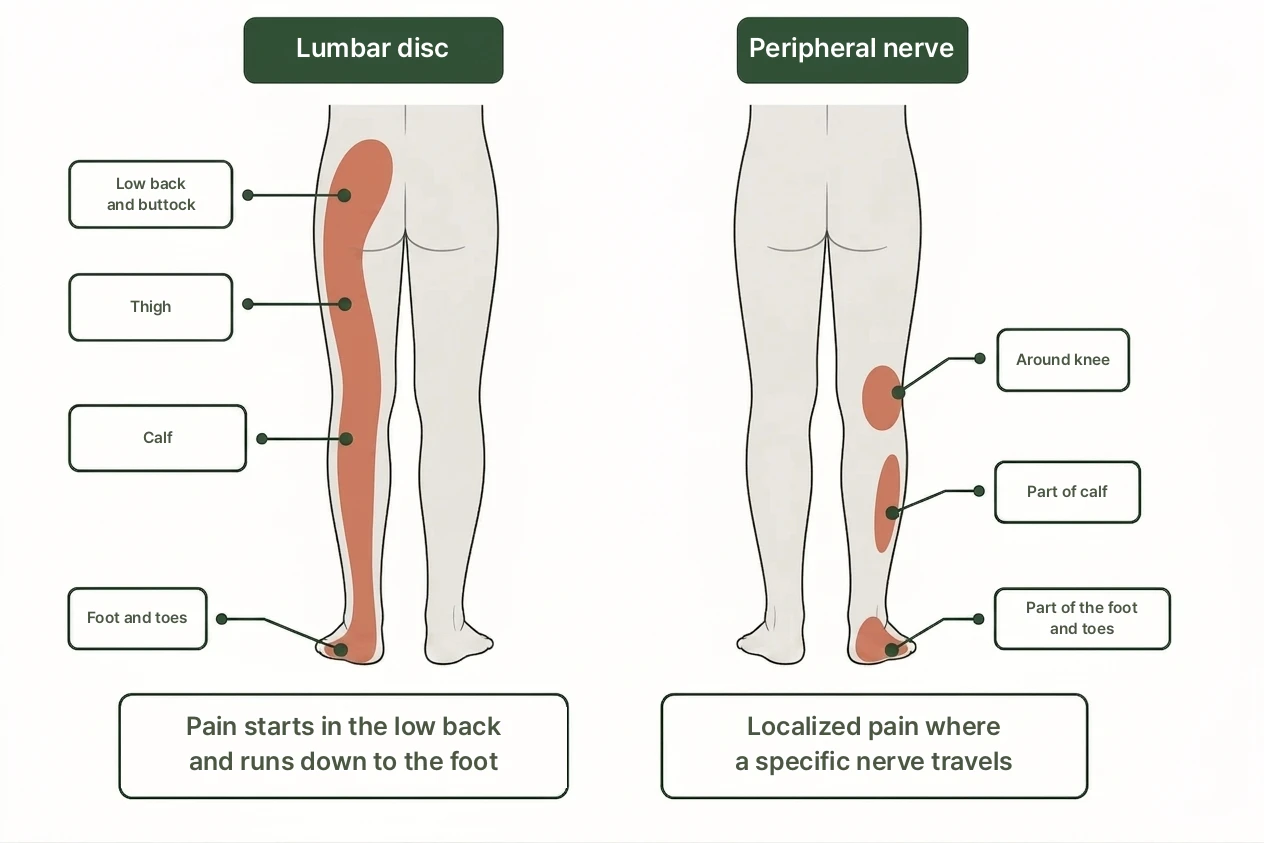
Nerves That Provide Sensation to the Lower Body Can Get Compressed
Nerves that exit from the spine travel down the leg through several narrow passages. When these nerves are compressed by fascia, ligaments, or bone, several problems can follow.
- Physical compression
- Reduced blood supply (ischemia)
- Nerve inflammation and fibrosis
- Central sensitization when chronic (increased pain sensitivity)
This is called pseudo-sciatica, and it often doesn’t show up on MRI.
Disc vs Peripheral Nerve, Key Differential Points
| Category | Lumbar Disc (Radiculopathy) | Peripheral Nerve Entrapment |
|---|---|---|
| Pain Distribution | Dermatome pattern, broad and vague | Specific nerve territory, focal and clear |
| Motor Strength | May be weakened (myotomal weakness) | Normal (if purely sensory nerve) |
| Deep Tendon Reflexes | Decreased or absent (L4, S1) | Always normal |
| Aggravating Factors | Spine movement, coughing, sneezing, Valsalva | Specific postures, repetitive motion, local pressure |
| Tenderness Point | Central lumbar spine, broad area | Nerve entrapment site, precise single point |
| Tinel Sign | Negative | Positive (electrical sensation at compression site) |
Precise Examination Sequence
Pain Mapping
Have the patient mark the exact location of pain. Compare with dermatome maps to determine if it’s a spinal nerve root vs peripheral nerve territory.
Motor and Reflex Testing
Evaluate major muscle strength (ankle dorsiflexion, knee extension, hip abduction, etc.) and check knee and ankle reflexes.
Palpation of Nerve Entrapment Sites
Palpate major nerve entrapment sites one by one (iliac crest, inguinal ligament, adductor canal, fibular head) to check for tenderness and Tinel sign.
Spine Provocation Tests
Check for nerve root tension using straight leg raise (SLR), slump test, etc.
Electrodiagnostics and Diagnostic Blocks
Check SNAP (sensory nerve action potential) changes with EMG, and confirm pain origin with ultrasound-guided local anesthetic injection.
Common Peripheral Nerve Entrapment Syndromes
Superior Cluneal Nerve Entrapment
Pain starts in the buttock and travels down the back of the thigh to below the knee.
It is often mistaken for an L4-L5 disc.
What sets it apart is a tender point on the iliac crest, with motor strength and reflexes staying normal.
Saphenous Nerve Entrapment
Pain runs from the medial knee down into the inner calf.
It is often mistaken for an L4 disc.
What sets it apart is tenderness in the adductor canal, with ankle strength staying normal.
Peroneal Nerve Entrapment
The foot drops and the outer lower leg goes numb.
It is often mistaken for an L5 disc.
What sets it apart is tenderness at the fibular head, with tibialis posterior strength staying normal.
The MRI Trap
Just because MRI shows a disc problem doesn’t mean it’s the cause of leg pain. 60% of adults over 40 have disc abnormalities on MRI without any symptoms. Precise physical examination is more important.
Accurate Treatment After Precise Differential Diagnosis
We evaluate both spine and peripheral nerves to find the real cause.
- Circulation HD:
- Treat nerve entrapment sites
- Support nerve recovery by improving circulation
- Reduce nerve sensitivity
- Circulation PT:
- Lumbar stabilization (for disc causes)
- Nerve mobilization (for peripheral nerve causes)
- Whole-body movement pattern correction
Frequently Asked Together
References
- Brinjikji W et al. Systematic literature review of imaging features of spinal degeneration in asymptomatic populations. AJNR Am J Neuroradiol. 2015;36(4):811-816. PMID 25430861
- Jensen MC et al. Magnetic resonance imaging of the lumbar spine in people without back pain. N Engl J Med. 1994;331(2):69-73. PMID 8208267
- Koes BW et al. Diagnosis and treatment of sciatica. BMJ. 2007;334(7607):1313-1317. PMID 17585160
- Carragee EJ et al. Discographic, MRI and psychosocial determinants of low back pain disability and remission: a prospective study in subjects with benign persistent back pain. Spine J. 2006;6(1):24-35.
Want to Find the Exact Cause of Your Leg Pain?
We evaluate both spine and peripheral nerves for accurate diagnosis.
Book Online