Told your eyes are normal, but your face and eyes still hurt?
The reason your face and the area around your eyes hurt may lie in your neck.
Your eyes feel heavy and your temples feel like they are being squeezed, yet the eye clinic and neurology say nothing is wrong. Often, a signal from a tight spot in a neck muscle travels along a nerve pathway into the face and is felt there as pain.
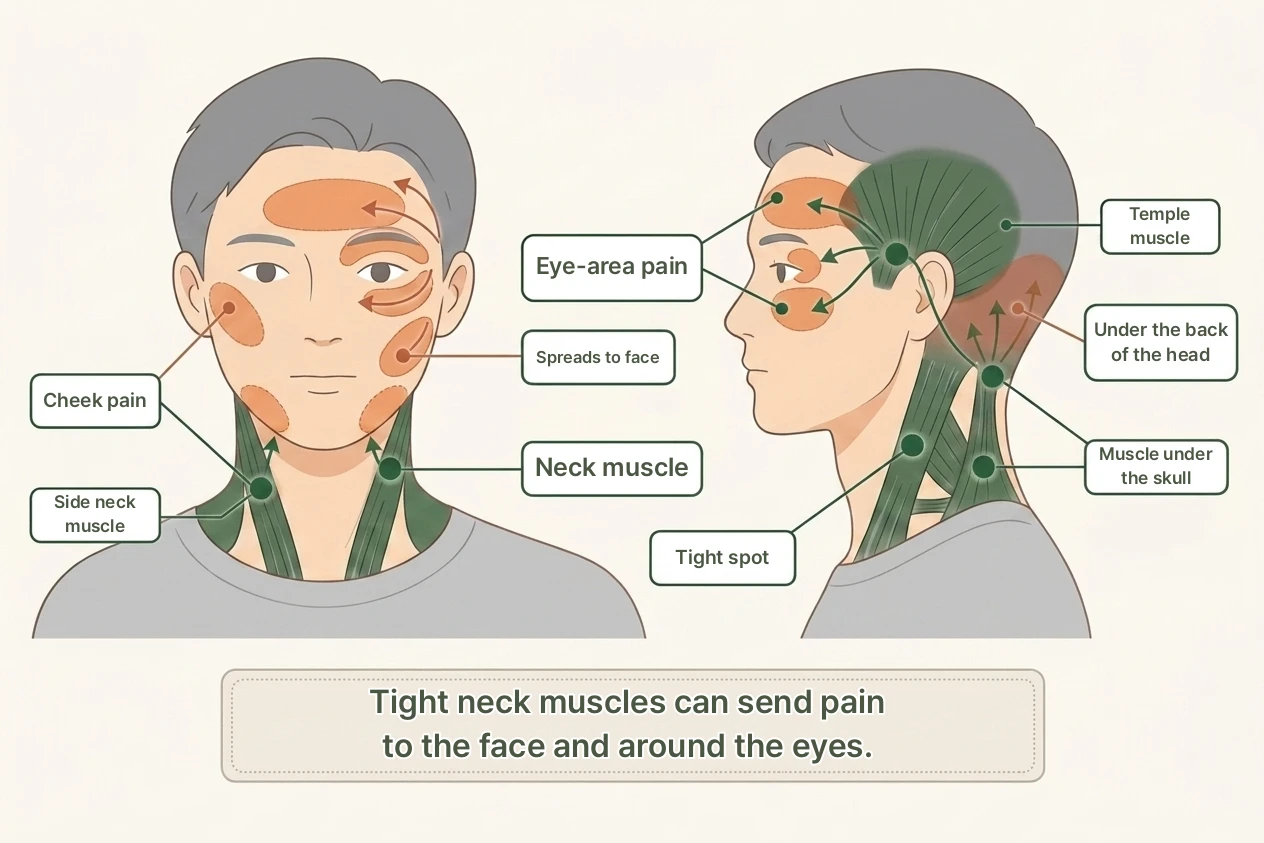
The muscle on the side of the neck (sternocleidomastoid) and the muscles at the back of the neck (suboccipital, upper trapezius) all have routes that send pain to the eye, forehead, and cheek. If the eyes, brain, and nerves all came back normal on testing, these muscles are worth looking at. That is why treating only the neck, or only the face, does not fix it.
At this stage the swollen muscles are pressing on the nerve. If that pressure lasts, the nerve itself can be damaged.
These signs may mean your neck is the cause
- The eye exam is normal, yet the eye feels heavy or as if it is being pushed out
- The temple, cheek, and area above the eyebrow ache with a squeezing feeling
- One eye waters noticeably more, or turns red often
- One eyelid feels slightly droopy
- Turning your head or pressing the back of the neck changes the facial pain as well
- The back of the neck and shoulder are always tight, and it stays that way for days
Why does the neck make the face and eyes hurt?
The neck has several muscles that send pain into the face. Each one refers pain to a different spot.
Sternocleidomastoid
The muscle on the side of the neck, running from below the ear to the collarbone. When it tightens, pain spreads to the inner eye, forehead, and cheek. Sometimes tearing, eye redness, and a drooping eyelid come along with it.
Upper trapezius
Runs from the neck up into the shoulder. It refers pain to the temple and the side of the eye, felt as a band tightening around the head.
Suboccipital muscles
Sit deep, just below the back of the head. Pain spreads behind the eye and into the forehead, so it often feels as if the eye is being pushed out. Meanwhile the eye exam comes back normal.
Temporalis
The chewing muscle at the temple. It refers pain above the eyebrow and around the eye, and commonly shows up together with a headache.
Up to here the swollen muscles are pressing on the nerve.
When that pressure lasts, the nerve itself is damaged, and the pain stops squeezing and starts burning.
If your face burns and the skin feels numb where it hurts, burning facial pain covers that stage.
The face hurts, so why the tearing and redness?
The nerve that carries sensation from the face and around the eye meets the nerve that relays pain from the neck muscles at the same point in the brainstem. So neck muscle tension can be misread as facial pain, and the autonomic nerves that control the tear glands and blood vessels can be stirred up at the same time.
In practice, patients with a tight neck-side muscle (sternocleidomastoid) have been reported to show excess tearing, conjunctival redness, a drooping eyelid, and blurred vision together. If the eye clinic could not find a cause, pressing this muscle can already give you a clue. If pressing the neck muscle eases the eye pain at the same time, the cause is more likely the neck than the eye.
What’s causing the facial and eye pain? How do you tell?
Not every pain in the face or around the eyes is a neck problem. Trigeminal neuralgia and migraine cause pain in similar areas.
When neck muscles are the cause
- Tight, heavy feeling that lingers steadily
- Pain changes when you move your head
- Neck and shoulder tightness is always there too
- Worse as the afternoon goes on
- Imaging and blood work all normal
Trigeminal neuralgia
- Intense, stabbing electric-shock-like pain
- A few seconds to tens of seconds, short and repeating
- Triggered by washing, brushing teeth, even a breeze
- No pain at all between attacks
Migraine
- Throbbing, pulsing pain on one side
- Sensitivity to light and sound
- Nausea may come along
- Lasts from a few hours up to three days
These symptoms need emergency care right away
- Sudden blurred vision or loss of sight in one eye
- Eye pain with severe headache and vomiting, which can point to acute glaucoma
- Weakness or numbness on one side of the face
- Pain with fever and blisters, which can point to shingles
- In people over 50, scalp tenderness to the touch and jaw pain when chewing
How Yonsei SM Pain Clinic approaches it
For pain in the face and around the eyes, we do not look at the face alone. We check the neck muscles behind it and work directly on the fascia and nerves.
We bring the swelling down, settling the overworked muscles and nerves
Guided by ultrasound, we inject the trigger points in the sternocleidomastoid, suboccipital, and upper trapezius muscles directly (Circulation HD) to quickly reduce the pain signals heading toward the face.
We wake the muscles up, restoring function with Circulation PT
A dedicated therapist releases the tight spots in the neck muscles and uses upper-cervical (C0 to C3) mobilization to ease the load on the nerve pathway that links the neck and face.
We make the movement stick, keeping it from coming back
We correct forward-head posture and jaw-clenching habits and train ways to hold the gains in daily life.
* Response to injection and therapy varies from person to person, and temporary soreness or bruising may occur. The exact diagnosis and treatment plan are decided after an in-person consultation.
What you can check in daily life
Press the neck muscles
- Gently press the muscle running from below the ear to the collarbone
- Notice whether the eye pain eases at the same time
- Loosen neck and shoulder tension with a warm compress
Check your posture
- Make sure your head is not jutting forward when you look at a screen
- Stretch the neck and shoulders every hour
- If you clench your teeth, notice it and let the jaw relax
Frequently asked questions
The eye clinic and neurology said I am normal, so why does it keep hurting?
An eye exam looks at the structure and function of the eye itself. Referred pain that started in the neck muscles is felt at the eye even when the eye has no real problem. The test result and the source of the pain are simply two different things.
Can the tearing and redness be from the neck too?
They can. When the neck-side muscle tightens, it can stir up the autonomic nerves that control the tear glands and blood vessels, which can bring on tearing, redness, and a drooping eyelid.
How do I tell it apart from trigeminal neuralgia?
Trigeminal neuralgia comes as short, intense electric-shock-like pain that repeats, with pain-free stretches between attacks. Pain from the neck muscles is a dull, heavy feeling that carries on and changes when you move the neck.
Painkillers barely help, why is that?
If neck muscle tension is the cause, painkillers do not address the root. The trigger points have to be released directly to cut down the signals being sent.
How many sessions until it improves?
It depends on how long the symptoms have been present and how widespread they are. Recent muscle tension tends to respond fairly quickly, while long-standing cases or those with autonomic symptoms need a step-by-step approach. We will lay out a plan after the exam.
Related reading
Face and eye-area pain that keeps going despite normal exams?
At Yonsei SM Pain Clinic near Gangnam-gu Office Station, we check the neck muscles as well.
Book onlineReferences
- Simons DG, Travell JG, Simons LS. Travell & Simons’ Myofascial Pain and Dysfunction: The Trigger Point Manual, Volume 1: Upper Half of Body. 2nd ed. Williams & Wilkins; 1999.
- Roth JK, Roth RS, Weintraub JR, Simons DG. Cervicogenic headache caused by myofascial trigger points in the sternocleidomastoid: a case report. Cephalalgia. 2007;27(4):375-380.
- Bogduk N, Govind J. Cervicogenic headache: an assessment of the evidence on clinical diagnosis, invasive tests, and treatment. Lancet Neurol. 2009;8(10):959-968.
- Benoliel R, Gaul C. Persistent idiopathic facial pain. Cephalalgia. 2017;37(7):680-691.
- Fernández-de-las-Peñas C, Cuadrado ML, Arendt-Nielsen L, Simons DG, Pareja JA. Myofascial trigger points and sensitization: an updated pain model for tension-type headache. Cephalalgia. 2007;27(5):383-393.
Last reviewed: 2026-07-10