Inner elbow pain and hand weakness?
Golfer’s Elbow — The tendons that flex your wrist are damaged.
You don’t need to play golf to get it. Lifting heavy objects or repeatedly twisting the wrist inward causes micro-damage to accumulate in the inner elbow tendons.
Quick Answer: Golfer’s elbow (medial epicondylitis) often results from repetitive overload to the inner elbow tendons. The key is to calm the pain (Downshift), progressively restore wrist and forearm function (Activate), and prevent recurrence in daily activities (Integrate).
Seek medical attention quickly if:
- Severe finger numbness or sudden hand weakness
- Rapid worsening after trauma
- Swelling, warmth, or fever
- Pain rapidly worsening despite rest
3 Key Points on This Page
- Differences between golfer’s elbow and tennis elbow
- Why inner elbow pain causes hand weakness
- Fundamental treatment approaches
These symptoms suggest golfer’s elbow
- Tenderness on inner elbow (medial epicondyle) — Sharp pain when pressed.
- Pain when flexing wrist — Hurts when making a fist or applying inward wrist force.
- Worse when lifting heavy objects — Shopping bags, luggage, carrying children.
- Pain during handshakes — Inner elbow pulls when gripping firmly.
- Accompanied finger numbness — 4th-5th fingers (pinky side) may feel numb.
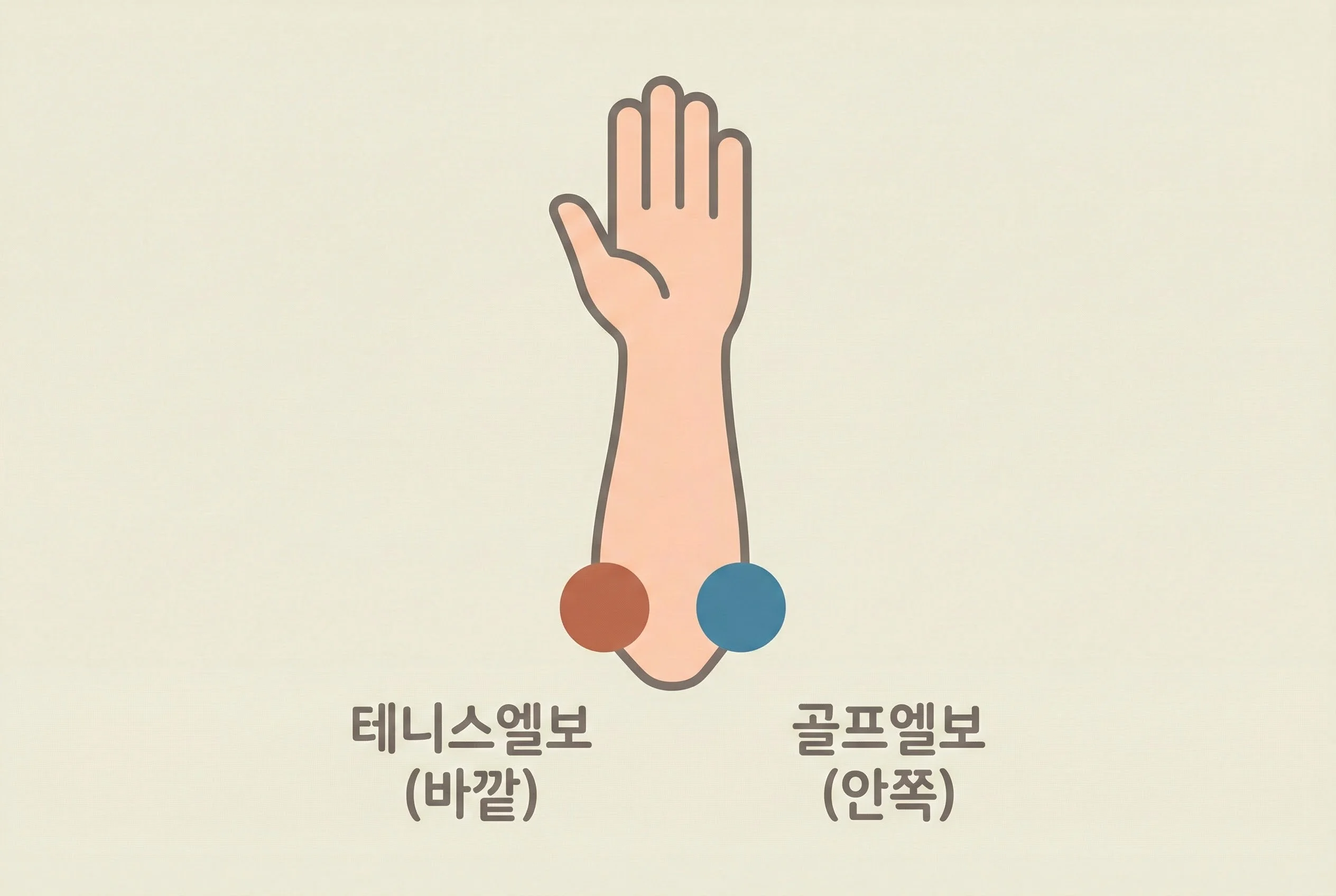
Tennis Elbow vs Golfer’s Elbow
Tennis Elbow (Lateral Epicondylitis)
- Location: Outer elbow
- Movement: Pain when extending wrist back
- Activities: Mouse use, gripping objects, twisting
- Prevalence: More common (10x more frequent)
Golfer’s Elbow (Medial Epicondylitis)
- Location: Inner elbow
- Movement: Pain when flexing wrist inward
- Activities: Lifting heavy objects, throwing, swinging
- Feature: May involve ulnar nerve symptoms
Why does golfer’s elbow develop?
The formal name is medial epicondylitis. The tendons of the wrist flexor muscles attach to the inner elbow bone (medial epicondyle), and this attachment point develops problems.
Activities that cause golfer’s elbow
- Golf, baseball pitching, javelin throwing
- Repeatedly lifting heavy objects
- Climbing, rock climbing
- Hammering, tightening screws
- Cooking (large pots, pans)
- Lifting children
Note: The ulnar nerve (responsible for pinky-side numbness) runs through the inner elbow. Golfer’s elbow and ulnar nerve issues often coexist, requiring accurate differentiation.
Our Approach at Yonsei Shinmyung
Golfer’s elbow requires tendon tissue regeneration and correcting arm use patterns. If ulnar nerve issues coexist, we treat both together.
- Phase 1: Downshift (Circulation HD)
Hydrodissection releases adhesions around tendons and improves blood flow. If ulnar nerve compression exists, we release the nerve area as well. - Phase 2: Activate (Circulation PT)
Progressively strengthen weakened wrist flexors. Eccentric exercises are effective. - Phase 3: Integrate
Correct patterns that strain the elbow—lifting techniques, swing form, throwing motions.
Golfer’s Elbow Self-Care
What You Can Do Now
- Reduce painful movements (use less, not complete rest)
- Ice pack (2-3x daily, 15 min)
- Lift objects with palms facing up
- Divide loads between both hands
Eccentric Exercise (Recovery Phase)
- Hold dumbbell (1-2kg) and flex wrist inward
- Use other hand to slowly extend wrist
- Take 3 seconds for slow extension
- 3 sets × 15 reps daily
If finger numbness is severe or hand strength significantly decreases, it may be an ulnar nerve issue. Consult a specialist.
Frequently Asked Questions
Does it hurt when gripping? Is it golfer’s elbow?
If gripping or lifting causes inner elbow pain, golfer’s elbow is possible. We assess pain location and triggering movements together. Gripping Pain Q&A →
Can I continue exercise (weights/golf)?
Reduce overload movements during painful periods and adjust routines to match your phase. Pushing through can delay recovery. Arm Exercise Q&A →
How is it different from tennis elbow?
Tennis elbow causes outer elbow pain; golfer’s elbow causes inner pain. They can coexist or overlap with other issues, requiring evaluation. Tennis Elbow Page →
Do mouse or smartphone use affect it?
Repetitive wrist and forearm use can strain tendons. Adjusting work environment and wrist angle helps. Mouse Pain Q&A →
Can I keep getting injections?
Injection frequency depends on type and purpose. Combining pain control with functional recovery routines is important. Injection Q&A →
Why does it improve then recur?
If daily use patterns repeat, tendons accumulate strain again. Changing recurrence-causing patterns alongside pain control is key. Recurrence Q&A →
Are there routines I can do at home?
Reduce overload during painful periods and approach with phase-appropriate stretching and strengthening routines. Exact routines are provided after evaluation. Arm Exercise Q&A →
What is the treatment sequence?
First calm pain and tension (Downshift), then restore function with eccentric exercises (Activate), and prevent recurrence in daily movements (Integrate). Circulation Therapy Introduction →
Related Articles
Want to resolve inner elbow pain without recurrence?
We treat fundamentally through tendon regeneration and use pattern correction.
Book Online