Why does my back hurt when I bend forward?
Pain when you bend forward may involve a disc, but muscles or joints may also contribute. We first check which movements hurt, whether you have leg numbness, and whether your strength has changed. Depending on the evaluation, we may consider Circulation HD or Circulation PT. Book an appointment if the pain keeps returning.
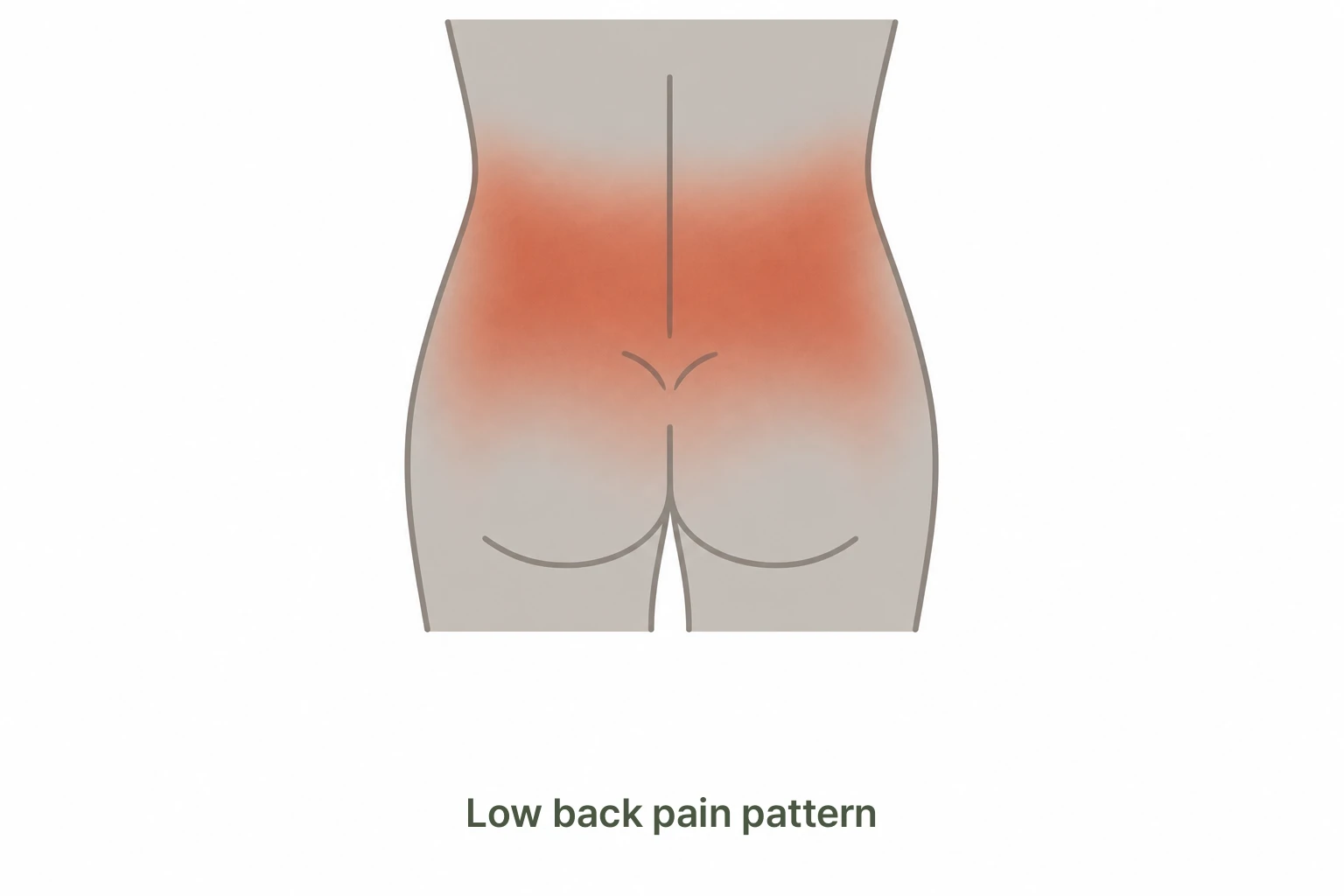
Seek urgent assessment if you have any of these signs.
- New bowel or bladder problems or reduced sensation around the groin.
- Leg weakness that begins suddenly or worsens quickly.
- Fever or rapidly worsening pain after an injury.
- Night pain that keeps worsening and wakes you from sleep.
Why does bending forward hurt my back?
When bending causes pain, we consider the muscles and joints as well as the discs. It also matters whether the pain starts as you reach for an object, when you stand after sitting, or when you straighten up again. We check for leg numbness and strength changes too. One movement cannot confirm a specific cause.
We look at painful movements and the activities that have become difficult before choosing treatment. Depending on your condition, we may consider Circulation HD for the painful area or Circulation PT to work on movement.
What changes when arching backward hurts?
Pain when you arch backward or stand for a long time shows up during a different movement. We also ask whether walking brings on leg numbness and sitting helps. These differences help guide the examination, but arching alone cannot diagnose a facet joint problem or spinal stenosis.
What do we check if twisting or leaning sideways hurts?
Pain when you twist or lean to one side gives us a reason to examine side-to-side differences and movement at the hips and pelvis. Pain on one side does not by itself mean that the pelvis is out of alignment.
What’s causing back pain during different movements? How do you tell?
Movements can overlap, such as bending while you turn. We ask when the pain starts, whether rest changes it, and whether it travels into the leg. Pain that persists regardless of movement, especially with fever or blood in the urine, needs assessment for other causes. Internal medicine or urology may be the right next step.
How do we choose treatment at Yonsei Shinmyung Pain Clinic?
We first check which movements hurt, whether you have leg symptoms, and whether your strength has changed. After the examination, we may consider Circulation HD or Circulation PT. If both are appropriate, we may consider Circulation Combo.
Our care follows three steps.
- We bring the swelling down. Circulation HD addresses the painful area.
- We wake the muscles up. Circulation PT assesses movement and helps you learn suitable exercises.
- We make the movement stick. Circulation PT includes practice for everyday movements.
We decide which treatment is appropriate at your appointment. Responses to treatment vary.
What do people ask about back pain?
Does pain when I bend forward mean I have a disc problem?
A disc problem is one possibility, but the movement alone cannot establish the cause. We also check for leg numbness, strength changes, and pain in other positions. Read about lumbar disc pain
What do you check if my back hurts only when I pick something up?
We ask whether the pain starts as you bend or as you stand again. We also look at how you lift and whether you have leg symptoms. Read more about bending pain
Does pain when I arch backward suggest a different cause?
Pain with arching is another useful clue. We need to check which other movements change the pain and whether you have leg symptoms. Read about spinal stenosis
Why does my back hurt more after sitting for a long time?
We ask how long you sit and whether the pain changes when you stand up. Sitting pain alone does not identify one cause. Read more about sitting pain
What if I also have numbness in my leg?
The location of the numbness and any change in strength matter. Seek urgent assessment if leg weakness begins suddenly or worsens quickly. Read more about leg numbness
Can an MRI show lumbar spine degeneration in someone without back pain?
Yes. An MRI can show degenerative changes in the lumbar spine in people without back pain. Imaging findings need to be considered alongside symptoms.
How should I start exercising for my back?
First, find out which movements make the pain worse. Then adjust movement to your condition. Do not keep repeating a movement through increasing pain. Read more about back exercise
When should I seek urgent care?
Get urgent assessment for bowel or bladder changes, reduced sensation around the groin, or new or worsening leg weakness. Do not delay if pain becomes severe after an injury or comes with fever.
What else can I read?
Should I book a visit for pain when I bend?
If the pain keeps returning, we can examine the movements that hurt and check for leg symptoms. Discuss your treatment options at an appointment.
Book OnlineReferences
- Han CS, et al. Low back pain of disc, sacroiliac joint, or facet joint origin: a diagnostic accuracy systematic review. EClinicalMedicine. 2023, 59, 101960. PMID 37096189. DOI 10.1016/j.eclinm.2023.101960
- Maher C, et al. Non-specific low back pain. Lancet. 2017, 389(10070), 736-747. PMID 27745712. DOI 10.1016/S0140-6736(16)30970-9
- George SZ, et al. Interventions for the Management of Acute and Chronic Low Back Pain: Revision 2021. J Orthop Sports Phys Ther. 2021, 51(11), CPG1-CPG60. PMID 34719942. DOI 10.2519/jospt.2021.0304
- Brinjikji W, et al. Systematic literature review of imaging features of spinal degeneration in asymptomatic populations. AJNR Am J Neuroradiol. 2015, 36(4), 811-816. PMID 25430861. DOI 10.3174/ajnr.A4173
- Expert Panel on Neurological Imaging, et al. ACR Appropriateness Criteria Low Back Pain: 2021 Update. J Am Coll Radiol. 2021, 18(11S), S361-S379. PMID 34794594. DOI 10.1016/j.jacr.2021.08.002