They say your pelvis is out of alignment. But is the bone really twisted?
Pelvic tilt. It often comes from muscle imbalance.
People are told one leg looks shorter, that their back often hurts, or that their body leans when they walk. They say the pelvis is twisted. But it is rare for the bone itself to actually be misaligned.
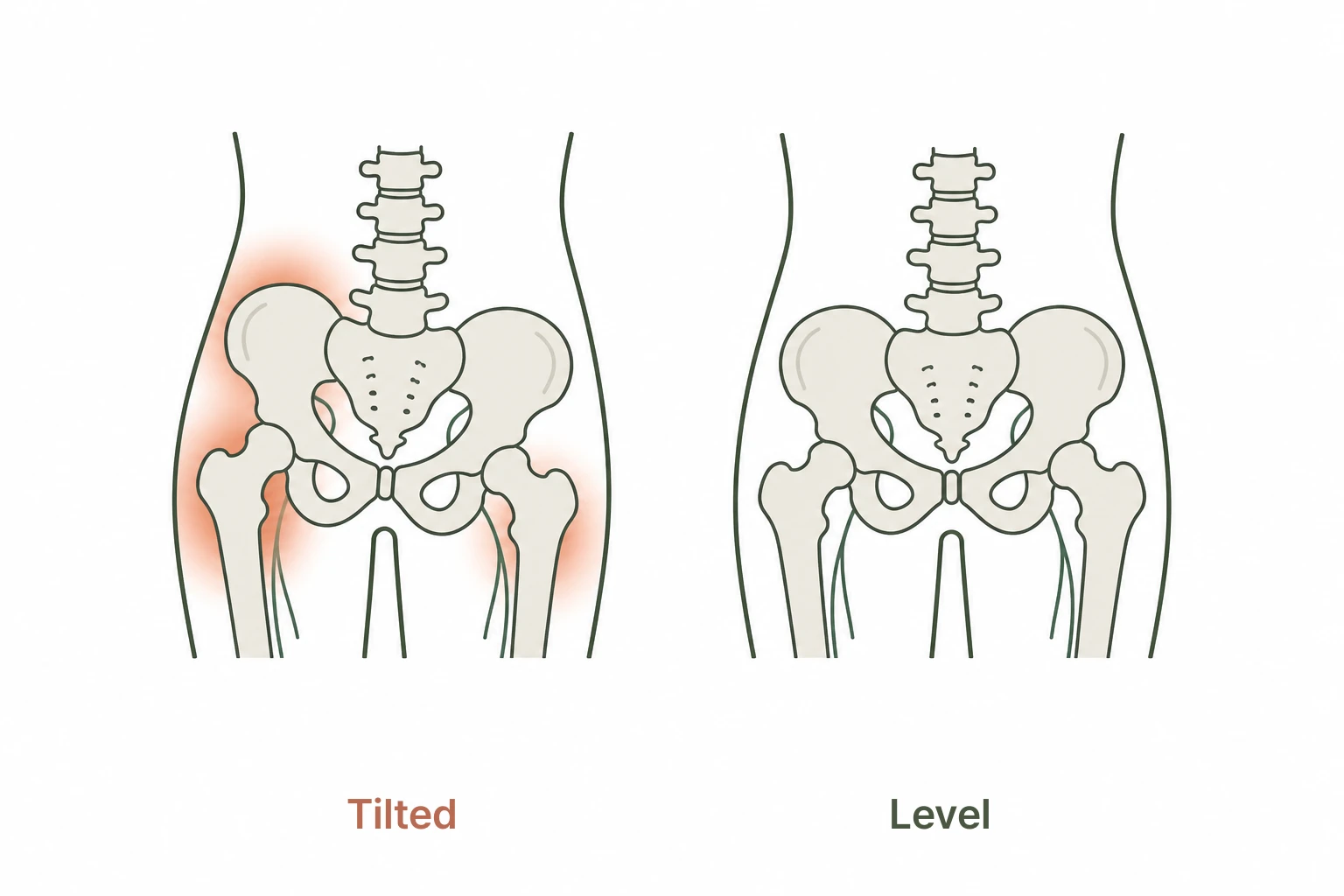
Quick answer: A “twisted pelvis” is rarely a permanently misaligned bone. It usually appears when muscle imbalance, posture, and gait patterns overlap. What matters is an approach that releases the shortened muscles, wakes up the weakened ones, and keeps everything from drifting out of balance again during everyday movement.
These signs call for urgent evaluation
- Bowel or bladder problems, or reduced sensation in the groin or perineum
- Leg weakness that comes on suddenly or worsens rapidly
- Sharp worsening of pain after an injury
- Systemic symptoms such as fever or chills
3 key points covered on this page
- Whether “pelvic tilt” is really about bone or muscle
- Why pelvic imbalance causes low back pain
- How to correct pelvic imbalance at the root
These symptoms may point to pelvic imbalance
- One side of your pants wears out faster. Your weight shifts to one side when you walk.
- You put more weight on one leg when standing. You unconsciously stand on one leg.
- Only one side of your back hurts. The pain is left-right asymmetric.
- One buttock presses down more when you sit. You sit leaning to one side.
- Your legs feel like different lengths. They may actually differ, or it may be due to a pelvic tilt.
What “pelvic tilt” really is
People often say “the pelvis is twisted,” but it is very rare for the pelvic bone itself to be deformed. In most cases it is:
- Muscle imbalance. Muscles on one side become short or weak, making the pelvis look tilted
- Sacroiliac joint dysfunction. A movement problem in the joint between the pelvis and spine
- Functional leg length difference. A pelvic tilt makes the legs look like different lengths
In other words, “restoring muscle balance” is a more accurate description than “putting the bone back in place.”
Types of pelvic imbalance
- Anterior tilt. The pelvis tips forward (excessive lordosis)
- Posterior tilt. The pelvis tips backward (flat back)
- Lateral tilt. One side of the pelvis sits higher
- Rotation. The pelvis twists to one side
The muscles that create pelvic imbalance
Muscles that tend to shorten
- Iliopsoas shortens with prolonged sitting and tips the pelvis forward
- Quadratus lumborum, when short on one side, tilts the pelvis sideways
- Piriformis, when shortened, rotates the pelvis
- Rectus femoris, tight at the front of the thigh, tips the pelvis forward
Muscles that tend to weaken
- Gluteal muscles, when weak, cause the pelvis to lose stability
- Transversus abdominis, when weak, lets the pelvis wobble
- Multifidus, when weak, reduces spinal stability
- Gluteus medius, when weak, causes the pelvis to sway while walking
Is it pelvic pain, or a nearby structure?
Pain around the hips and pelvis has many possible sources. Sacroiliac joint dysfunction and hip joint problems occur in similar locations and are frequently confused.
Sacroiliac Joint Dysfunction
- One-sided pain right beside the sacrum (PSIS area)
- Worse when rising from a chair or climbing stairs
- Pain when standing on one leg or getting in and out of a car
- Positive FABER test (hip flexion, abduction, external rotation)
Hip Joint Arthritis or Femoroacetabular Impingement
- Pain in the groin or front of the thigh
- Catching or pain when rotating the leg inward or bending the hip
- Progressive heaviness in the leg with prolonged walking
- Hip joint changes visible on X-ray
Pelvic pain also overlaps with lumbar disc herniation and piriformis syndrome. In women, uterine or ovarian pathology can manifest as pelvic pain, so gynaecological causes should be excluded when the picture is unclear. Pinpointing the exact pain location and what provokes it is the starting point for accurate diagnosis.
Our approach at Yonsei Shinmyung Pain Clinic
Pelvic correction is not about “putting the bone back in place” but about “restoring muscle balance.”
- Stage 1. We bring the swelling down (Circulation HD)
We focus on easing swelling and inflammation, improving circulation around stiffened, adhered tissue, and helping movement return. Knotted muscle bands may ease along the way. We also address adhesions around the sacroiliac joint. - Stage 2. We wake the muscles up (Circulation PT)
We strengthen the weakened glutes, transversus abdominis, and gluteus medius, with exercises that restore left-right balance. - Stage 3. We make the movement stick
You learn to stand, walk, and sit with good posture. We correct habits that create imbalance, such as standing on one leg or crossing your legs.
Pelvic imbalance self-check
- Stand in front of a mirror and compare the height of both hip bones (iliac crests). If one is higher, that suggests a lateral tilt
- Stand with your back against a wall and try to slide your hand behind your lower back. If a fist fits, that suggests excessive lordosis. If your hand won’t fit, that suggests a posterior tilt
- Stand on one leg. If one side is noticeably unstable, that suggests a weak gluteus medius
- Notice whether you usually stand on one leg. This unconscious habit causes imbalance
Self-checks are for reference only. An accurate assessment requires evaluation by a specialist.
Frequently asked questions
Can hip pain actually come from the lower back?
Hip pain can arise not only from the hip joint itself but also from the lower back, nerves, or fascial tension. We look at both where the pain is and what movements bring it on. Hip Pain Q&A →
Is sciatica-like pain running down the leg related to the pelvis too?
Sciatica-type symptoms can have many causes beyond a disc, including pelvic and gluteal muscle tension or pressure along the nerve’s path. The distribution of symptoms and the movements that trigger them are clues. Sciatica Q&A →
Why does my pelvis or back hurt more when I sit for a long time?
Prolonged sitting can shorten the muscles around the pelvis and increase the load on your lower back. Adjusting your posture and rest patterns can help. Sitting Pain Q&A →
Does one leg looking shorter mean the bone is twisted?
In reality, muscle tension and posture patterns can create an apparent “functional length difference.” An accurate assessment is best confirmed through examination. Posture Q&A →
Can stretching alone correct it?
Simply releasing the shortened muscles can leave things prone to drifting back. After releasing them, it is important to strengthen the weakened muscles and change your walking and standing patterns as well. About Circulation PT →
Can my pelvis or back hurt even when the MRI is normal?
Even without major findings on imaging, functional problems such as fascial tension or nerve hypersensitivity can produce pain. In these cases, assessing symptoms and movement may matter more. Normal MRI Pain Q&A →
It got better and then hurt again. Why does it keep coming back?
When the same posture and gait patterns repeat in daily life, strain can build up again. Along with controlling the pain, it is important to change the patterns that drive recurrence. Recurrence Q&A →
In what order does the treatment proceed?
We recommend first calming the pain and excess tension, then restoring weakened core and glute function, and building habits that hold up during everyday movement. About Circulation Therapy →
Articles worth reading together
Wondering whether pelvic imbalance is the cause of your back pain?
After a thorough evaluation, we’ll build a correction plan that addresses the root cause.
Book OnlineReferences
- Laslett M, et al. Diagnosis of sacroiliac joint pain: validity of individual provocation tests and composites of tests. Man Ther. 2005;10(3):207-218.
- Cohen SP. Sacroiliac joint pain: a comprehensive review of anatomy, diagnosis, and treatment. Anesth Analg. 2005;101(5):1440-1453.
- Ruhe A, et al. Is there a relationship between lumbar spine pathology and muscle imbalance in chronic low back pain? Clin Biomech. 2011;26(2):143-148.
- Vad VB, et al. Sacroiliac joint pain: evaluation and management. Am J Orthop. 2008;37(8):395-399.