Catching feeling in shoulder when lifting arm?
Impingement Syndrome — Tendon pinches between bones causing pain.
Lifting arm at certain angles produces a ‘catching’ sensation with pain. Sometimes feels better when lifted higher. If this symptom repeats, it can lead to tendon damage.
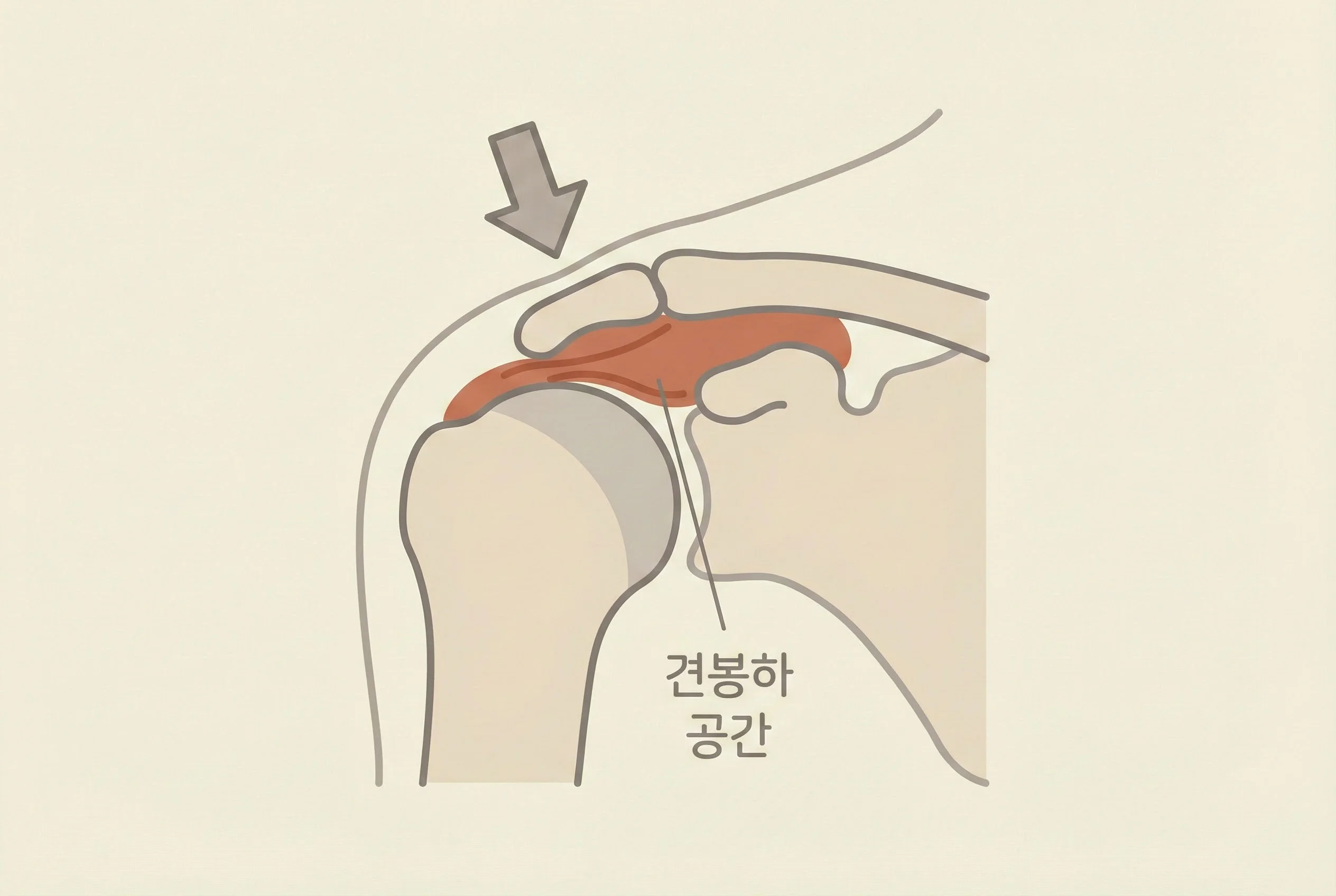
Quick Answer: Impingement syndrome occurs when shoulder tendons repeatedly pinch or rub in the subacromial space causing pain. The flow is important: calming pain (Downshift), restoring scapula/rotator cuff function (Activate), and changing patterns to prevent re-impingement in daily movements (Integrate).
Seek medical attention quickly if:
- Sudden inability to lift arm or sharp strength drop after trauma
- Night pain so severe sleep is impossible
- Swelling, warmth, fever with rapidly worsening pain
- Numbness or decreased sensation progressing
3 Key Points on This Page
- Structural reason why impingement syndrome occurs
- Why pain occurs only at certain angles
- How posture correction prevents and treats
These symptoms suggest impingement syndrome
- Pain when lifting arm 60-120 degrees — Hurts at certain angle, feels better when lifted higher (Painful Arc).
- Catching feeling in shoulder — Something catches or ‘clicks’ when lifting arm.
- Front shoulder pain when reaching — Especially when reaching forward or grabbing something overhead.
- Uncomfortable lying on painful side at night — Pressure worsens pain.
- Worsens after repetitive shoulder use — More pain after cleaning, exercising, painting-type movements.
Why does tendon get pinched?
The shoulder has a narrow tunnel called the subacromial space. Rotator cuff tendons pass through this space, and when it narrows, tendons repeatedly pinch against bone (acromion) causing friction.
Repeated friction creates inflammation, inflammation causes tendon swelling, and swelling further narrows the space — a vicious cycle begins.
Why Space Narrows
- Rounded shoulders — Shoulders rolling forward causes acromion to tilt forward narrowing space
- Shoulder muscle imbalance — Excessive upper trapezius tension pulls scapula upward
- Acromion shape — Congenitally downward curved acromion
- Bursa inflammation — Shock-absorbing bursa swells
Why pain only at certain angles? (Painful Arc)
When lifting arm sideways:
- 0-60 degrees — Tendon under acromion, not pinching yet
- 60-120 degrees — Tendon passes under acromion causing impingement → Most painful range
- 120+ degrees — Scapula rotates securing space again → Pain decreases
This ‘Painful Arc’ pattern is characteristic of impingement syndrome. However, rotator cuff tear can show similar pattern, requiring precise evaluation.
Our Approach at Yonsei Shinmyung
The key to impingement syndrome is ‘expanding the space.’ We treat by functionally creating space without structural surgery.
- Phase 1: Downshift (Circulation HD)
Stabilize inflamed bursa and tendon area. Precise ultrasound-guided procedure reduces swelling when needed. - Phase 2: Activate (Circulation PT)
Strengthen scapula-stabilizing muscles (lower trapezius, serratus anterior) and relax overtense upper trapezius to normalize scapula position. - Phase 3: Integrate
Correct rounded shoulders and learn proper scapulohumeral rhythm when lifting arm. This enables lifting arm without impingement.
Key Posture Correction Points
Most important for preventing and treating impingement syndrome is shoulder and scapula position.
❌ Problematic Postures
- Rounded shoulders rolling forward
- Forward head posture
- Shrugging shoulders when lifting arm
- Rounded back posture
✓ Correct Posture
- Shoulder blades flat against back
- Shoulders positioned behind ears
- Keep shoulders down, lift only arm
- Thoracic spine naturally extended
What is Scapulohumeral Rhythm?
When lifting arm, humerus and scapula must move together in 2:1 ratio. When this rhythm breaks, impingement occurs. Circulation PT trains to restore this rhythm.
Frequently Asked Questions
Why pain only at certain angles?
There may be angles during arm lifting where tendon gets more compressed. Evaluating pain angle with posture and scapula movement helps find the cause. Arm Raising Q&A →
Is shoulder noise impingement syndrome?
Can’t determine cause from noise alone. Evaluation needed if noise accompanies pain or catching feeling. Clicking Sound Q&A →
How to distinguish from frozen shoulder?
Frozen shoulder involves movement restriction itself from stiffened capsule, while impingement typically shows pain at specific movements/angles. We look at range and pain pattern together. Differentiation Q&A →
Can it progress to rotator cuff tear?
Repeated impingement can accumulate burden on tendon. Good to establish treatment direction after evaluation if pain persists or function decline accompanies. Rotator Cuff Tear Page →
How should I exercise my shoulder?
Range-of-motion exercises appropriate to current stage and scapula stabilization routine are important. Excessive exercise can worsen, safer to establish routine after evaluation. Shoulder Routine Q&A →
Worse at night, is it shoulder problem?
Night pain can appear in impingement or tendon issues too. May need differentiation from frozen shoulder and other conditions, so we check pain pattern and movement together. Night Pain Q&A →
Can I keep getting injections?
Injection repeat plans vary by type and purpose. Important to design addressing patterns causing impingement and function recovery together rather than just briefly reducing symptoms. Injections Q&A →
Better then painful again, why does it repeat?
If same movement patterns repeat in daily life, burden can accumulate on tendon again. Important to change patterns causing recurrence along with pain control. Recurrence Q&A →
Related Articles
Catching and pain when lifting arm?
We accurately identify the cause of impingement and resolve it fundamentally through posture correction.
Book Online