Only One Side of My Back Stings During the Downswing
Backs usually ache broadly. A single sharp point means load is landing there again and again. The golf swing has a moment where exactly that happens.
Get seen right away if you have these
- Pain spreading below the buttock into the thigh or calf
- Numbness or weakness in the leg
- Changes in bladder or bowel control
- Pain that will not settle even at rest
One sided back pain with any of these means the nerves need checking first.
Why only one side
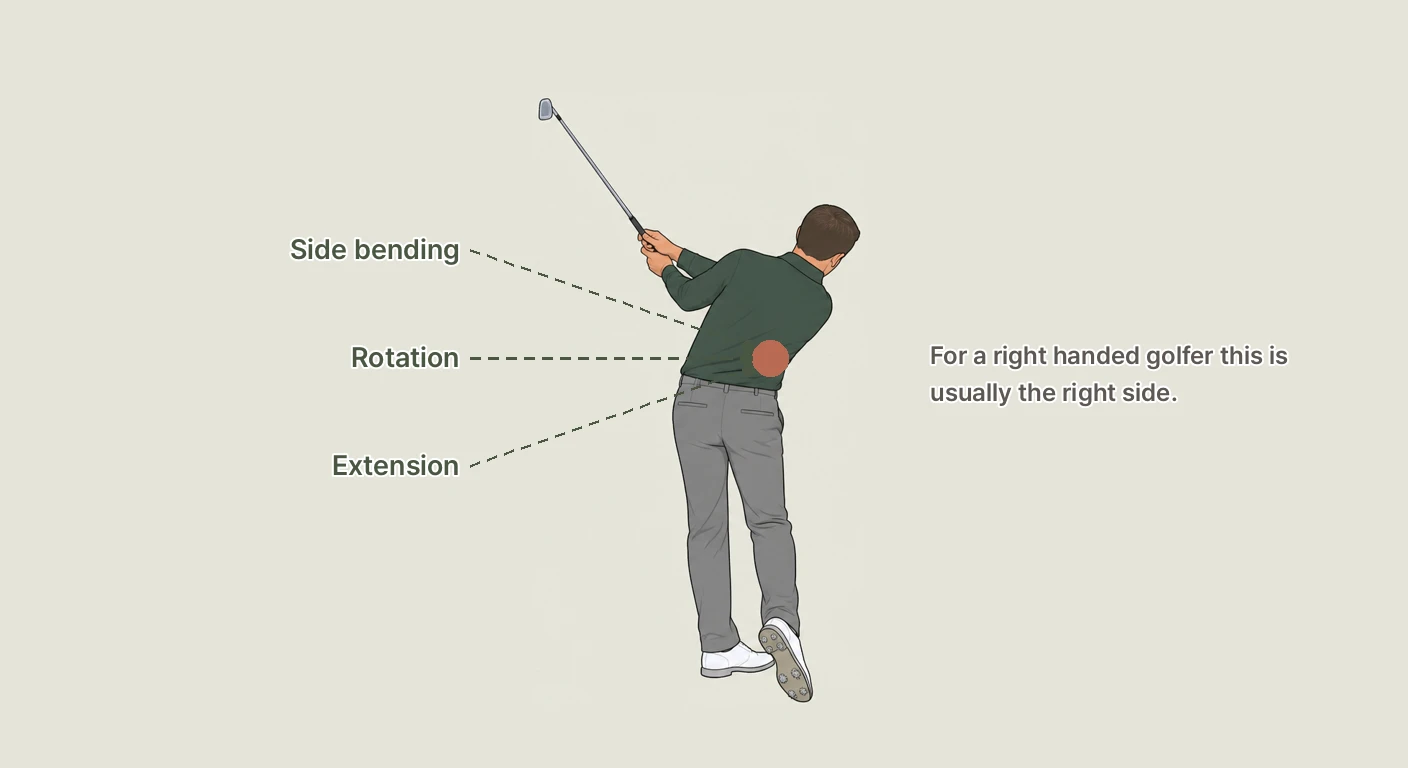
Three forces overlap early in the downswing
Three things land on the low back at once as the club starts down. The body is tilted away from the target, it has already begun turning toward it, and the back is arched. Where side bending, rotation, and extension converge, one side of the joints at the back of the spine takes all of it. For a right handed golfer that is usually the right.
Thousands of turns, always the same way
Golf repeats in one direction. The two sides were never carrying equal amounts, and adding whatever difference in mobility you already had means the same side speaks up first every time.
Something has to stop the turn
A swing does not end with acceleration. The follow through has to bring a rotating body to a halt. If the glutes and trunk do not share that braking, one side of the low back does it instead.
Where the pain is coming from
A disc is the first thing most people worry about here too. One sided pain has several possible sources though, and a disc is only one of them. Which position brings it on is the best clue.
Joints at the back of the spine
- Stings on leaning back, or turning toward the painful side
- Small enough an area to point to with one finger
- Worse standing, easier sitting
- Stiff on waking, loose again after a few minutes
Sacroiliac joint
- Lower than the back proper, just above the buttock
- Worse standing on one leg or climbing stairs
- Sharpest in the moment you rise from a chair
Disc and nerve
- Spreads below the buttock, with numbness somewhere
- Worse sitting and bending forward
- A sense that the leg is giving way
Ribs
- Higher than the low back, closer to the flank
- Hurts on a deep breath or a cough
- Practice volume went up sharply in recent weeks
- Rolling over in bed wakes you up
What not to do
- Digging into the spot or rolling it out. If a joint is the source, pressing the muscle over it will not release anything. It usually makes the area touchier.
- Swinging the other way to even things out. Side to side differences start in how far each joint turns, not in muscle bulk. Reverse swings while you hurt just add load.
- Swinging bigger through the sting. Trying to power past it adds extension, and the extra load goes straight to the spot that already hurts.
3-Stage Response to One Sided Back Pain
Stage 1: We bring the swelling down
Pinpoint what is actually reactive on the painful side and settle the swelling. This is where Circulation HD is used.
Stage 2: We wake the muscles up
Restore the mid back and hip on whichever side turns less, and train the glutes that should be braking to switch on in time. That work happens in Circulation PT.
Stage 3: We make the movement stick
Start at half swings and grow only as far as the sting stays away, checking that the side to side gap holds closed as the swing gets bigger.
How We Assess at Yonsei Shinmyung Pain Clinic
Radiating pain, numbness, and weakness come first, to sort out nerve involvement. Then we move you through extension and rotation to find which position reproduces the pain.
One sided pain usually starts from a side to side difference, so we look at the other side as well. How weight transfers onto one leg and how the pelvis absorbs rotation both show up in walking. Gait analysis traces where that difference begins, and muscle response testing shows whether the glutes on the painful side answer as readily as the other.
※ Treatment response varies between individuals. Diagnosis and treatment direction are determined after consultation.
Frequently Asked Questions
Q. Is left sided pain different from right sided pain?
For a right handed golfer the direction differs. The right side is what gets compressed early in the downswing as extension and rotation overlap. The left side more often comes from a lead hip that will not open at the finish, leaving the low back to turn in place of the pelvis. Same one sided pain, different joint to examine.
Q. Do I need an MRI?
If nothing radiates or goes numb and a specific position reproduces the pain, examination and movement testing come first. Imaging is needed when there is leg numbness or weakness, or when treatment produces no response.
Q. Only one side hurts, so why examine both?
Because the painful side is often the result rather than the cause. If the mid back or hip on the other side turns less, that shortfall crosses over. Measuring the two sides next to each other is what shows which one is the origin and which one is covering for it.
Related Articles
References
One sided pain needs both sides looked at
We find which position reproduces the pain and rebuild the direction that falls short.
Book OnlineLast reviewed: 2026-08-11