My Shins Hurt When Running
Shin pain while running is often linked to repeated running load. We first check where it hurts and how you move, then look for tissue that feels bound down and assess circulation around it. Pain across a broad area along the inner shin may suggest medial tibial stress syndrome, also called shin splints.
Based on the findings, we may consider Circulation PT, our movement rehabilitation program. Depending on your pain and inflammation, we may also consider Circulation HD, our injection treatment, or Circulation Combo, which combines both. We decide which tests and treatment steps are needed. You can book an exam online below.
Is Shin Pain Always Shin Splints?
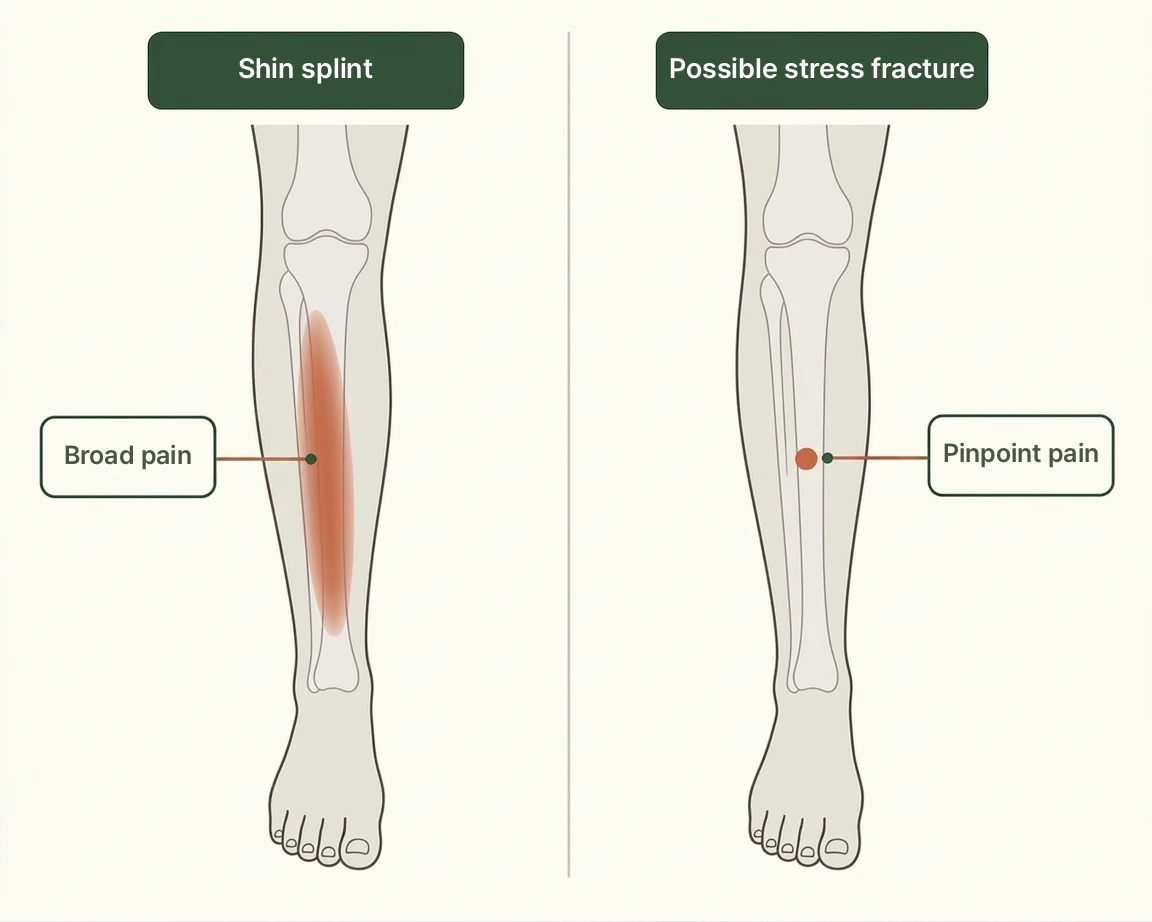
No. Medial tibial stress syndrome, commonly called shin splints, may cause pain across a broad area along the inner shinbone when you run. Pressing several points may be painful. It is associated with how the bone adapts to repeated load and cannot be explained simply as inflammation of the periosteum.1
Pain at the front or outside of the shin should not automatically be grouped with medial tibial stress syndrome. We first check where the pain is and how much of the area is tender.
When Should We Consider a Stress Fracture?
If one point on the shinbone is clearly tender or there is swelling, we need to consider a bone stress injury. Stop running and seek an examination if walking hurts or the pain is getting worse. Imaging or a referral for other care may be needed depending on the findings.5
Why Can Running Put Stress on the Shin?
A sudden increase in training or too little time to adapt to running load may put repeated stress on the shin. Studies also report associations with foot movement and a history of running injury. None of these factors alone can establish the cause of one person’s pain.23
What Do We Examine and Treat at This Clinic?
We examine where the pain occurs, how wide the painful area is, whether there is swelling, and how you move when walking and running. Based on the findings, we discuss how to adjust your running load and whether to use Circulation PT to practice the movements you need.
- Circulation PT is movement rehabilitation with a therapist. It includes assessing ankle and leg movement and practicing those movements again.
- Circulation HD is our injection treatment. We consider it when needed after assessing pain and inflammation.
- Circulation Combo combines injections and rehabilitation. We consider it when both are needed.
There is not enough evidence to say that any one treatment for medial tibial stress syndrome is reliably effective. We decide on treatment based on the examination findings.4
How Should I Adjust My Running When My Shin Hurts?
If the pain worsens as you run, reduce your distance and intensity or stop for a while. Seek an examination if walking hurts, or if one point is painful and swollen. Decide when and how much to run again based on your pain and the examination findings.25
How Does Treatment to Restore Movement Work?
We assess ankle and leg movement during the examination. If Circulation PT is needed, you practice the movements again with a therapist.
When you start running again, we adjust your distance and intensity based on your pain and examination findings.
Have Questions About Other Leg Pain?
Have More Questions About Shin Pain?
What causes shin pain while running?
It is often linked to repeated running load. Pain across a broad area along the inner shin may suggest medial tibial stress syndrome, also called shin splints. We examine where it hurts, how much of the area is tender, and whether there is swelling to distinguish other causes.
How are medial tibial stress syndrome and a stress fracture different?
Medial tibial stress syndrome commonly causes pain across a broad area along the inner shin. Tenderness at one distinct point or swelling may raise concern for a stress fracture. Symptoms alone cannot confirm the diagnosis, so we decide which tests are needed after an examination.
Can I keep running if my shin hurts?
If the pain worsens as you run, reduce your training or stop for a while. Seek an examination if walking hurts or the pain continues at rest. Decide when and how much to run again based on the examination findings.
What treatment can I receive at this clinic?
After examining where it hurts and how you move, we may consider Circulation PT. Depending on your pain and inflammation, we may also consider Circulation HD or Circulation Combo. If we suspect a stress fracture, we decide first whether tests or a referral are needed.
Would You Like to Book an Appointment for Shin Pain?
We examine where it hurts and how you move, then decide which tests and treatment steps are needed.
Book OnlineLast reviewed 2026-09-27
References
- 1. Moen MH, Tol JL, Weir A, et al. Medial tibial stress syndrome: a critical review. Sports Med. 2009;39(7):523-546. PMID 19530750. DOI 10.2165/00007256-200939070-00002.
- 2. Galbraith RM, Lavallee ME. Medial tibial stress syndrome: conservative treatment options. Curr Rev Musculoskelet Med. 2009;2(3):127-133. PMID 19809896. DOI 10.1007/s12178-009-9055-6.
- 3. Reinking MF, Austin TM, Richter RR, Krieger MM. Medial Tibial Stress Syndrome in Active Individuals: A Systematic Review and Meta-analysis of Risk Factors. Sports Health. 2017;9(3):252-261. PMID 27729482. DOI 10.1177/1941738116673299.
- 4. Winters M, Eskes M, Weir A, et al. Treatment of medial tibial stress syndrome: a systematic review. Sports Med. 2013;43(12):1315-1333. PMID 23979968. DOI 10.1007/s40279-013-0087-0.
- 5. Patel DS, Roth M, Kapil N. Stress fractures: diagnosis, treatment, and prevention. Am Fam Physician. 2011;83(1):39-46. PMID 21888126.