Band-like headache, relying only on painkillers?
Tension Headache — Neck and shoulder tension is the cause.
It feels like a band wrapped around your head, your head feels heavy, and your eyes are tired. Painkillers provide temporary relief but pain soon returns.
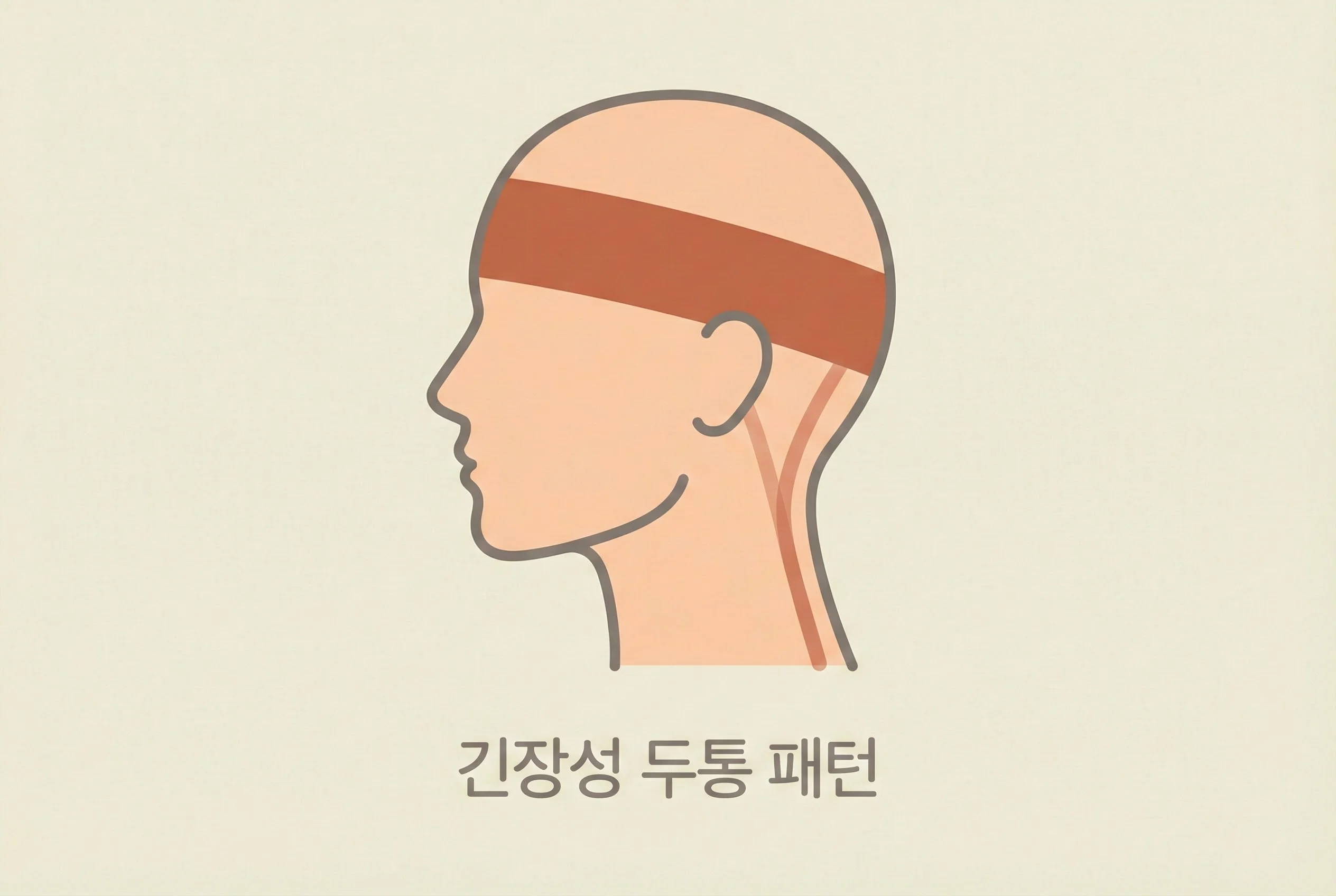
Quick Answer: Tension headaches typically result from neck and shoulder muscle tension leading to headaches. While painkillers provide brief relief, if tension repeats, checking the underlying causes (posture, fascial tension, sleep habits) together is helpful.
Seek medical attention quickly if:
- Sudden onset of ‘worst headache of my life’
- Neurological symptoms like paralysis, speech difficulty, or vision problems
- Fever, neck stiffness, or altered consciousness
- Headache worsens or repeated vomiting after trauma
3 Key Points on This Page
- Causes and characteristics of tension headaches
- How it differs from migraines
- Managing headaches without painkillers
These headaches suggest tension headache
- Band-like tightening sensation — Feels like wearing a band or helmet with pressure.
- Heavy back of head and neck — Starts at back of head and spreads to sides and forehead.
- Both sides hurt similarly — Unlike migraines that hurt severely on one side.
- Movement doesn’t worsen it — Unlike migraines that worsen with movement.
- Worse in the afternoon — Worsens as work stress or fatigue accumulates.
- Neck and shoulder stiffness together — Headache accompanied by neck and shoulder pain.
Why does neck tension cause headaches?
When trigger points form in neck muscles (trapezius, suboccipital, sternocleidomastoid), headaches occur even without pressing those areas.
This is called Referred Pain. When pain signals are transmitted to the brain, areas other than the actual problem site feel painful.
Particularly, suboccipital muscle trigger points cause behind-eye pain and forehead headaches, and headaches persist even when eye exams show no abnormalities.
Major Referred Pain Patterns
- Upper trapezius → Side head, temples
- Suboccipital muscles → Behind eyes, forehead
- Sternocleidomastoid → Forehead, behind ears
- Splenius muscles → Top of head
Tension Headache vs Migraine
Tension Headache
- Both sides hurt similarly
- Band-like pressure sensation
- Movement doesn’t significantly worsen
- Rarely nauseous
- Mild light/sound sensitivity
- Accompanied by neck/shoulder tension
Migraine
- Mainly one side hurts severely
- Throbbing, pulsating pain
- Worsens with movement
- Nausea, vomiting
- Very sensitive to light/sound
- Possible aura (vision changes)
‘Mixed headaches’ with both types together are also common. Accurate differentiation is important.
Our Approach at Yonsei Shinmyung
Tension headaches require resolving the cause (muscle tension) rather than painkillers.
- Phase 1: Downshift (Circulation HD)
Accurately identify and release trigger points in suboccipital, trapezius, and sternocleidomastoid muscles. Directly treat the source of headaches. - Phase 2: Activate (Circulation PT)
Strengthen weakened deep neck flexors and reduce burden on over-tensed superficial muscles. - Phase 3: Integrate
Correct forward head and rounded shoulder posture, and check stress management and sleep habits.
Lifestyle Habits for Headache Prevention
- Regular sleep — Sleep at same time, get 7-8 hours sufficient sleep
- Hydration — Drink 1.5-2L water daily
- Stretching — Neck and shoulder stretching every hour
- Posture check — Monitor height, smartphone usage posture
- Stress management — Deep breathing, meditation, regular exercise
- Caution with painkiller overuse — Risk of ‘medication overuse headache’ if taking painkillers more than 15 days per month
Frequently Asked Questions
How are tension headaches and migraines different?
Tension headaches often come with band-like sensation and neck/shoulder stiffness. Migraines may involve one-sided throbbing or sensitivity to light/sound. Headache Types Overview →
Can heavy back of head be from the neck?
Neck muscle tension or postural problems can cause heavy, pulling headaches at back of head. If it worsens from prolonged sitting or forward head posture, consider neck connection. Back-of-Head Headache Q&A →
Will changing pillows help headaches?
Incorrect pillow height and support can accumulate neck tension during sleep, worsening headaches. However, rather than ‘pillow alone,’ checking neck condition and sleep habits together is safer. Pillow Selection Q&A →
Can headaches continue even with normal MRI?
Even without major imaging abnormalities, functional factors like fascial tension, nerve sensitization, and postural problems can cause pain. In such cases, current symptom and movement pattern evaluation may be more important than ‘visible abnormalities.’ Normal MRI Pain Q&A →
Can I keep getting injections?
Repeat plans vary by injection type and purpose. An approach addressing causes (tension, adhesions, movement problems) together rather than just briefly reducing symptoms can help with recurrence management. Injections Q&A →
What order for Circulation HD and PT?
We recommend first calming pain signals and hypertension (Downshift), then awakening weakened function (Activate) and connecting to daily life (Integrate). Combinations vary by condition, so we create plans after consultation. Circulation Therapy Overview →
It improves then hurts again, why does it recur?
If posture, sleep, and work environment remain the same even as pain decreases, tension can accumulate again causing recurrence. Changing ‘patterns that create recurrence’ together with pain control is key. Recurrence Q&A →
Is there management I can do at home right away?
Small changes like brief rest and stretching, hydration, screen height adjustment can help. However, if pain persists or worsens, cause evaluation comes first. Office Worker Neck/Headache Q&A →
Related Articles
Want to manage headaches without painkillers?
We resolve neck tension causing headaches and prevent recurrence.
Book Online