Arm won’t lift, worse pain at night — is it frozen shoulder?
Not just inflammation, but a problem of frozen movement.
It starts as stiffness, then gradually your arm stops lifting. Pain intensifies when dressing or washing your hair, and sleeping on the affected side becomes unbearable at night.
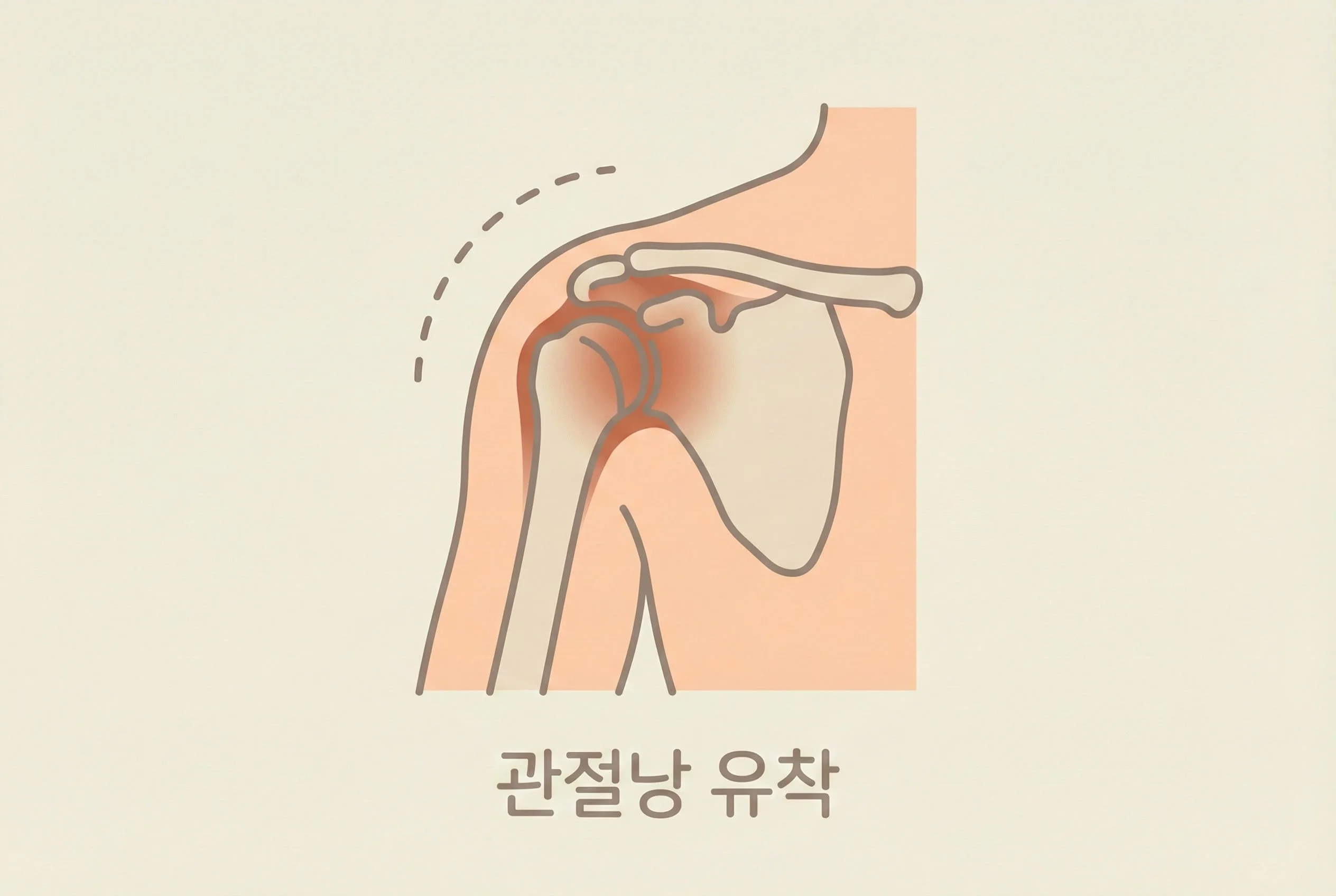
Quick Answer: Frozen shoulder occurs when the shoulder capsule stiffens, causing pain + movement restriction together. The flow is important: calming pain (Downshift), gradually regaining frozen range (Activate), and restoring use in daily life (Integrate).
Seek medical attention quickly if:
- Sudden inability to lift arm or weakness after trauma
- Fever, swelling, warmth with rapidly worsening pain
- Night pain so severe it prevents sleep
- Arm/hand numbness or decreased sensation progressing
3 Key Points on This Page
- What symptoms suggest frozen shoulder
- Why it keeps stiffening and hurting — the mechanism
- How to treat to prevent re-freezing
These symptoms suggest frozen shoulder
- Arm won’t lift — Difficult to reach overhead or retrieve items from high places.
- Worse pain at night — Tolerable during day, but throbbing at night, worse when lying on affected side.
- Difficulty dressing and undressing — Hard to put arm in sleeves or reach behind to fasten bra.
- Clearly different from other side — Comparing shoulder range of motion shows affected side lifts much less.
- Progressive stiffening — Started with slight discomfort, but over weeks and months movement decreases further.
Why does the shoulder freeze?
Frozen shoulder (adhesive capsulitis) is a condition where the capsule surrounding the shoulder joint thickens and stiffens.
Various causes exist, but the common factor is prolonged ‘reduced movement and decreased circulation.’
- Prolonged same posture — Not using shoulder causes surrounding tissues to gradually stiffen.
- Post-injury sequelae — Not moving shoulder due to pain after injury leads to stiffening.
- Reduced circulation — Decreased blood flow causes fascia to stick together, blocking fine movements.
- Diabetes, thyroid disease — Metabolic issues increase frozen shoulder incidence.
3 Stages of Frozen Shoulder
Stage 1 (Freezing)
Pain begins and movement gradually decreases. 2-9 months.
Stage 2 (Frozen)
Pain decreases but stiffness persists. 4-12 months.
Stage 3 (Thawing)
Gradually loosens. 5-24+ months.
Left to natural course without aggressive treatment can take 1-3 years.
Simple Home Check
- Raising both arms in front of wall
Stand facing wall and slowly raise both arms simultaneously. Does one arm lift less or stop midway? - Hands behind back
Put both hands behind back and try lifting up spine. Does affected hand stop at lower position? - Lifting arms sideways
Spread arms sideways and lift. Does pain worsen between 60-120 degrees? - Daily movement check
Are certain daily movements particularly uncomfortable like washing hair, dressing, or using back pocket?
※ If pain feels severe, stop and don’t force it. Pushing through can cause more damage.
Our Approach at Yonsei Shinmyung
We view frozen shoulder not just as ‘inflammation,’ but as frozen movement and blocked circulation together. We apply the 3-phase Circulation therapy system.
- Phase 1: Downshift (Circulation HD)
Restore circulation to stiffened capsule and surrounding tissues. Reduce inflammation and calm pain signals. - Phase 2: Activate (Circulation PT)
Awaken weakened rotator cuff and shoulder muscles. 1:1 therapy gradually expands frozen joint range of motion. - Phase 3: Integrate
Correct movement patterns to naturally use shoulder in daily activities. Change habits to prevent re-freezing.
Frozen Shoulder Intensive Program
Intensive treatment program for frozen shoulder patients.
Systematic treatment combining Circulation HD and Circulation PT.
- 12-week intensive treatment plan
- Circulation Combo (HD + PT) applied
- Focus on range of motion recovery
- Home care guidance included
Frequently Asked Questions
How do frozen shoulder and rotator cuff tear differ?
Frozen shoulder involves ‘movement restriction itself’ due to stiffened capsule, while rotator cuff issues typically show pain/weakness in specific motions. Accurate differentiation requires evaluation. Differentiation Q&A →
It hurts more at night, is it frozen shoulder?
Night pain is common in frozen shoulder, but other shoulder conditions can also cause night pain. Need to check pain pattern and range of motion together. Night Pain Q&A →
Arm won’t lift. When is examination needed?
Evaluation needed when movement restriction is clear with pain, or if weakness is felt. Particularly careful after trauma with sudden restriction. Arm Raising Q&A →
Hand won’t reach behind. Is this frozen shoulder?
Reaching behind becomes particularly uncomfortable in frozen shoulder. But other shoulder problems can be similar, so we look at range and pain location together. Hand Behind Back Q&A →
How long does treatment take?
Treatment duration varies by stage (pain-centered or freezing stage). Both pain-calming phase and range recovery phase needed together. Treatment Duration Q&A →
Can I keep getting injections?
Injection repeat plans vary by type and purpose. Important to design addressing stiff tissues and function recovery together rather than just briefly reducing symptoms. Injections Q&A →
What should I do at home?
Rather than excessive stretching, range-of-motion exercises appropriate to current stage and lifestyle habit adjustments are important. Safer to establish routine after evaluation as contraindicated movements may exist depending on condition. Shoulder Routine Q&A →
When should Circulation Combo (HD + PT) be considered?
When both pain control and function recovery are needed, it can help design the 3-phase flow together. Composition varies by individual condition. Frozen Shoulder Program →
Related Articles
Don’t endure frozen shoulder alone
We provide accurate diagnosis and customized treatment plan.
Book Online